Get inspired for your next home improvement projects by browsing through our blog posts, which are full of great tips, valuable advice, and industry insights.

Blog
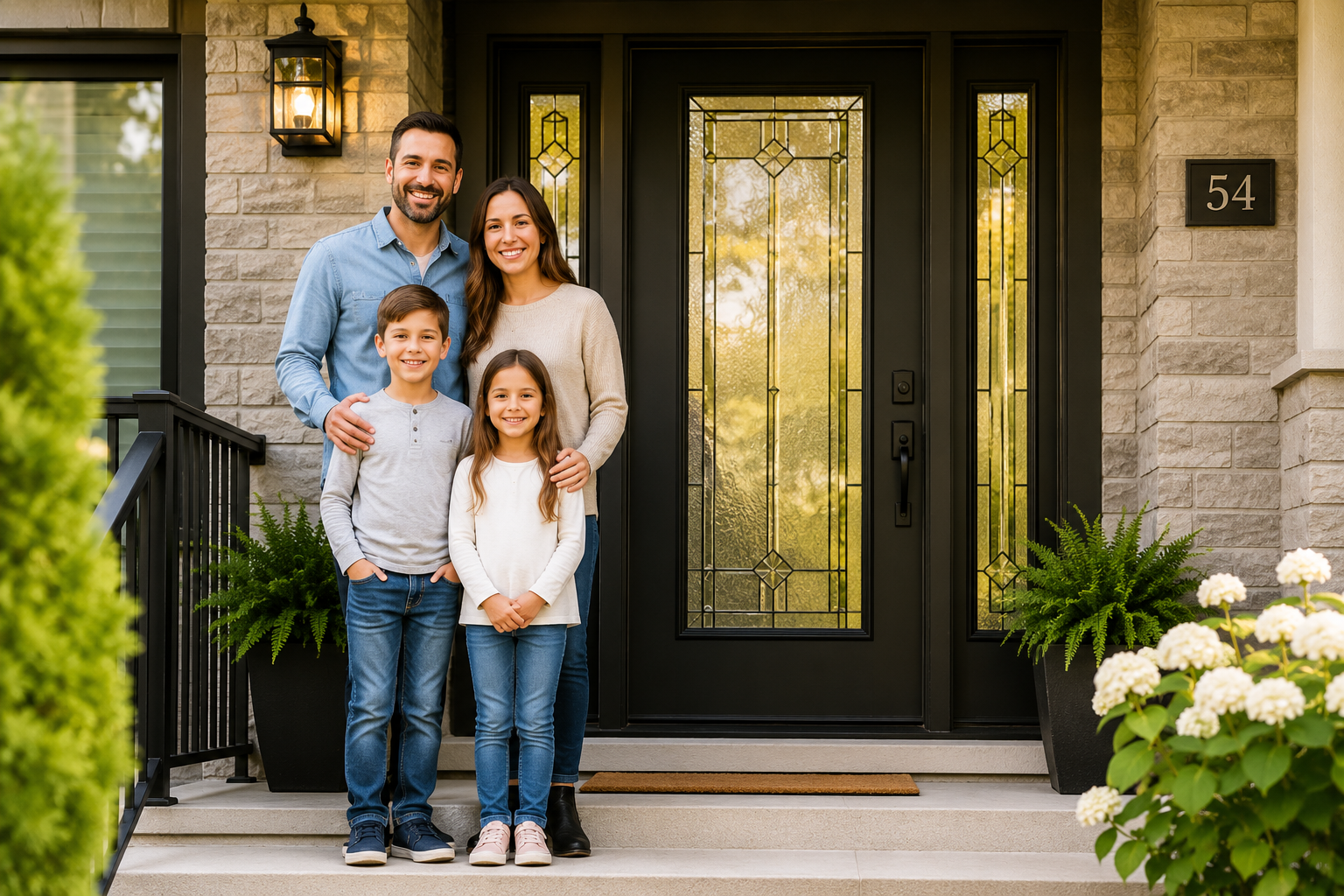
Your front door is more than just an entrance—it's one of the first things people notice about your home. It creates the first impression for visitors, protects your family, helps regulate indoor temperatures, and plays a major role in your home's overall energy efficiency. Yet many homeowners don't think much about their entry door until it becomes difficult to open, starts letting in cold drafts, or simply looks worn after years of exposure to Toronto's changing seasons.
Replacing an entry door is one of the few home improvements that combines beauty, security, comfort, and long-term value. A well-built, professionally installed door can dramatically improve curb appeal while helping reduce heat loss during the winter and keeping your home more comfortable throughout the year. Whether your goal is better curb appeal, improved security, or lower energy bills, choosing the right entry door can make a noticeable difference in how your home looks, feels, and performs.
However, choosing the right replacement door isn't always straightforward. Homeowners often ask:
✅ Should I choose fiberglass or steel?
✅ How much does a new entry door cost in Toronto?
✅ Which material lasts the longest?
✅ What type of glass provides privacy without sacrificing natural light?
✅ Will a new entry door improve energy efficiency?
✅ How long does professional installation take?
If any of these questions sound familiar, you're in the right place.
This guide was created specifically for homeowners in Toronto and the Greater Toronto Area. Instead of providing quick answers or sales pitches, we've put together a comprehensive resource that explains everything you need to know before investing in a new entry door. Whether you're replacing an aging front entrance, building a new home, or simply exploring your options, this guide will help you make an informed decision with confidence.
Many online articles about entry doors repeat generic advice or manufacturer marketing without addressing the unique challenges of owning a home in Southern Ontario.
At Imperial Windows & Doors, we've helped homeowners throughout Toronto and the GTA choose entry doors that are designed to withstand these conditions while complementing a wide range of architectural styles. From traditional homes in North York to modern builds in Vaughan and custom residences in Richmond Hill, we’ve helped homeowners choose entry doors that complement their home’s architecture while standing up to Toronto’s demanding climate.
Rather than focusing on sales, this guide explains how entry doors work, what influences their durability, and which options make the most sense for different homes and budgets. Our goal is to provide practical, straightforward information so you can make a decision based on facts—not marketing claims.
By the end of this guide, you'll have a clear understanding of:
Whether you're planning to replace an aging front door or simply exploring your options, this guide will give you the knowledge and confidence to choose an entry door that enhances your home's appearance, comfort, security, and long-term value.
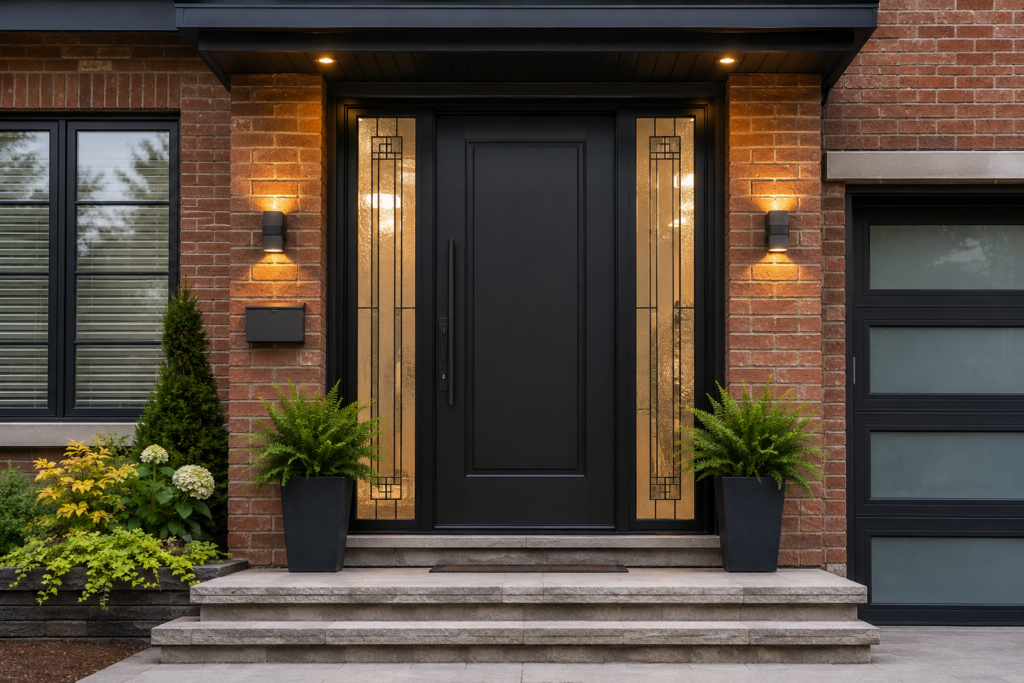
When homeowners think about improving their home's appearance or energy efficiency, they often focus on replacing windows, upgrading insulation, or renovating the kitchen. The front door is frequently overlooked, even though it plays a critical role in several aspects of your home's performance.
A modern entry door is much more than a decorative feature. It's one of the hardest-working components of your home, providing security, insulation, weather protection, and lasting curb appeal every single day. It serves as your home's primary barrier against weather, intruders, noise, and energy loss while contributing significantly to curb appeal and property value.
Your front entrance is one of the most noticeable architectural features of your home. It immediately shapes how visitors, neighbors, and potential buyers perceive your property.
An outdated door with peeling paint, faded finishes, worn hardware, or visible damage can make an otherwise well-maintained home appear neglected. In contrast, a thoughtfully selected replacement door can instantly refresh the entire façade without requiring a major renovation.
For many homeowners, replacing the front door is one of the simplest ways to improve curb appeal and create a more inviting entrance.
🔒 Security Insight
A strong entry door is only as secure as the frame surrounding it. Professional installation, reinforced strike plates, and properly anchored hardware are just as important as the door itself.
The front door is one of the most frequently used entry points into your home, making it an essential part of your overall home security.
Modern entry doors are built with reinforced frames, stronger cores, improved locking mechanisms, and durable materials that provide significantly greater resistance than many older doors.
Features such as multi-point locking systems, reinforced strike plates, impact-resistant glass, and high-quality deadbolts can make forced entry far more difficult while providing homeowners with greater peace of mind.
It's important to remember that even the strongest door relies on proper installation. A premium fiberglass or steel door won't perform as intended if the frame isn't securely anchored or the hardware isn't correctly aligned. That's why professional installation is just as important as the quality of the door itself.
💰 Money-Saving Tip
Replacing an older, poorly insulated entry door can help reduce drafts and improve your home's overall energy efficiency. When combined with energy-efficient windows and proper insulation, the savings can add up over time.
Many older entry doors were built with little or no insulation, allowing heat to escape during the winter and warm air to enter during the summer. Over time, worn weatherstripping, shrinking materials, and shifting door frames can create small gaps around the door. Even tiny openings can lead to noticeable drafts, uneven indoor temperatures, and higher heating and cooling costs.
Modern entry doors are designed to reduce these issues. Features such as insulated cores, advanced weather seals, energy-efficient glass, and precision-fit frames help minimize heat transfer and improve overall comfort throughout the year.
For homeowners in Toronto, where winters are long and temperatures often fluctuate around the freezing point, these improvements can make a meaningful difference in day-to-day comfort.
Replacing an aging entry door is widely regarded as one of the home improvement projects with the strongest return on investment. A new front door enhances curb appeal, improves perceived quality, and signals that the home has been well maintained.
While every property is different, a professionally installed entry door can make a lasting impression on prospective buyers and contribute to a home's overall marketability.
Even if you're not planning to sell in the near future, investing in a quality replacement door allows you to enjoy the benefits every day while protecting your home's value over the long term.
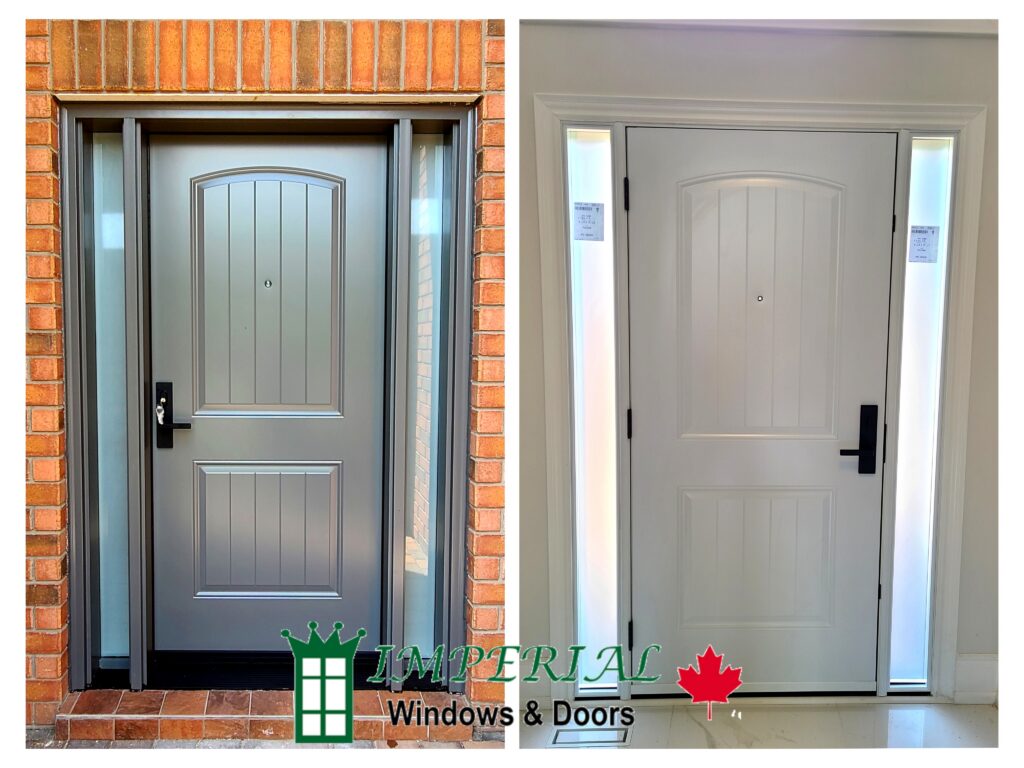
🏡 Toronto Climate Tip
Toronto experiences frequent freeze-thaw cycles throughout the year. Choosing an entry door designed for Canadian weather helps minimize expansion, moisture intrusion, and long-term wear.
Toronto's climate presents unique challenges for exterior doors. Throughout the year, a front door may be exposed to intense summer sunlight, heavy rain, high humidity, snow, freezing temperatures, ice buildup, and repeated freeze-thaw cycles.
These conditions can gradually affect the appearance and performance of older doors, particularly those made from materials that are susceptible to warping, rust, moisture damage, or fading.
Modern fiberglass and steel entry doors are specifically engineered to withstand these environmental conditions while requiring far less maintenance than many traditional wood doors.
Choosing the right material—and ensuring it's professionally installed—helps protect your home from water infiltration, drafts, and premature wear.
🔒 Improved Security
Modern entry doors feature stronger materials, reinforced frames, and advanced locking systems that help better protect your home and family.
🌡️ Better Energy Efficiency
A properly insulated entry door helps reduce drafts and heat loss, making your home more comfortable throughout every season.
🏡 Enhanced Curb Appeal
A new entry door instantly refreshes the appearance of your home and creates a welcoming first impression.
💰 Increased Home Value
Replacing an aging entry door is consistently recognized as one of the exterior home improvements with the strongest return on investment.
🌧️ Better Weather Protection
Modern door systems are designed to resist water infiltration, air leaks, and harsh Canadian weather, helping protect your home year-round.
😊 Everyday Convenience
A professionally installed entry door opens smoothly, closes securely, locks effortlessly, and provides dependable performance every day.
Your front door is one of the most frequently used features of your home. From welcoming guests to leaving for work each morning, it should operate smoothly, lock securely, and provide dependable protection in every season.
A properly fitted entry door should open smoothly, close securely, lock effortlessly, and create a tight seal every time it's used. Replacing a worn or poorly functioning door can eliminate many everyday frustrations, from sticking locks to cold drafts and noisy operation.
It's a simple upgrade that quietly improves your home's comfort, security, and functionality every single day.
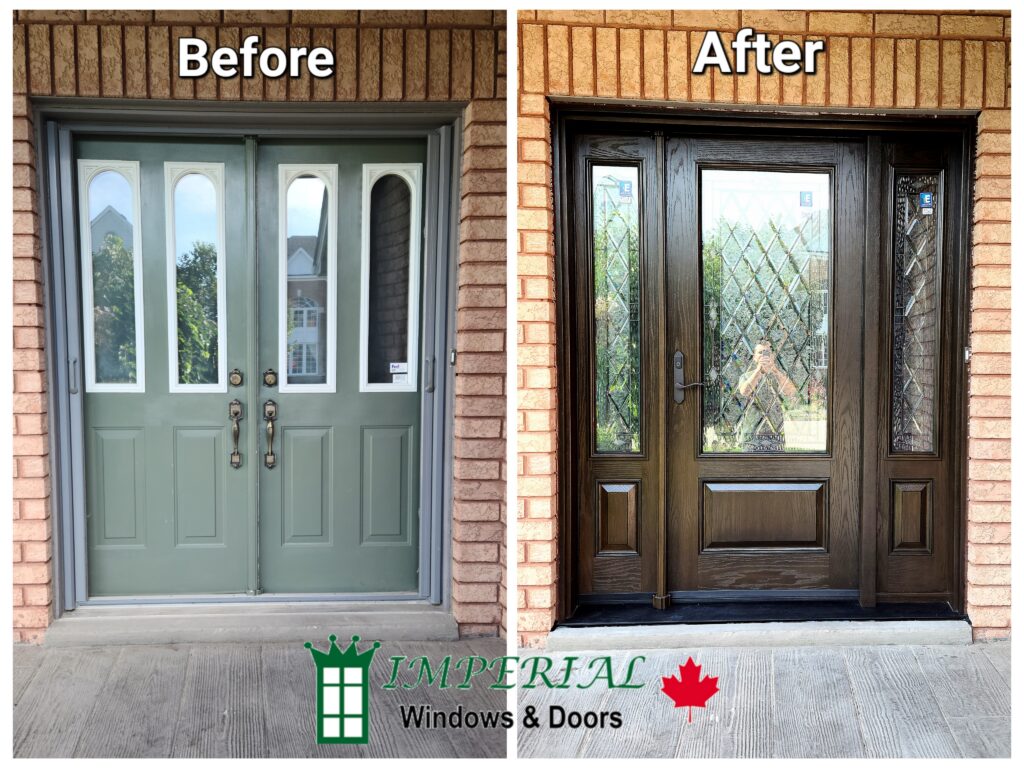
Now that we've covered why your entry door plays such an important role in your home's comfort, security, and curb appeal, let's look at the warning signs that indicate it may be time for a replacement.
An entry door rarely fails all at once. In most cases, the warning signs appear gradually over months or even years. You may notice a small draft during the winter, a door that sticks when opening or closing, or fading finishes caused by years of exposure to the elements. While these issues may seem minor at first, they often indicate that your entry door is no longer performing as it should.
Replacing your entry door at the right time can improve your home's comfort, security, energy efficiency, and curb appeal while helping you avoid more costly repairs in the future.
Below are ten common signs that it may be time to replace your entry door.
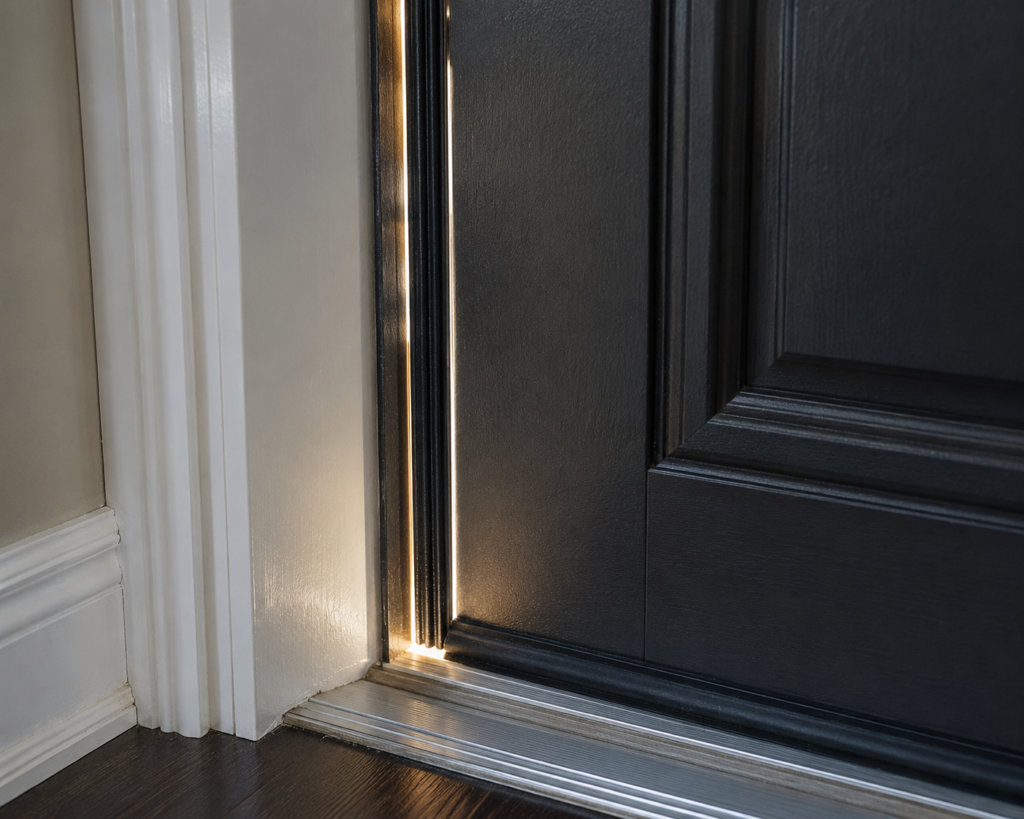
Feeling cold air around your front door is one of the most common signs that your entry door is no longer sealing properly. Even a small gap around the weatherstripping or threshold can allow outside air to enter your home, making nearby rooms feel colder and forcing your heating system to work harder.
In some cases, replacing worn weatherstripping may solve the problem. However, if the door or frame has shifted over time, the issue may be with the entire door system rather than the seal alone.
Ignoring persistent drafts can lead to higher energy bills, reduced comfort, and moisture entering around the frame during heavy rain or snow.
💡 Expert Tip
On a cold, windy day, slowly move your hand around the edges of your closed entry door. If you feel moving air or notice the area is significantly colder than the surrounding wall, your door may no longer be sealing properly.
🏡 Toronto Climate Tip
Toronto's freeze-thaw cycles can cause door frames and weatherstripping to expand and contract over time. Even small seasonal movements can create gaps that allow cold air and moisture to enter your home.
📋 Quick Checklist
✓ Feel for cold air around the edges of the door.
✓ Look for daylight around the weatherstripping.
✓ Inspect the threshold for worn or damaged seals.
✓ Check if the door closes tightly without forcing it.
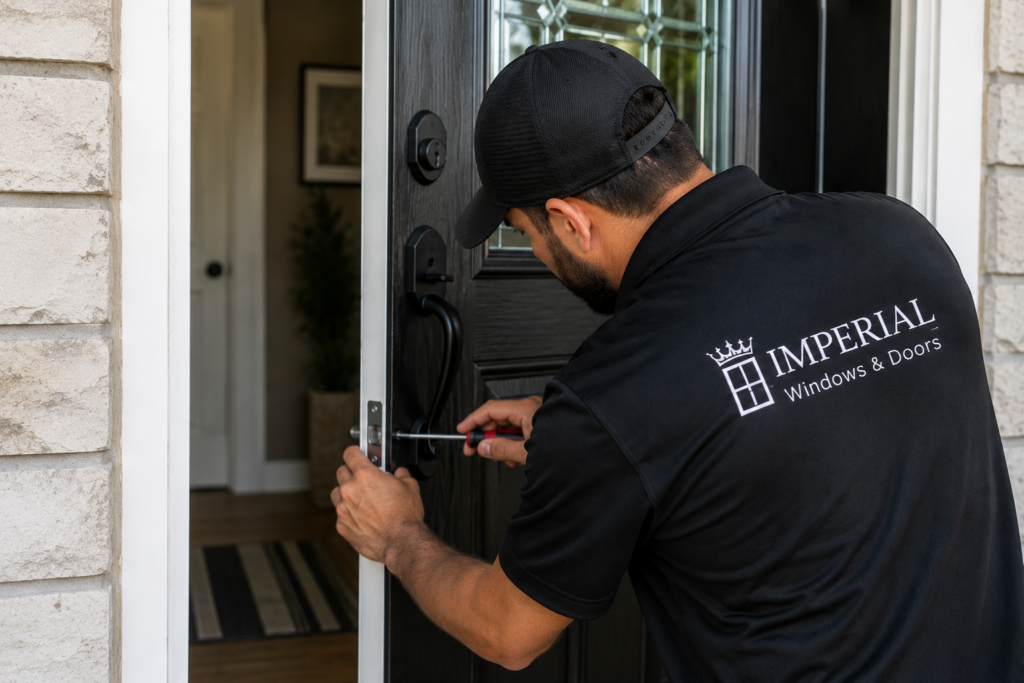
A properly installed entry door should open, close, and latch smoothly every time. If you need to push, pull, lift, or slam your door to get it to close properly, something isn't working as it should.
This can happen for several reasons, including a warped door slab, shifting door frame, loose hinges, moisture damage, or natural settling of the home. While minor adjustments can sometimes correct the problem, repeated sticking or misalignment often indicates that the entire door system has reached the end of its service life.
A door that doesn't close properly can also compromise your home's security and energy efficiency.
⚠️ Common Mistake
Many homeowners repeatedly adjust the hinges or replace the weatherstripping without identifying the underlying problem. If the frame has shifted or the door has warped, these temporary fixes usually won't solve the issue.
✅ Pro Recommendation
If your entry door sticks throughout the year—not just during humid weather—have the entire door system professionally inspected before investing in repeated repairs.
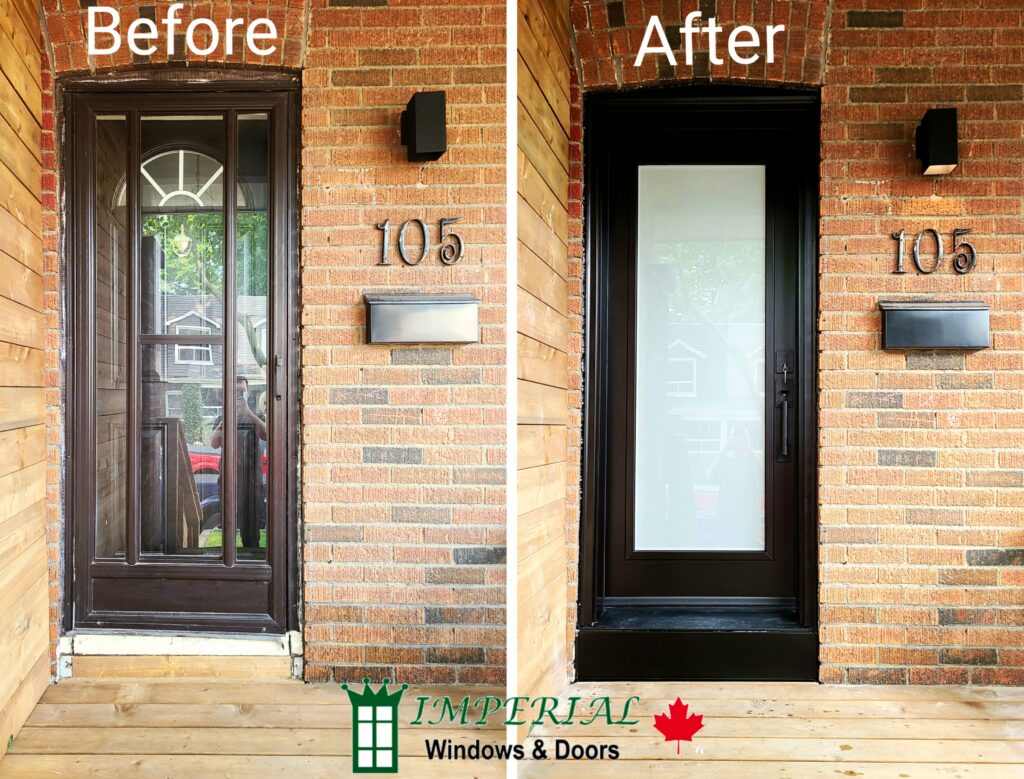
Years of exposure to sun, rain, snow, and changing temperatures can gradually take a toll on an exterior door. While some cosmetic wear is normal, visible damage often indicates that the door's protective finish or structural integrity has begun to deteriorate.
Look for signs such as:
These issues not only affect the appearance of your home but may also allow moisture to penetrate the door or surrounding frame, leading to more extensive damage over time.
🛠️ Maintenance Tip
Minor scratches or chipped paint can often be repaired, but widespread rot, rust, or structural damage usually indicates that replacement is the most reliable long-term solution.
Older entry doors often provide significantly less insulation than today's modern fiberglass and steel doors. As weatherstripping wears out and materials begin to deteriorate, heated or cooled air can escape more easily, making your HVAC system work harder to maintain a comfortable indoor temperature.
If you've noticed rising energy bills along with drafts near your front entrance, your entry door could be contributing to the problem.
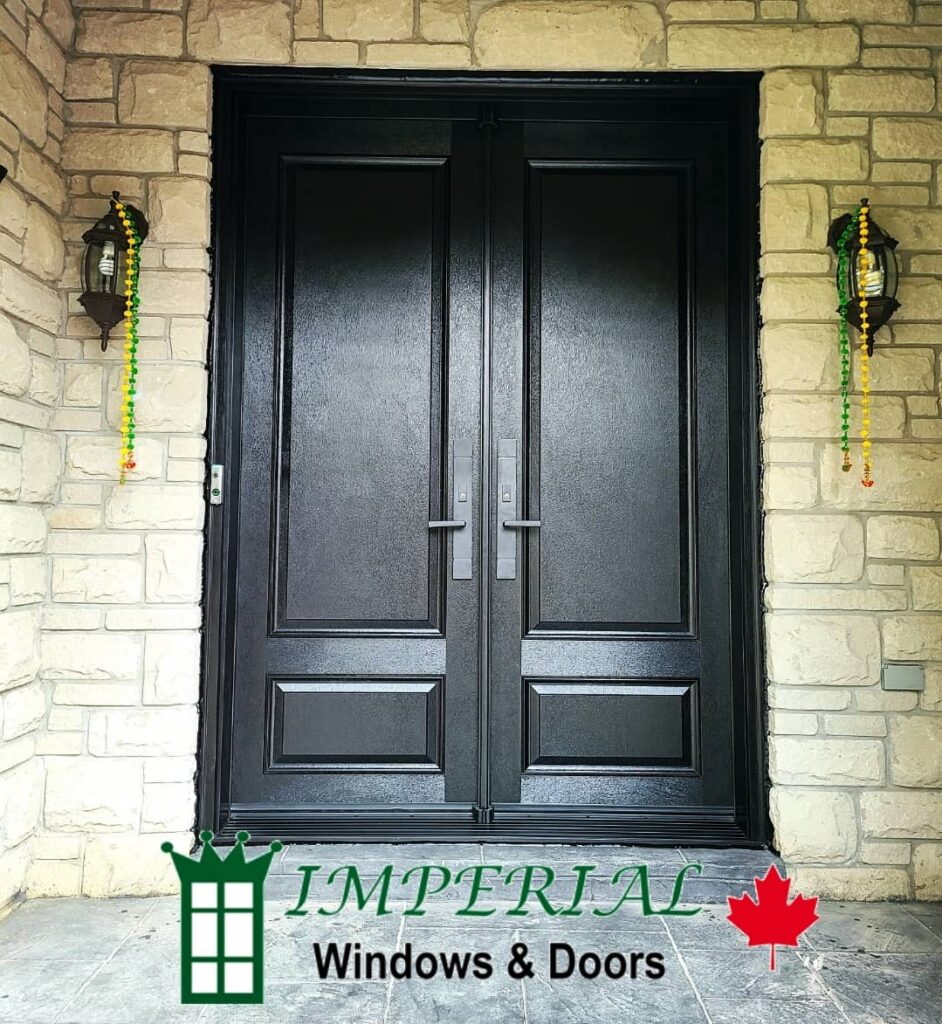
Modern entry doors are designed with insulated cores, compression weatherstripping, thermal breaks, and energy-efficient decorative glass that help reduce heat transfer and improve year-round comfort.
💰 Money-Saving Tip
Upgrading to an energy-efficient entry door can improve indoor comfort and reduce unwanted heat loss. While savings vary from home to home, improved insulation and tighter weather seals often contribute to lower heating and cooling costs over time.
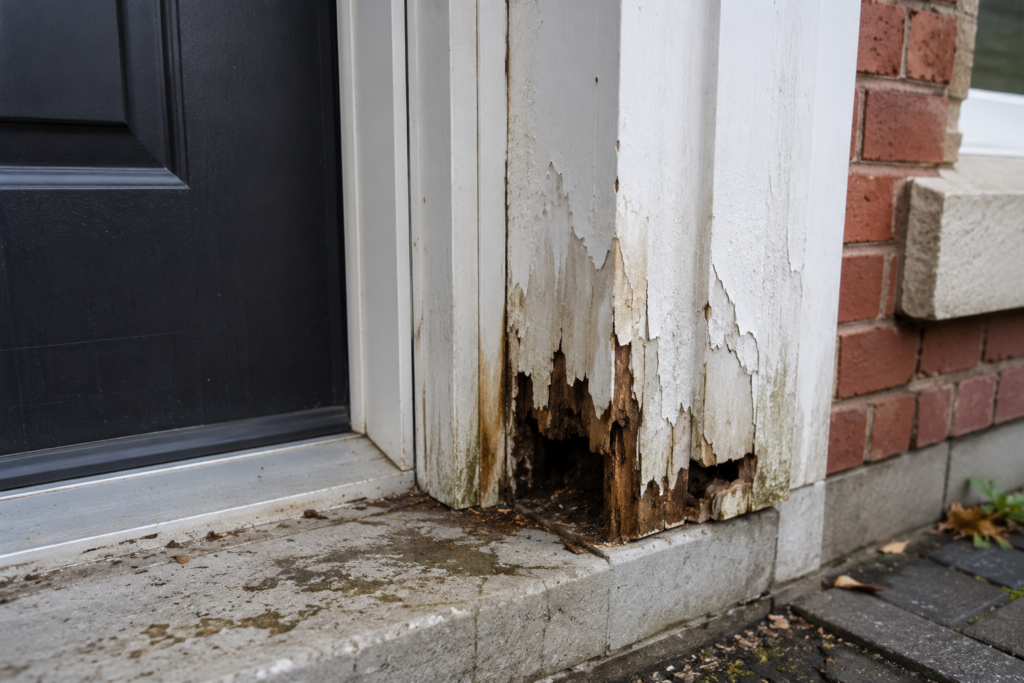
Your entry door is designed to protect your home from rain, snow, and moisture. If you notice water stains, peeling paint, soft wood, or signs of mold around the door or frame, it's important to investigate the problem as soon as possible.
Moisture damage is often caused by worn weatherstripping, failed caulking, poor installation, or a door that no longer seals properly. Over time, even small amounts of water can penetrate the frame and surrounding structure, leading to wood rot, mold growth, and costly repairs that extend beyond the door itself.
While replacing exterior caulking may solve minor issues, recurring leaks usually indicate that the door system has reached the end of its lifespan or was not installed correctly in the first place.
Addressing moisture problems early can help prevent structural damage and protect one of the most important entrances to your home.
⚠️ Common Mistake
Many homeowners repaint or re-caulk the affected area without identifying where the water is coming from. Cosmetic repairs may hide the problem temporarily, but moisture will continue to cause damage if the source isn't addressed.
🛠️ Maintenance Tip
Inspect the caulking, weatherstripping, and bottom sweep around your entry door at least once a year. Replacing worn seals early can help prevent water infiltration and extend the life of your door.
📋 Quick Checklist
✓ Look for peeling paint or bubbling finishes around the frame.
✓ Check for soft or rotting wood near the threshold.
✓ Inspect interior trim for water stains or discoloration.
✓ Make sure the caulking around the exterior frame is intact.
✓ Look for mold or mildew caused by excess moisture.
Not every problem is immediately visible. In some cases, your entry door may appear to be in good condition while hidden issues affect how it operates and protects your home. The next sign is one that many homeowners overlook until it becomes impossible to ignore.
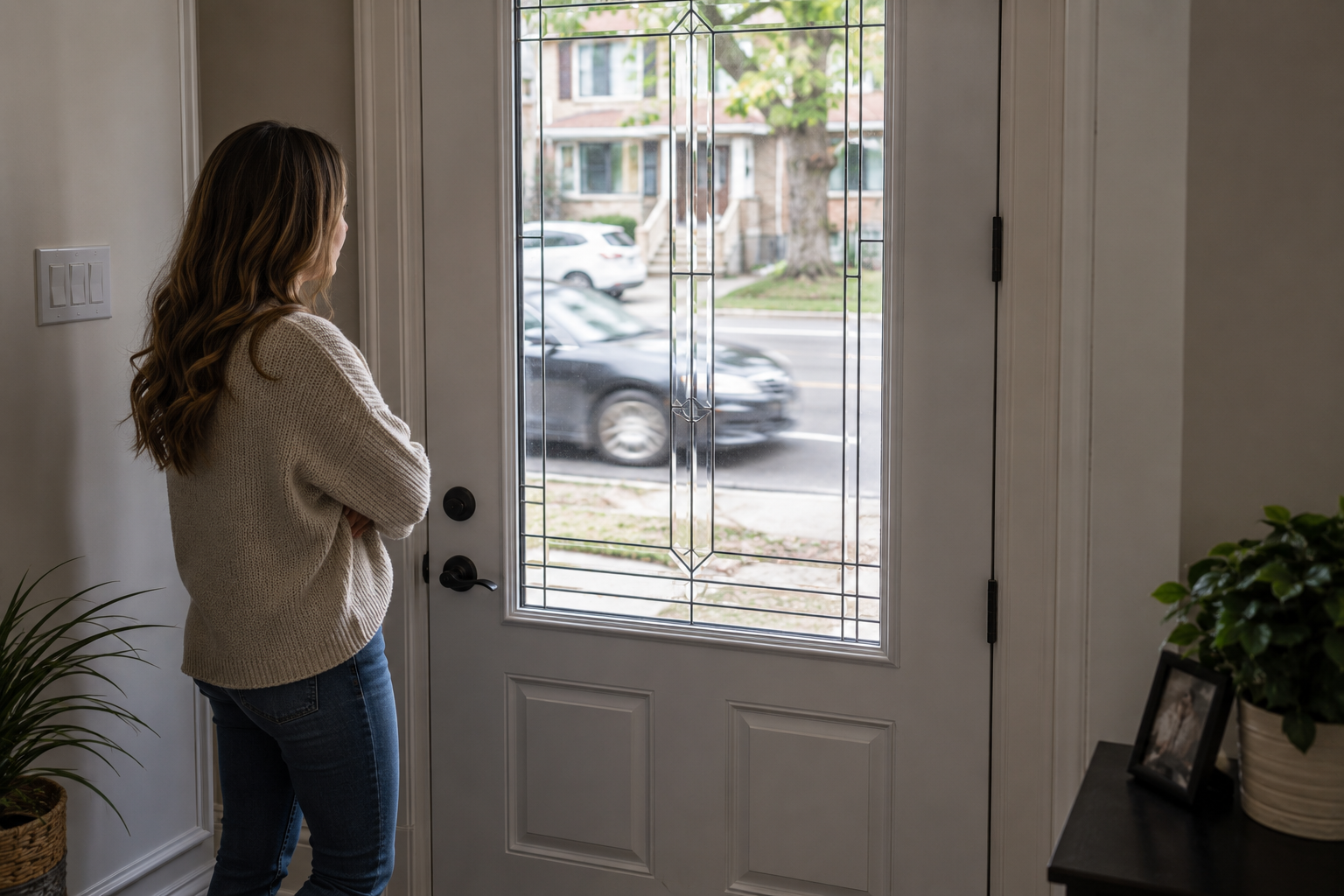
Your front door should do more than keep out the weather—it should also help create a quieter, more comfortable home. If you've started noticing more traffic noise, barking dogs, construction, or other outdoor sounds than you used to, your entry door may no longer be providing the level of insulation it once did.
Older doors often develop small gaps around the frame or lose their ability to seal tightly. Combined with worn weatherstripping or aging materials, these openings allow sound to travel more easily into your home.
Modern fiberglass and insulated steel entry doors are built with solid insulated cores, improved weather seals, and precision-engineered frames that help reduce outside noise while improving overall comfort.
If you live on a busy street or in a densely populated neighborhood, replacing an older entry door can make a noticeable difference in creating a quieter indoor environment.
💡 Expert Tip
If you can clearly hear conversations, traffic, or other outdoor noise through your closed front door, inspect the weatherstripping first. If the seals are in good condition, the door itself may no longer provide adequate insulation.
✅ Pro Recommendation
If reducing outside noise is a priority, choose an insulated fiberglass entry door with high-quality weatherstripping and professional installation. A properly sealed door system performs much better than the door alone.
Noise isn't always the first thing homeowners notice. Sometimes the biggest concern is seeing the door itself begin to deteriorate, especially when years of sunlight, moisture, and changing temperatures start affecting its appearance.
Your front door is one of the first features people notice when they arrive at your home. Even if the rest of your property is well maintained, an outdated or worn entry door can make the entire exterior look tired and neglected.
Over time, paint begins to fade, finishes lose their shine, decorative glass styles become dated, and hardware starts to show signs of wear. While these changes may happen gradually, they can have a significant impact on your home's overall appearance.
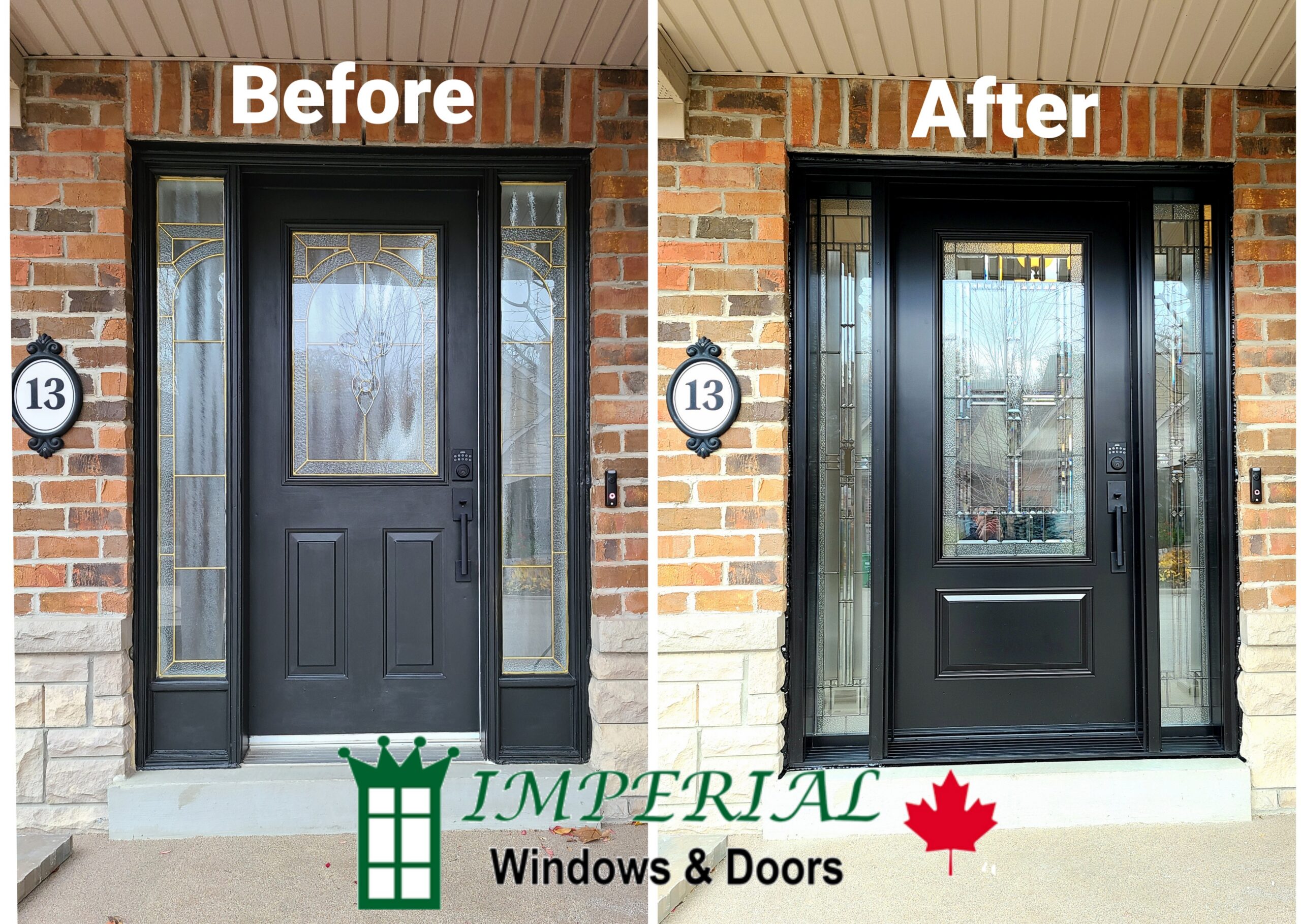
Replacing an older entry door is one of the quickest ways to transform your home's exterior without undertaking a major renovation. A modern door with updated glass, stylish hardware, and a colour that complements your home's architecture can dramatically improve curb appeal and create a welcoming entrance.
Today's homeowners also have far more design options than ever before. Whether you prefer a sleek contemporary look, a timeless traditional style, or something in between, modern entry doors are available in a wide variety of colours, panel designs, decorative glass patterns, sidelites, and transoms to suit virtually any home.
If you're already planning exterior improvements such as new windows, siding, or landscaping, replacing your front door at the same time can create a more cohesive and polished appearance.
💰 Money-Saving Tip
If you're planning multiple exterior upgrades, replacing your entry door during the same renovation can often reduce labour costs and ensure all design elements complement one another.
✅ Pro Recommendation
Choose an entry door that complements your home's architectural style rather than following short-term design trends. A timeless design will continue to look attractive for many years.
📋 Quick Checklist
While appearance is often the first thing homeowners notice, some of the most important problems aren't visible at all. Next, we'll look at one of the biggest reasons homeowners choose a replacement door—improving the safety and security of their home.
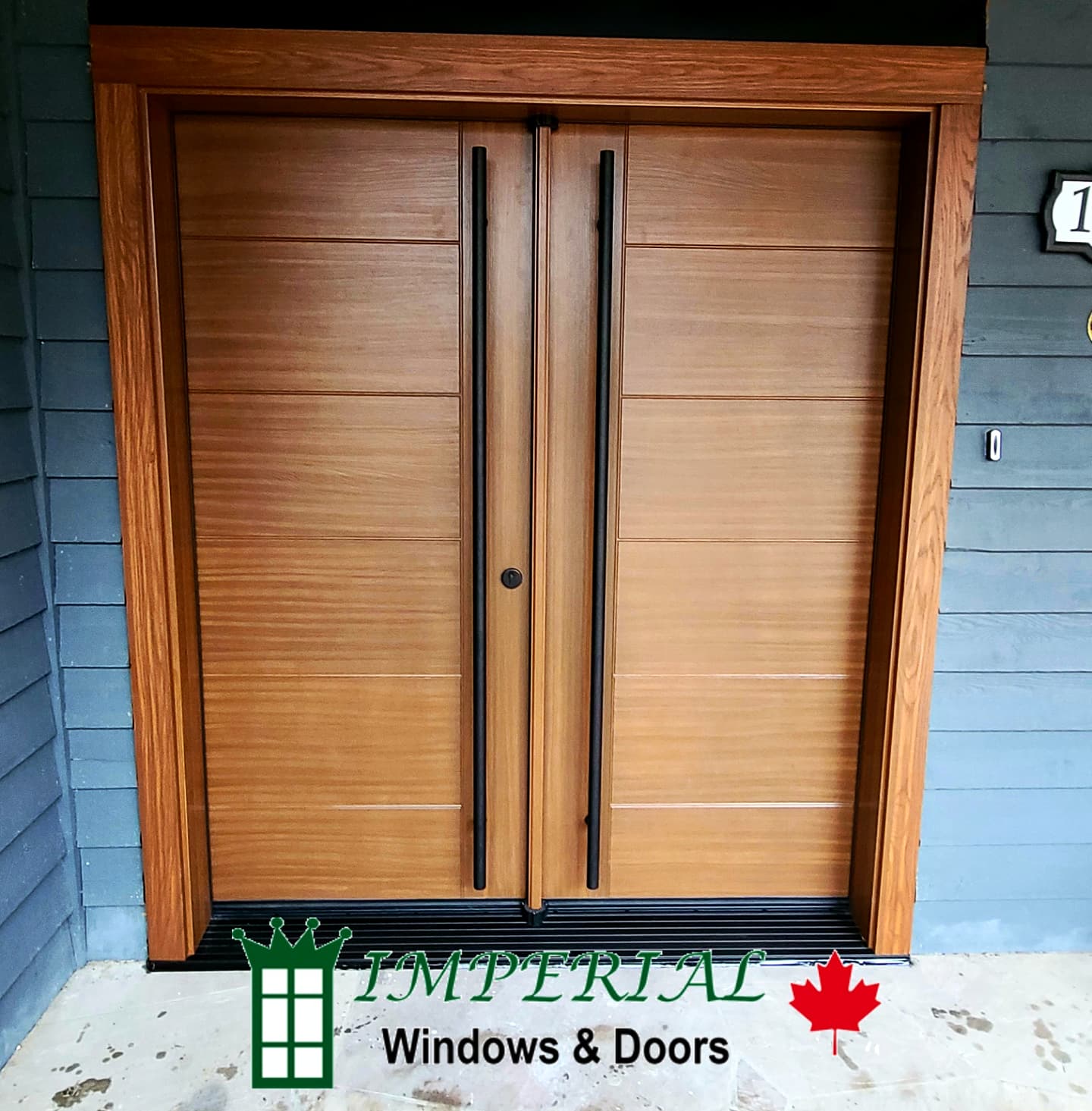
Your front door is your home's first line of defense. While older entry doors may still appear to be in good condition, years of daily use can weaken the door, frame, hinges, and locking hardware, making your home more vulnerable than you realize.
Many older doors were installed before today's security standards became common. They may have hollow cores, worn locks, weaker strike plates, or frames that have loosened over time. Even a solid door can become less secure if it no longer closes properly or the deadbolt doesn't fully engage.
Modern entry door systems are designed with security in mind. Fiberglass and steel entry doors feature reinforced construction, stronger frames, heavy-duty hinges, and advanced locking options that provide significantly better protection than many older doors.
It's also important to remember that security depends on the entire door system—not just the lock. A professionally installed door with a properly secured frame will perform far better than simply replacing the deadbolt on an aging door.
Whether you're upgrading for peace of mind or replacing a door that's decades old, investing in a secure entry door is an investment in your family's safety.
🔒 Security Insight
A high-quality deadbolt is only as strong as the frame surrounding it. Reinforced strike plates, long mounting screws, and professional installation all play a major role in improving home security.
✅ Pro Recommendation
If you're replacing an older entry door, consider upgrading to a multi-point locking system. Instead of securing the door at just one location, these systems lock the door at multiple points along the frame, creating a tighter seal and making forced entry more difficult.
📋 Quick Checklist
Not every replacement is driven by security concerns. Sometimes homeowners simply reach a point where constant repairs become more expensive—and more frustrating—than investing in a new door.
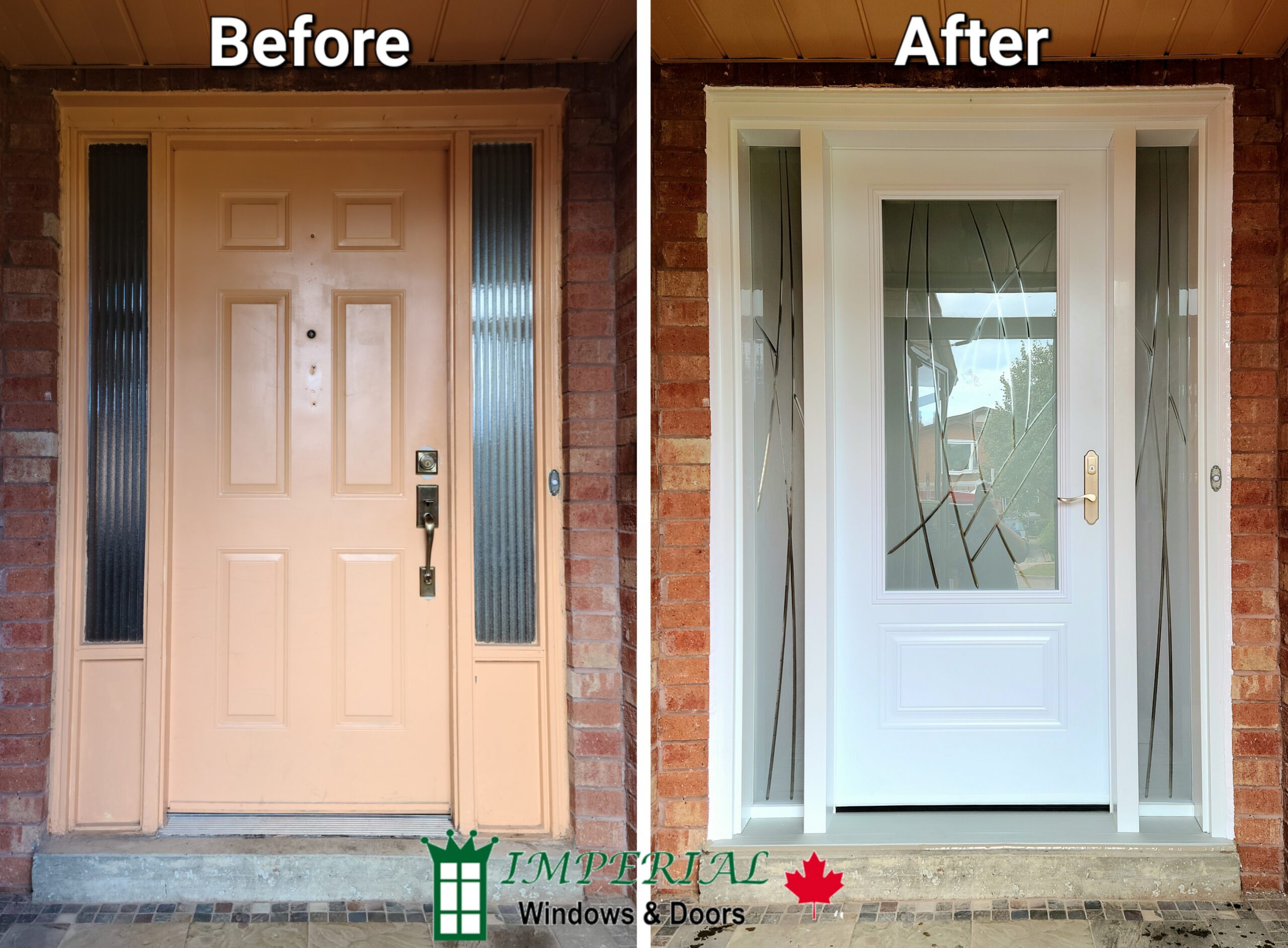
Every entry door requires occasional maintenance, but there comes a point when repairs stop being cost-effective. If you find yourself repainting the door every few years, replacing weatherstripping repeatedly, adjusting sagging hinges, repairing damaged trim, or fixing locks that continue to stick, it may be time to consider a complete replacement.
While each repair may seem inexpensive on its own, the costs can quickly add up. More importantly, repeated repairs often address the symptoms rather than the underlying problem. If the door has warped, the frame has shifted, or moisture has begun affecting the surrounding structure, temporary fixes are unlikely to restore the door's original performance.
Modern entry doors are designed to require far less maintenance than many older models. Fiberglass doors, in particular, resist warping, cracking, rust, and rot while maintaining their appearance for many years with minimal upkeep.
Instead of continuing to invest time and money into an aging door, replacing it can provide a long-term solution that improves comfort, security, energy efficiency, and curb appeal all at once.
💰 Money-Saving Tip
If you're spending money on repeated repairs every year, replacing the entire door system is often the more economical choice over the long term.
⚠️ Common Mistake
Replacing locks, weatherstripping, or repainting the door may improve its appearance temporarily, but these repairs won't fix problems caused by a warped slab, deteriorating frame, or poor insulation.
🛠️ Maintenance Tip
A quality fiberglass entry door requires very little maintenance beyond periodic cleaning, inspecting the weatherstripping, and lubricating the hinges and lock hardware once or twice a year.
Sometimes, the clearest sign isn't a draft or a sticking door—it's simply the age of the door itself. Even if it still functions reasonably well, older entry doors often lack the energy efficiency, security, and durability of today's modern door systems.
Not every entry door needs to be replaced because it's damaged. Sometimes, age alone is enough reason to consider an upgrade.
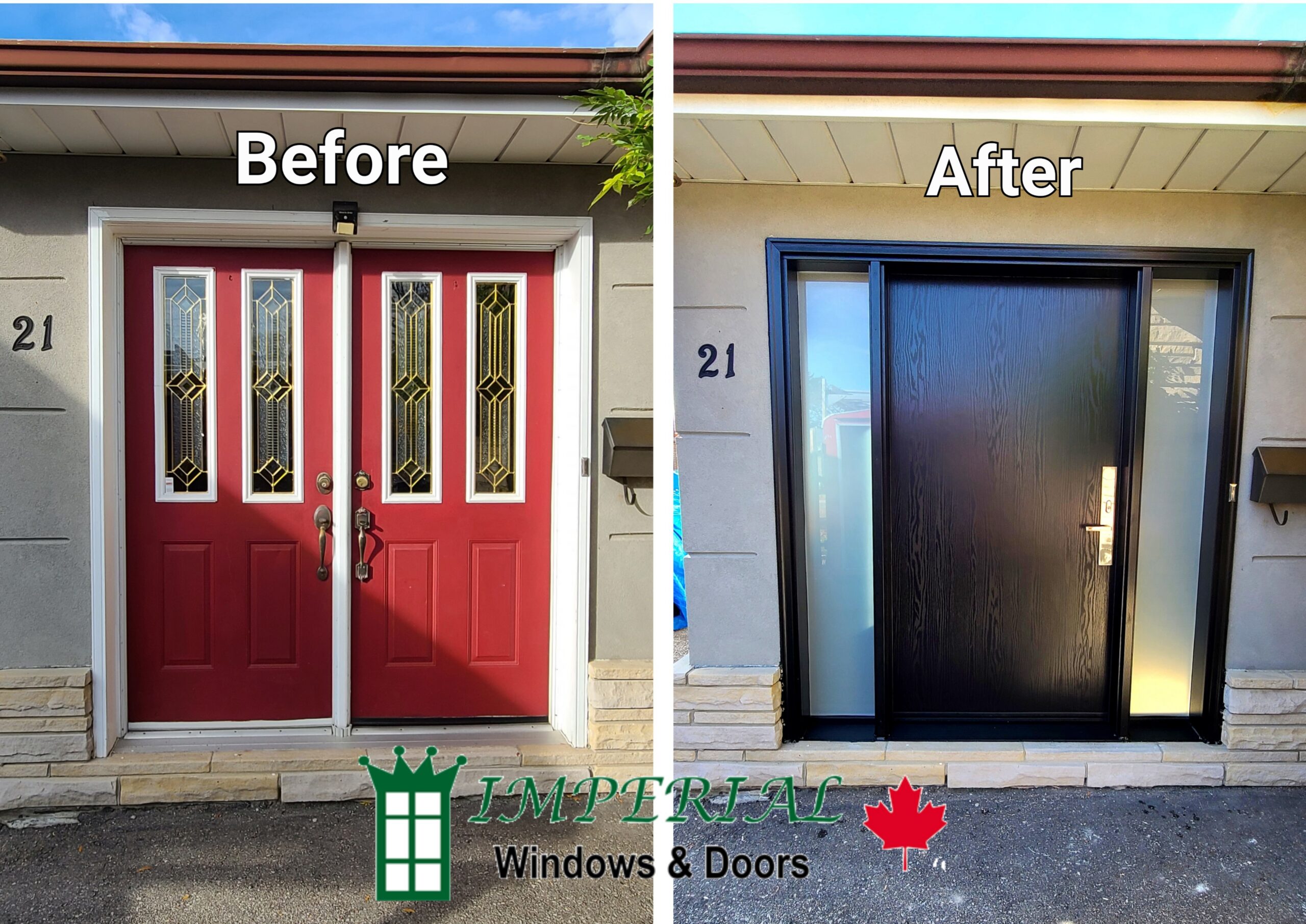
If your front door is 20 years old or more, it was likely manufactured using older materials, insulation, and weather sealing technology. Even if it still functions reasonably well, it probably doesn't offer the same level of energy efficiency, security, or durability as today's modern entry door systems.
Years of exposure to Toronto's changing weather can gradually affect the door, frame, threshold, and hardware. Weatherstripping loses its flexibility, seals become less effective, and repeated expansion and contraction can impact how the door fits within the frame.
Modern fiberglass and insulated steel entry doors are built to withstand Canada's climate while requiring significantly less maintenance than many older doors. They also offer improved thermal performance, stronger security features, and a wider selection of styles, colours, and decorative glass options.
If your entry door is more than two decades old, replacing it isn't just about updating its appearance—it's an opportunity to improve your home's comfort, efficiency, and long-term value.
✅ Pro Recommendation
If your entry door is more than 20 years old, have it professionally evaluated before investing in additional repairs. In many cases, replacement provides better long-term value than continuing to maintain an aging door system.
📋 Quick Checklist
There's rarely a perfect time to replace an entry door, but waiting too long can lead to higher energy bills, ongoing maintenance, water damage, and unnecessary frustration.
If you've recognized several of the warning signs we've covered, replacing your entry door now can help improve your home's comfort, security, and curb appeal before minor issues become major repairs.
For many homeowners, the best time to replace an entry door is before it fails completely. Planning ahead gives you more time to compare materials, choose a style that complements your home, and schedule installation at a time that's convenient for you.
💡 Expert Tip
If you've identified three or more of the signs in this guide, it's a good indication that your current entry door may no longer be performing as it should. A professional inspection can help determine whether a repair is sufficient or if replacement is the better long-term solution.
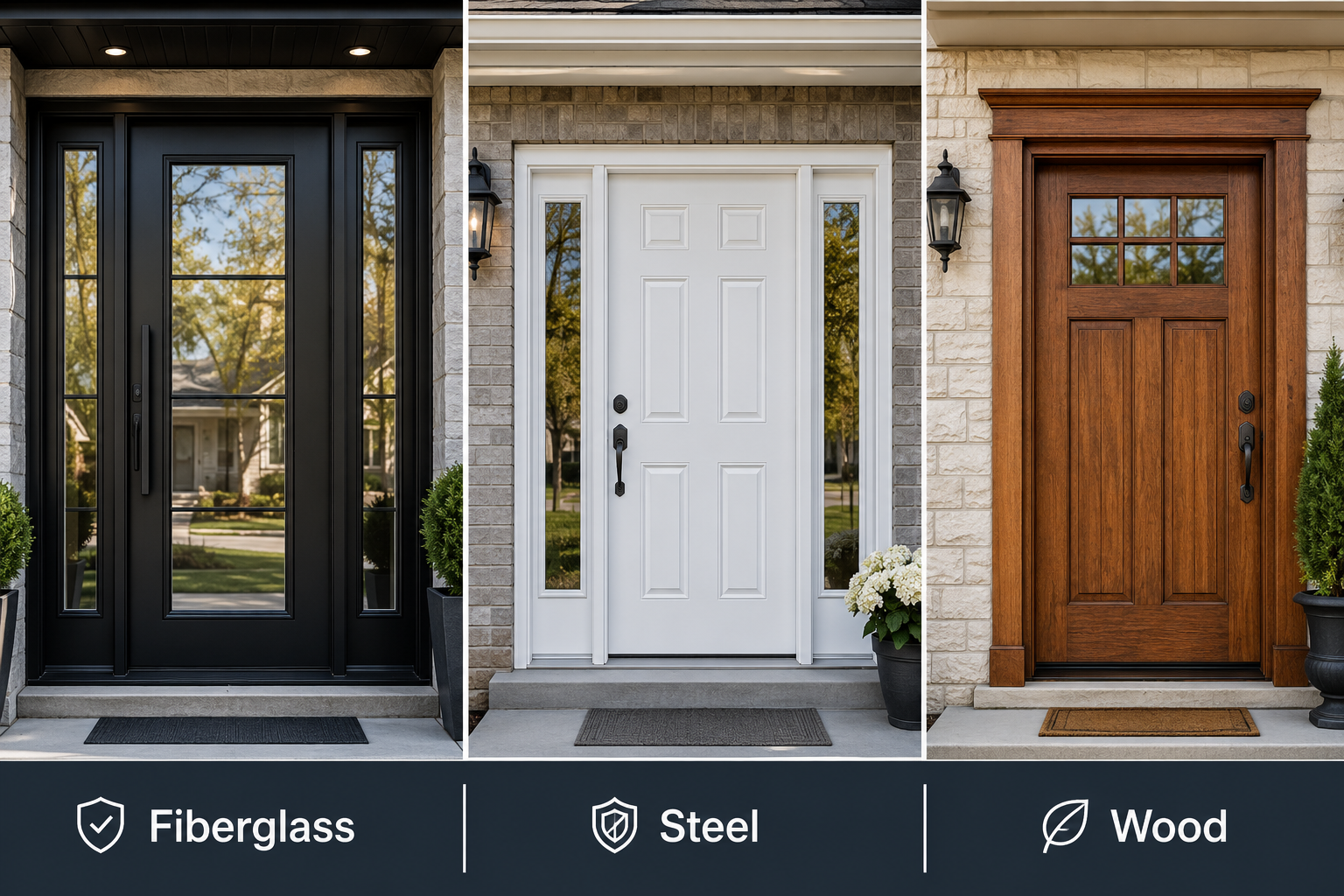
Choosing the right material is one of the most important decisions you'll make when replacing your entry door. While fiberglass, steel, and wood doors all have their advantages, they perform very differently when it comes to durability, maintenance, energy efficiency, security, and long-term value.
For homeowners in Toronto and the Greater Toronto Area, climate should be a major consideration. Our doors must withstand freezing winters, hot and humid summers, heavy rainfall, snow, ice, and repeated freeze-thaw cycles throughout the year. Not every material performs equally well under these conditions.
Below, we'll compare the three most common entry door materials to help you determine which option best suits your home, budget, and lifestyle.
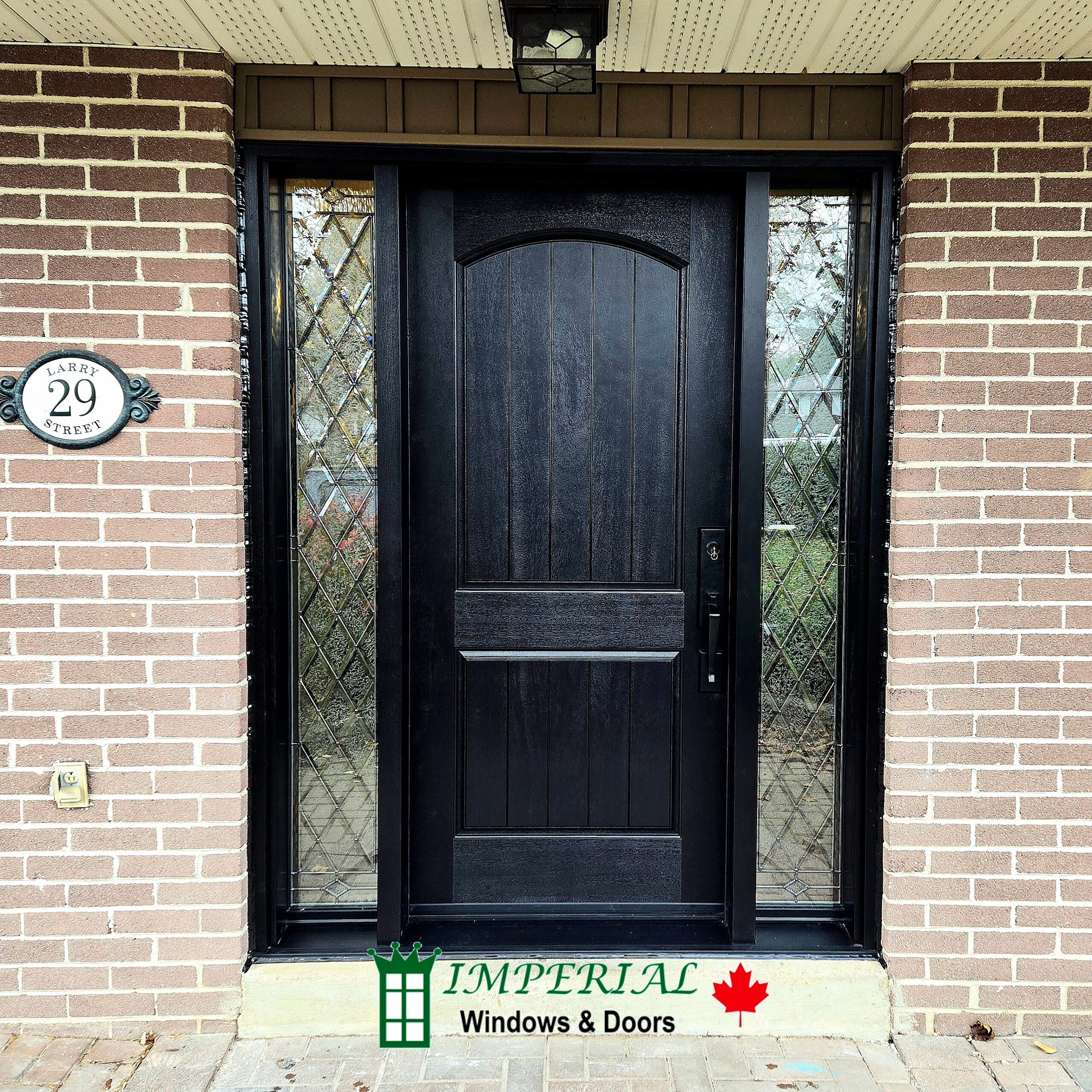
For most homeowners in Toronto and the GTA, fiberglass is the material we recommend most often—and for good reason.
Modern fiberglass entry doors are designed to combine the beauty of wood with outstanding durability and energy efficiency. Unlike traditional wood doors, fiberglass won't warp, crack, split, rot, or swell when exposed to changing weather conditions. It also resists dents better than many homeowners expect and requires very little maintenance over its lifetime.
Another major advantage is energy efficiency. Most fiberglass doors feature insulated polyurethane cores, compression weatherstripping, and high-performance glass options that help reduce drafts and improve indoor comfort throughout every season.
Fiberglass doors are also available in an extensive range of colours, woodgrain finishes, decorative glass designs, sidelights, and transoms, making them suitable for both traditional and contemporary homes.
For homeowners looking for the best combination of appearance, durability, security, and long-term value, fiberglass is often the clear choice.
✅ Pro Recommendation
If you're planning to stay in your home for many years, fiberglass offers one of the best long-term investments thanks to its durability, low maintenance requirements, and excellent energy efficiency.
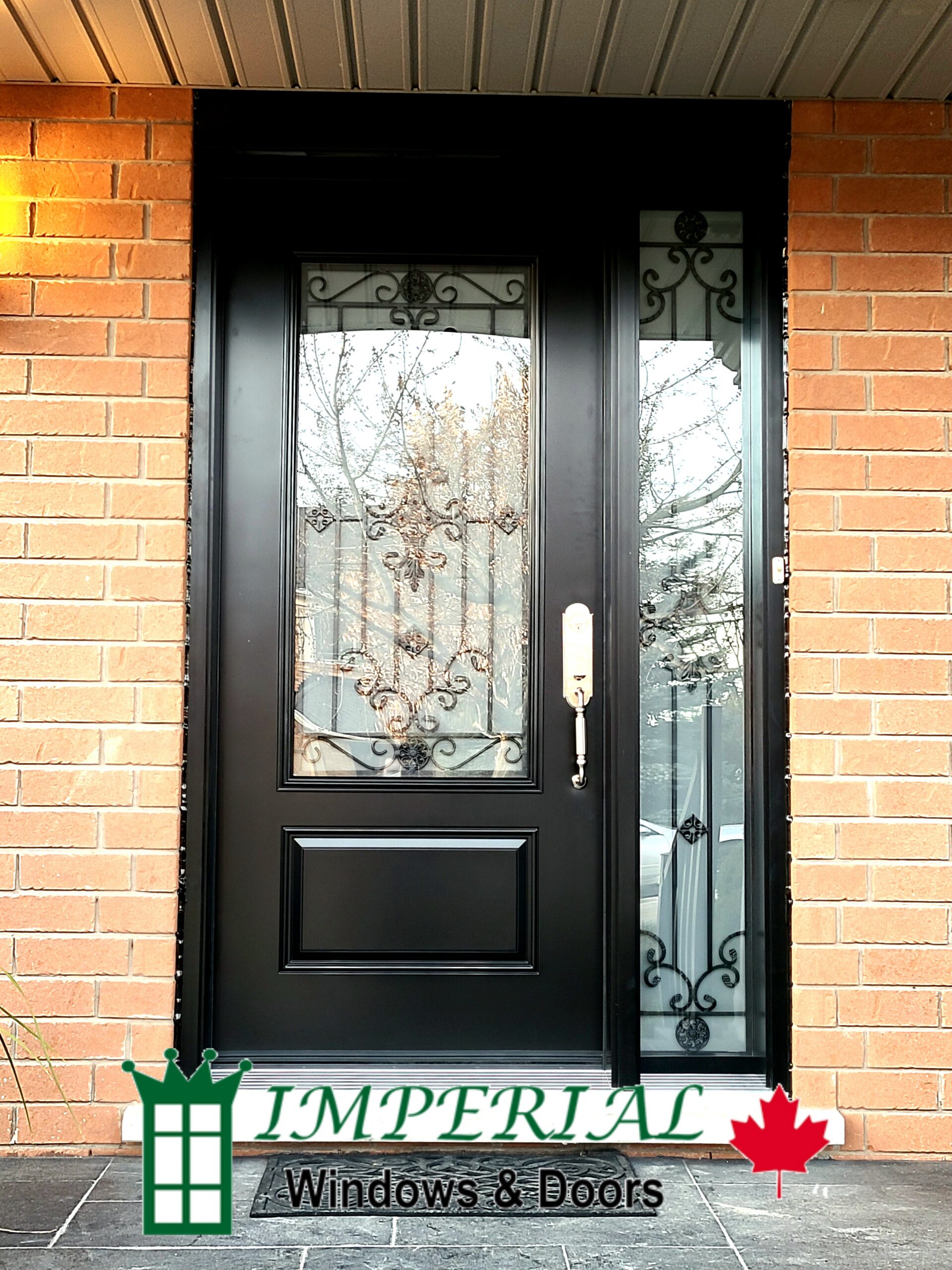
Steel entry doors remain a popular choice because they offer excellent security, durability, and affordability. They're especially well suited for homeowners looking for a strong, dependable entry door without the higher cost of premium fiberglass models.
Modern steel entry doors typically feature insulated cores that provide good thermal performance while helping improve security through reinforced construction.
However, steel doors aren't without their drawbacks. Deep scratches or dents can expose the underlying metal to moisture, potentially leading to rust if left untreated. They also offer fewer design options than fiberglass, particularly when it comes to realistic woodgrain finishes.
For many homes, steel provides an excellent balance between performance and value, particularly when properly installed and maintained.
💰 Money-Saving Tip
Steel entry doors are often an excellent option for homeowners who want dependable performance at a more affordable price point while still benefiting from modern insulation and security features.
Wood entry doors have long been appreciated for their natural beauty and traditional craftsmanship. They remain a popular option for some custom homes and heritage properties where maintaining an authentic architectural style is a priority.
However, wood requires significantly more maintenance than fiberglass or steel. Because it is a natural material, it can absorb moisture, expand, contract, warp, crack, or rot if it isn't regularly maintained. In Toronto's climate—where doors are exposed to humidity, rain, snow, ice, and repeated freeze-thaw cycles—these challenges can become even more noticeable over time.
Regular sanding, staining, painting, and sealing are often necessary to keep a wood door looking its best and performing properly. Without ongoing maintenance, its appearance and durability can deteriorate much faster than other materials.
For these reasons, wood entry doors are generally not recommended for most homeowners in Toronto and the GTA. While they can be the right choice for certain architectural styles, modern fiberglass doors can often achieve a similar appearance while offering far better durability, energy efficiency, and lower maintenance.
⚠️ Common Mistake
Many homeowners choose a wood door based on appearance alone without realizing the level of maintenance it requires. Before making a decision, consider how much time and money you're willing to invest in keeping the door looking and performing its best.
Instead of comparing every feature in a large table, here's a simple summary:
🟢 Choose Fiberglass if you want:
🔵 Choose Steel if you want:
🟤 Consider Wood only if you:
💡 Expert Tip
For the vast majority of homes in Toronto and the GTA, fiberglass offers the best balance of durability, energy efficiency, curb appeal, and long-term value. That's why it's the material we recommend most often for homeowners looking to replace their entry door.
Now that you've chosen the right material, the next step is selecting the features that will make your new entry door both beautiful and functional. From decorative glass and sidelites to hardware, colours, and finishes, today's entry doors offer more customization options than ever before.
Choosing the right material is only the beginning. Today's entry doors are available in a wide range of styles, colours, glass designs, and decorative features, allowing homeowners to create an entrance that complements both their home's architecture and their personal taste.
Whether you're updating a traditional brick home, renovating a modern property, or building a custom residence, selecting the right combination of door style and accessories can dramatically improve your home's curb appeal.
The following design ideas will help you understand the most popular options available and what works best for different types of homes.
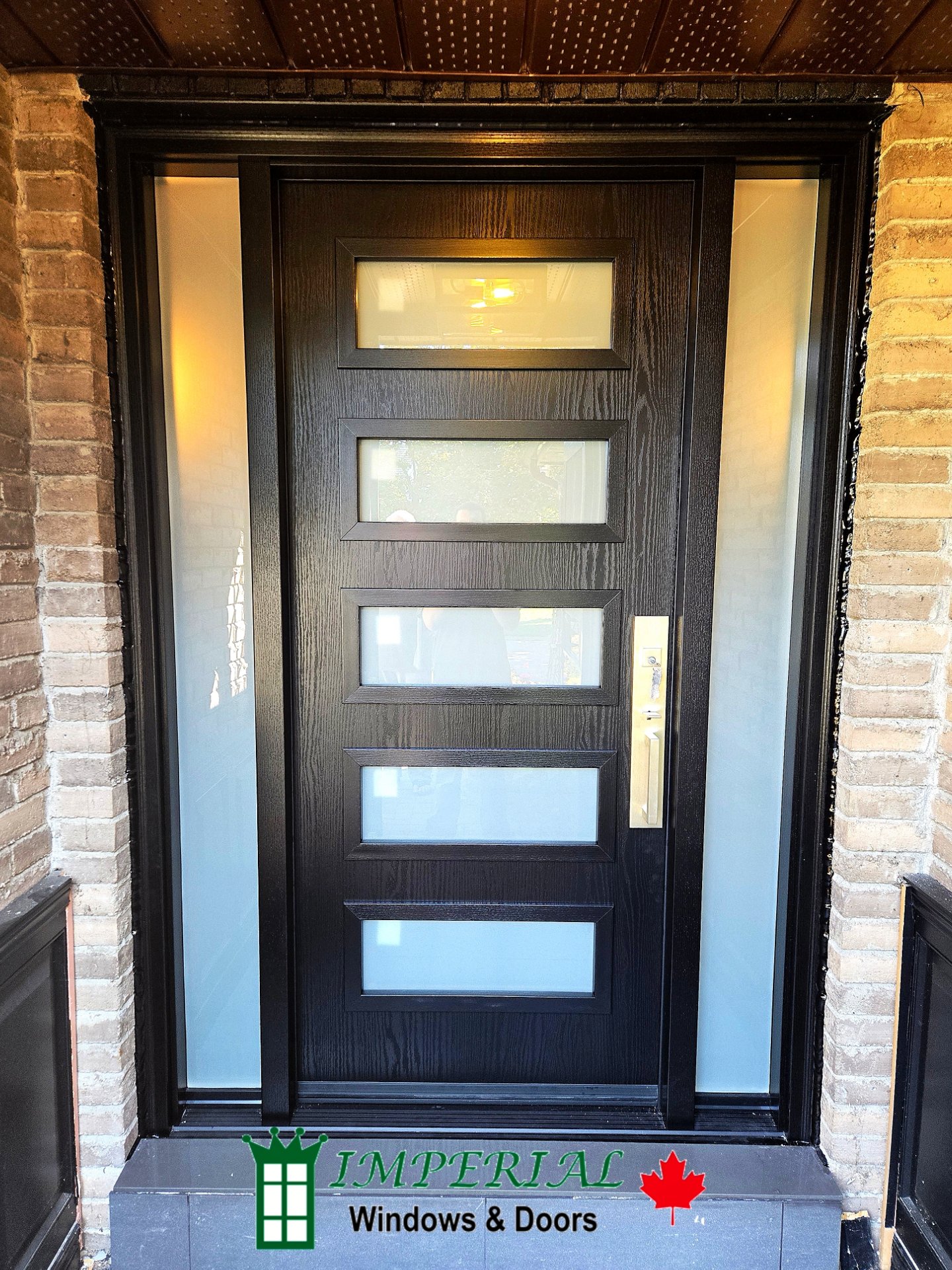
Modern entry doors are one of the fastest-growing trends in Toronto and the GTA. They typically feature clean lines, large glass inserts, minimal decorative details, and bold colours such as black, charcoal, bronze, or dark grey.
These doors pair especially well with contemporary homes, renovated bungalows, and newer subdivisions where homeowners want a sleek, sophisticated appearance.
Large vertical glass panels are often combined with matching sidelights to bring natural light into the entryway while maintaining a clean architectural look.
✅ Pro Recommendation
Black continues to be one of the most popular entry door colours because it complements almost every exterior finish while creating a bold first impression.
Traditional entry doors remain a popular choice for older neighbourhoods throughout Toronto. Raised panels, decorative glass, and classic hardware create a timeless appearance that works well with brick homes, stone facades, and colonial-style architecture.
Many homeowners choose traditional designs because they blend seamlessly with the original character of the home while still benefiting from modern insulation and security features.
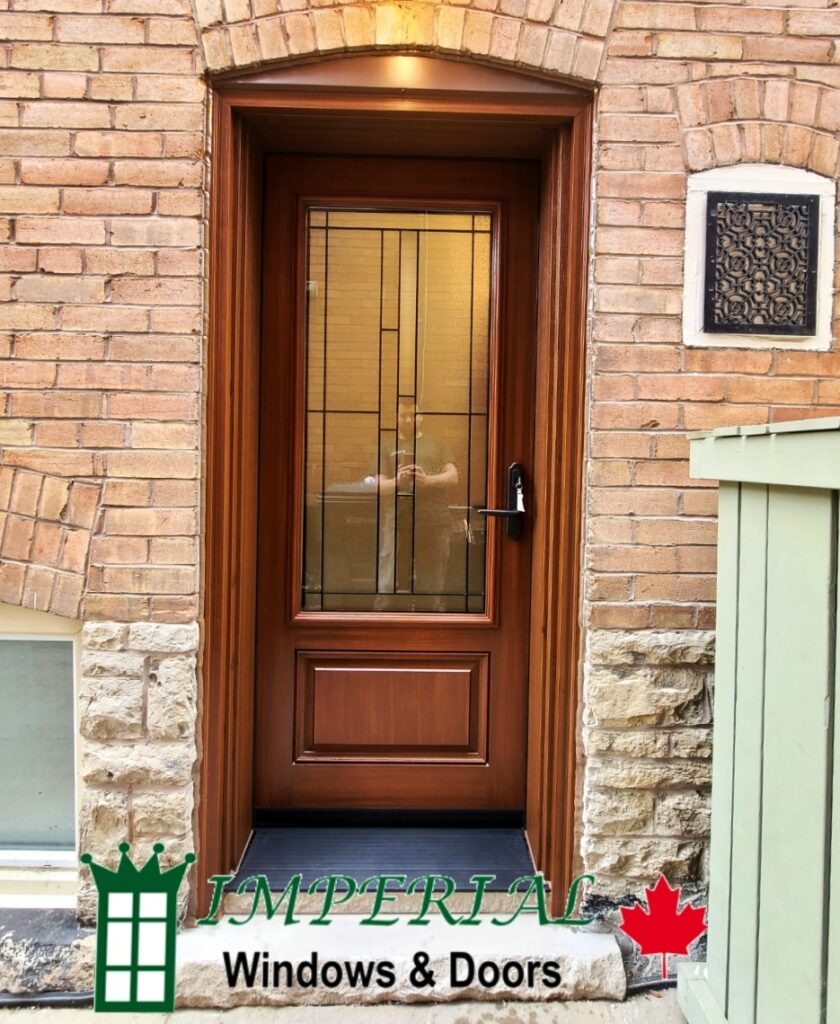
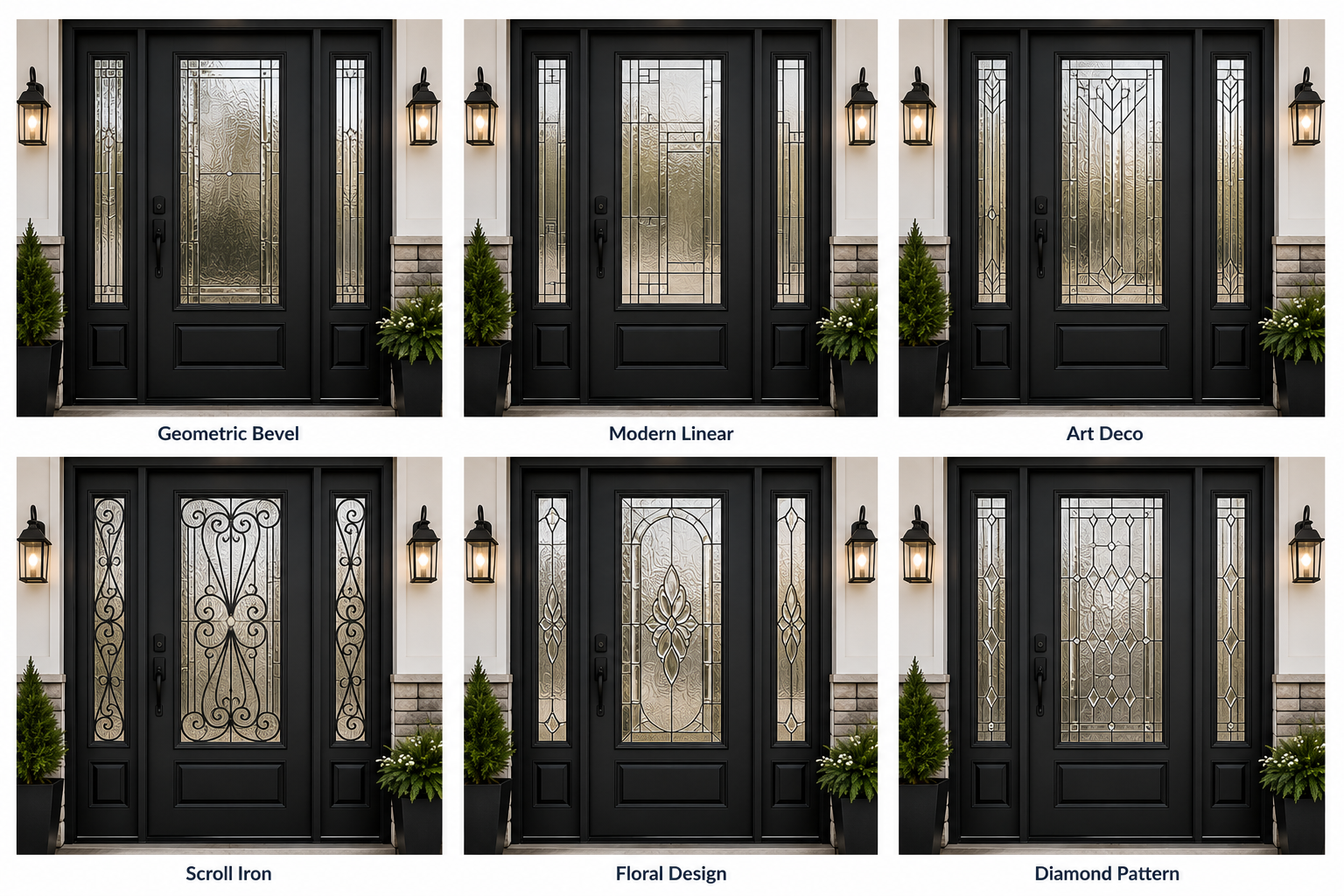
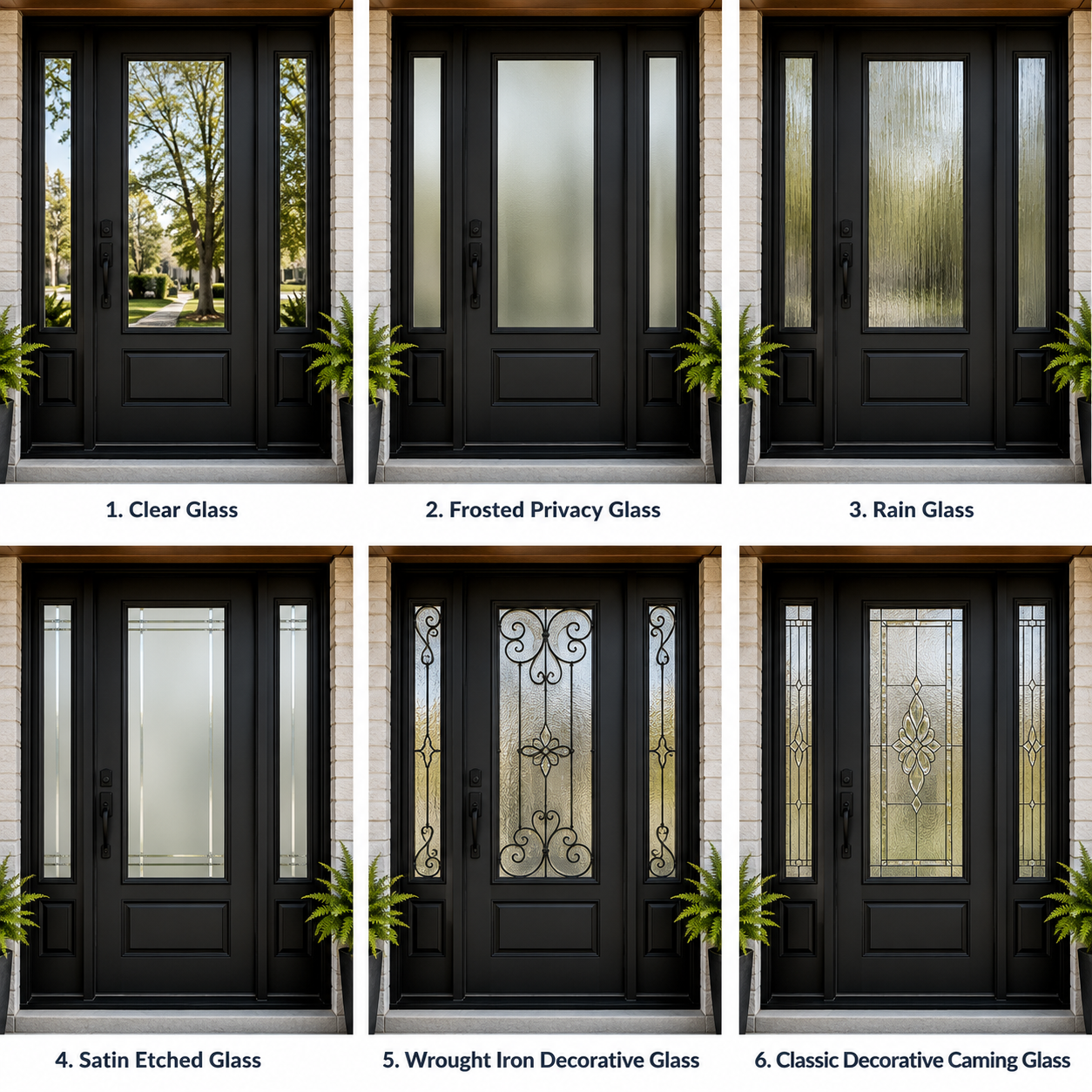
Glass is one of the most customizable features of an entry door. It allows natural light into your home while adding personality and enhancing curb appeal.
Popular options include:
The right choice depends on how much privacy you want and how much natural light you'd like to bring into your entryway.
💡 Expert Tip
If your front entrance faces a busy street, consider privacy glass. It allows natural light into your home while limiting visibility from outside.
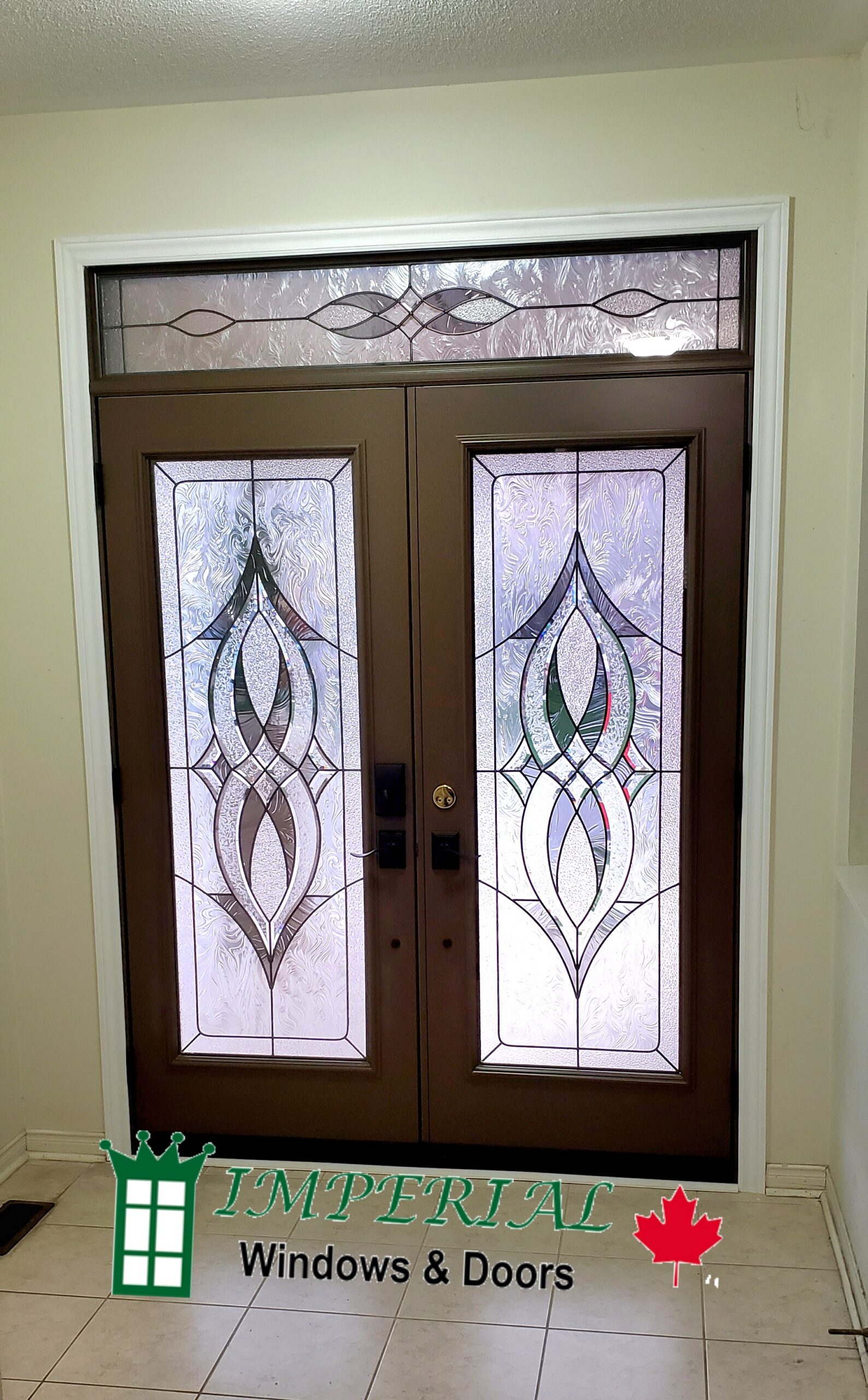
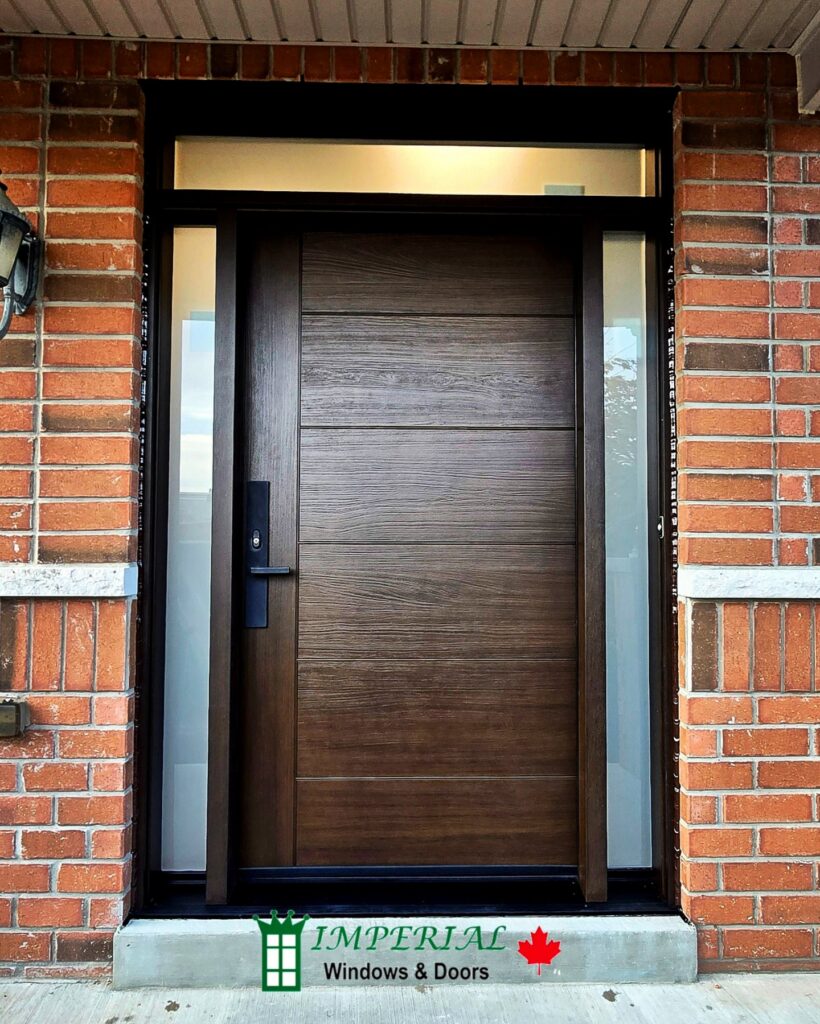
Adding sidelights or a transom window can completely transform the appearance of your front entrance.
Sidelights make the entryway feel larger and brighter, while a transom window above the door introduces even more natural light. Together, these features create a grand entrance that enhances both curb appeal and interior brightness.
Whether you choose full-height frosted glass sidelights or narrower decorative panels, these additions can make your home feel more open and inviting.
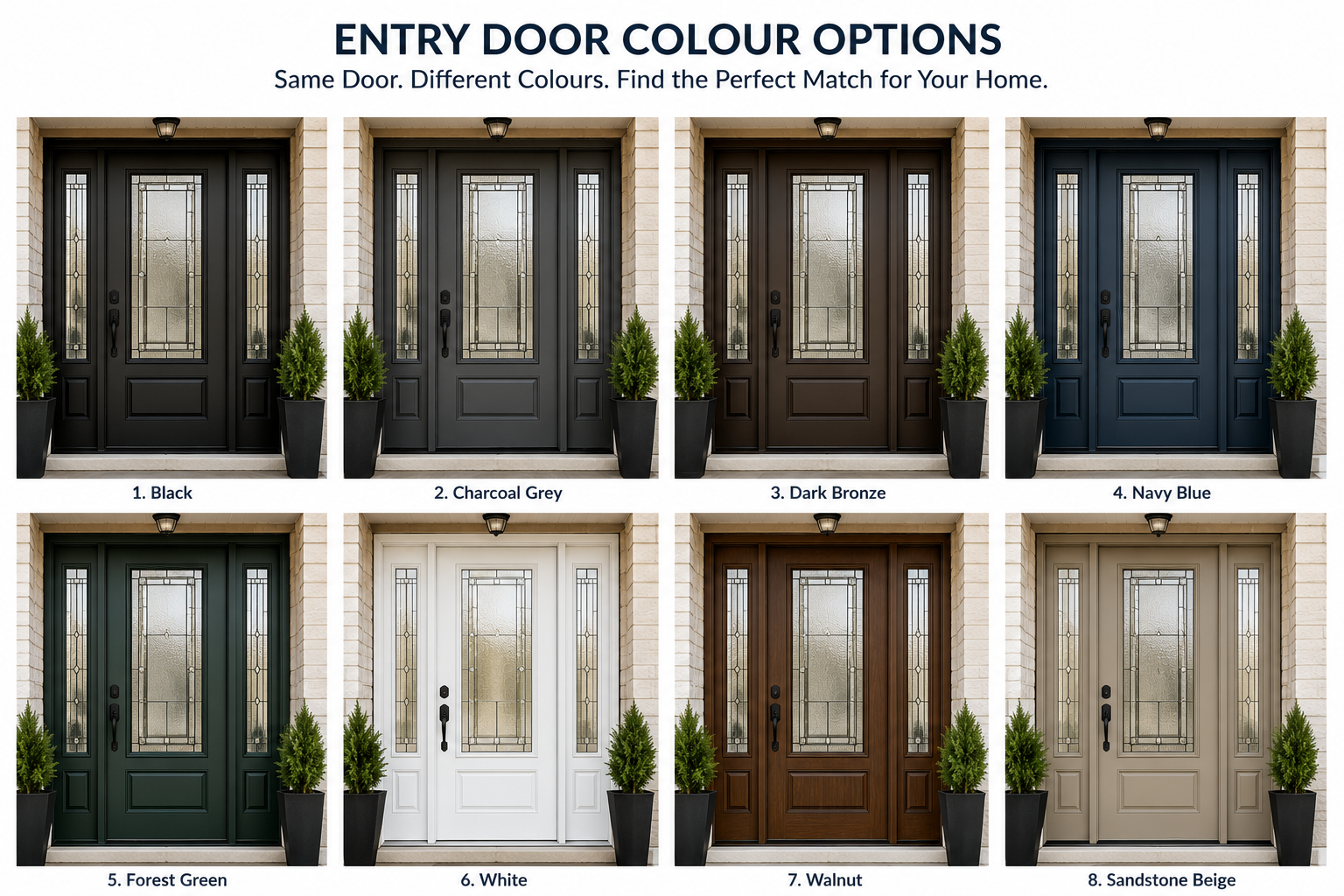
Your entry door color should complement your home's brick, stone, siding, roof, and trim.
Some of the most popular colors include:
Neutral colors remain the safest long-term choice because they work well with a wide variety of architectural styles and are less likely to go out of fashion.
🏡 Toronto Climate Tip
Dark-coloured doors absorb more heat during the summer, especially on south-facing homes. Choosing a high-quality factory finish helps protect against fading and ensures long-lasting color performance.
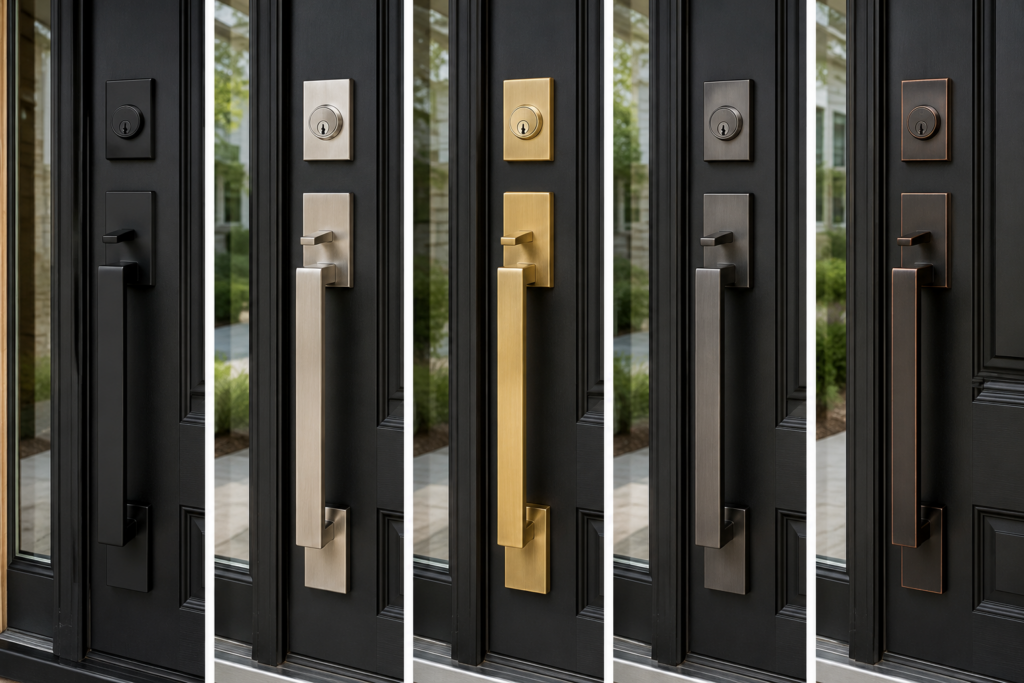
The right hardware completes the look of your new entry door.
Popular finishes include:
When selecting hardware, consider matching it with your exterior lighting fixtures, house numbers, and mailbox to create a cohesive design.
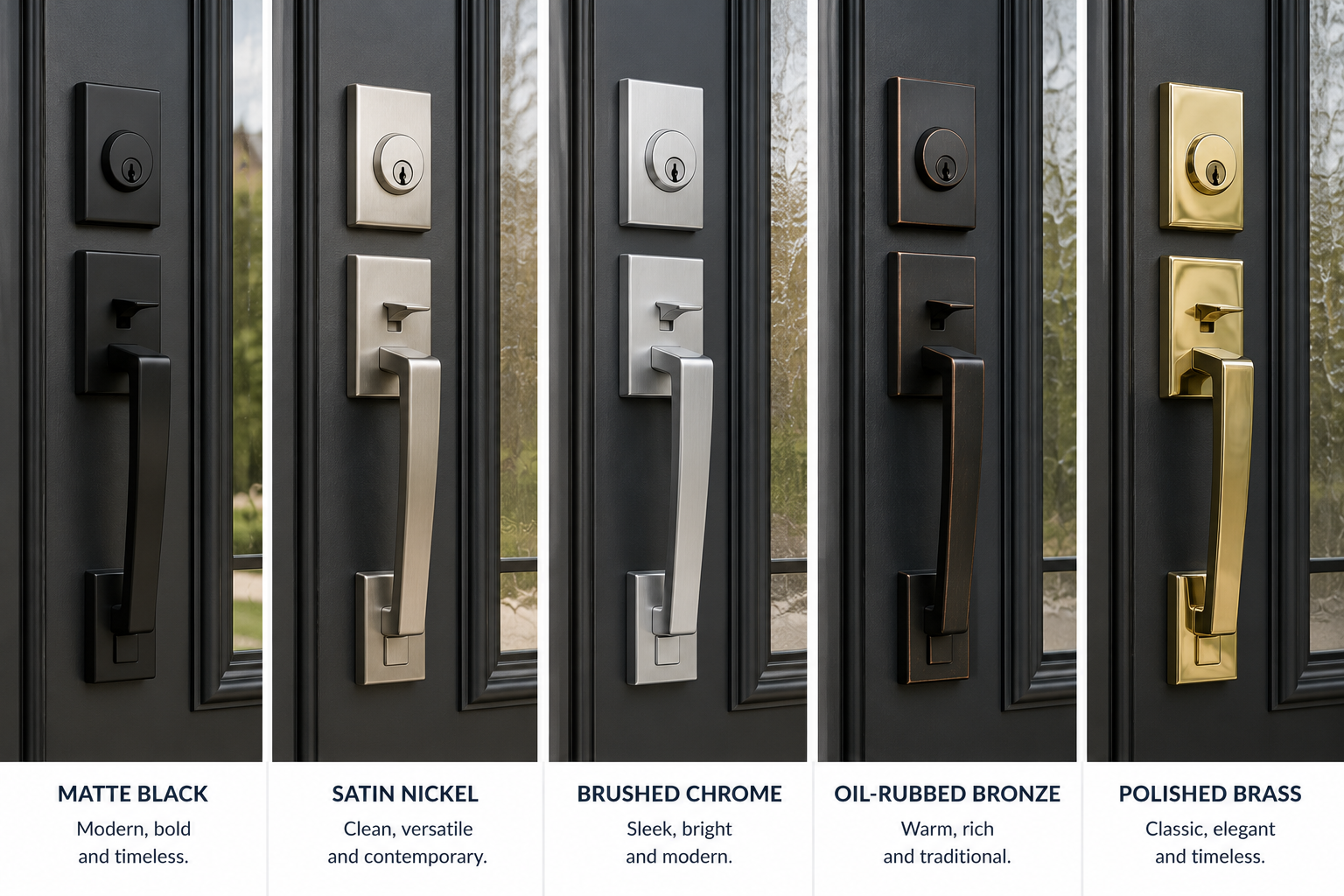
While trends come and go, some design choices remain attractive for decades.
These include:
Choosing timeless features instead of short-lived trends helps ensure your investment continues to look modern for years to come.
📋 Quick Checklist
For most homeowners, cost is one of the biggest factors when planning an entry door replacement. While it's natural to focus on the price of the door itself, the total investment depends on much more than the material you choose.
The size of the opening, decorative glass, sidelites, hardware, installation requirements, and customization options can all influence the final cost.
Rather than looking for the lowest price, it's important to understand what you're paying for. A quality entry door is an investment that can improve your home's security, energy efficiency, curb appeal, and long-term value for many years.
Several factors determine the price of an entry door replacement.
The material you choose has one of the biggest impacts on cost.
Larger entry doors naturally cost more than standard sizes.
If your project includes:
you can expect the overall cost to increase due to additional materials and labour.
Glass options can significantly change both the appearance and price of your new door.
Decorative glass, privacy glass, wrought iron inserts, and custom designs generally cost more than clear glass but can dramatically improve curb appeal and natural light.
Adding sidelights or a transom creates a larger, brighter entrance but also increases the overall cost because of the additional glass, framing, and installation work involved.
Many homeowners feel this upgrade offers one of the biggest improvements in curb appeal.
Hardware varies considerably depending on style and security features.
Options include:
While upgraded hardware adds to the initial investment, it often improves both security and everyday convenience.
Not every replacement is the same.
Some projects require only replacing the door slab, while others involve:
A professional assessment ensures your quote accurately reflects the work required.
Every home is different, so the final price depends on the door size, material, glass options, hardware, and installation requirements. Instead of focusing on exact numbers—which change over time—these general investment levels provide a better way to compare your options.
Investment: $$
A practical and budget-friendly option that offers solid security, good insulation, and dependable everyday performance. Ideal for homeowners looking for quality at an affordable price.
Investment: $$$
A great balance between style and value. Decorative glass adds natural light and curb appeal while maintaining the strength and durability of a steel door.
Investment: $$$
One of the most popular choices for Toronto homeowners thanks to its excellent energy efficiency, low maintenance, long lifespan, and realistic woodgrain finishes.
Investment: $$$$
A premium upgrade that creates a brighter, more welcoming entrance. Sidelites increase natural light and significantly enhance your home's curb appeal.
Investment: $$$$$
The ideal choice for luxury homes and grand entrances. Double doors create a dramatic first impression while providing a wide, elegant entryway.
💰 Money-Saving Tip
A lower quote doesn't always mean better value. Compare the quality of the door, energy efficiency, hardware, warranty, and installation—not just the initial price.
⚠️ Common Mistake
Some quotes include only the door itself, while others include professional installation, disposal of the old door, trim work, finishing, and warranty coverage. Always compare what's included before making a decision.
If your entry door only has a minor issue—such as worn weatherstripping or loose hardware—a repair may be enough.
However, replacement is often the better long-term investment if your door has:
A modern entry door provides benefits that go well beyond appearance, including improved comfort, reduced maintenance, and greater peace of mind.
✅ Pro Recommendation
Think of your entry door as a complete system. A quality door paired with professional installation will almost always deliver better long-term performance than repairing an aging door repeatedly.
For many homeowners, the answer is yes.
A professionally installed entry door can improve:
It's one of the few home improvements you'll appreciate every time you come home.
Now that you understand what influences the cost of an entry door replacement, it's time to learn how to choose the right installer.
Even the highest-quality door won't perform as intended if it's installed incorrectly. In the next section, we'll explain what professional installation involves, why it matters, and the questions every homeowner should ask before hiring a contractor.
Choosing a high-quality entry door is only half the equation. Even the most energy-efficient fiberglass or steel door won't perform as intended if it's installed incorrectly.
Professional installation ensures your new entry door operates smoothly, seals tightly against the weather, provides maximum security, and continues performing reliably for many years. In fact, many of the problems homeowners experience with entry doors—such as drafts, water leaks, sticking, or difficulty locking—are often caused by improper installation rather than the door itself.
If you're investing in a new entry door, proper installation is just as important as the quality of the product.
Modern entry doors are manufactured with precise tolerances. For the door to open, close, and seal correctly, the frame must be perfectly level, plumb, and square.
Even a slight misalignment can cause problems, including:
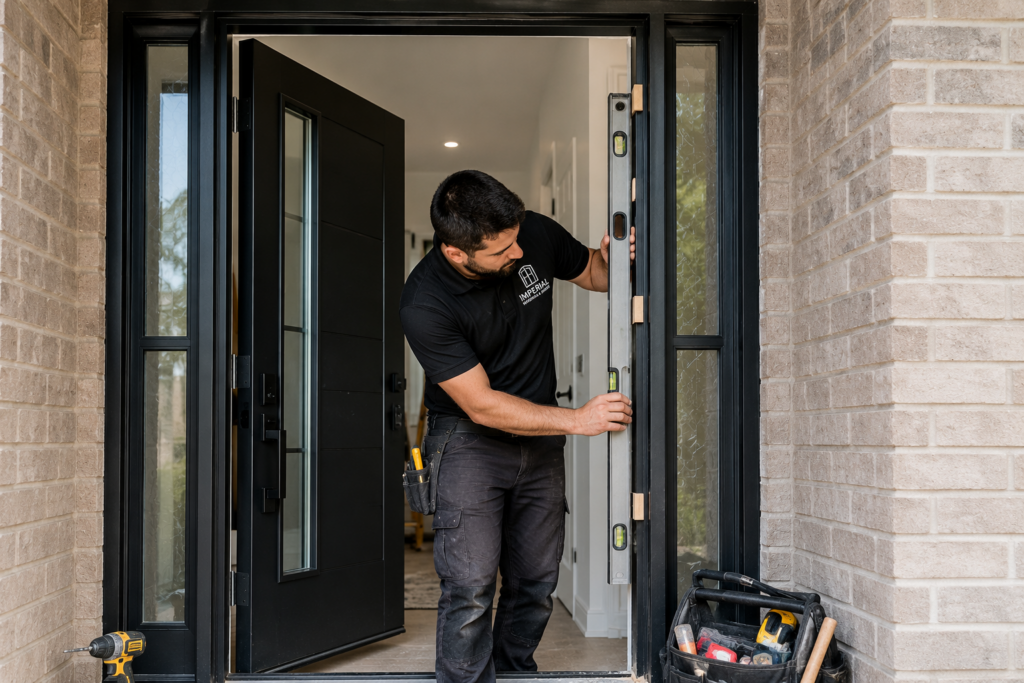
While every home is different, a professional installation typically follows a series of important steps.
The old door, frame, trim, and hardware are carefully removed without damaging the surrounding structure whenever possible.
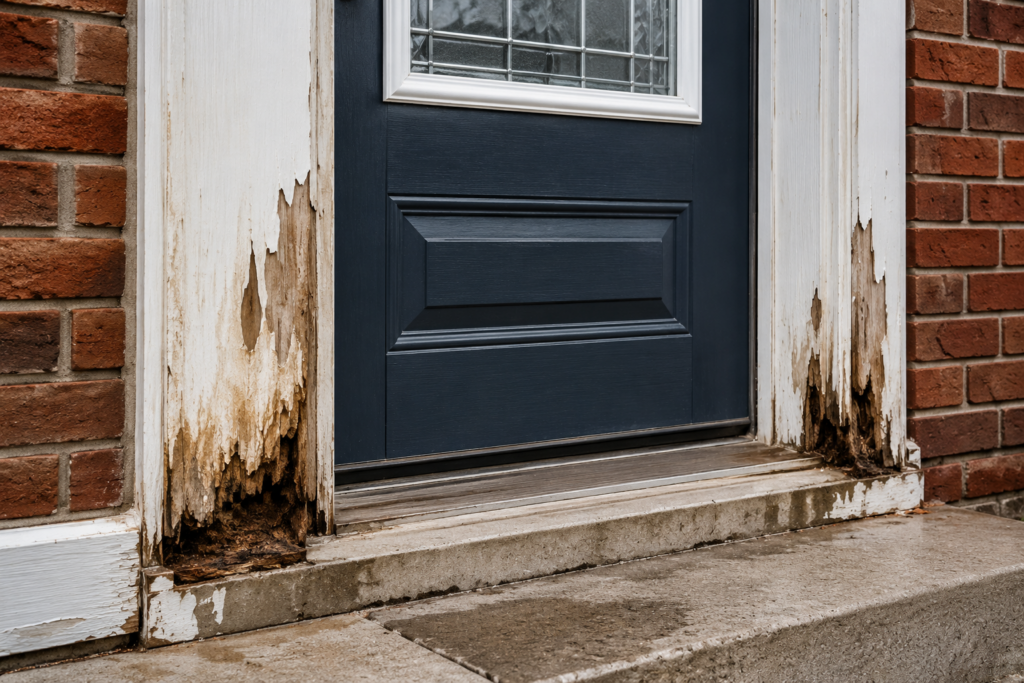
Before installing the new door, the opening is inspected for:
Addressing these problems before installation helps prevent future issues.
⚠️ Common Mistake
Installing a new door over damaged framing may hide the problem temporarily, but moisture and structural damage can continue to worsen behind the new door.
The installer verifies that the opening is level, square, and structurally sound before positioning the new door.
Proper preparation is essential for achieving a weather-tight seal and ensuring smooth operation.
The new entry door is carefully positioned, shimmed, and secured.
Every adjustment is made to ensure:
This step often makes the biggest difference in how well the door performs over time.
Professional installers use high-quality sealants, insulation, and flashing techniques to help protect your home from:
Proper sealing improves both comfort and energy efficiency.
🏡 Toronto Climate Tip
Toronto experiences frequent freeze-thaw cycles throughout the winter. Proper sealing around your entry door helps prevent moisture from entering the wall cavity, where it can freeze, expand, and cause long-term damage.
Before the installation is complete, the installer checks every aspect of the new door.
This includes verifying that:
Only after these final checks is the installation considered complete.
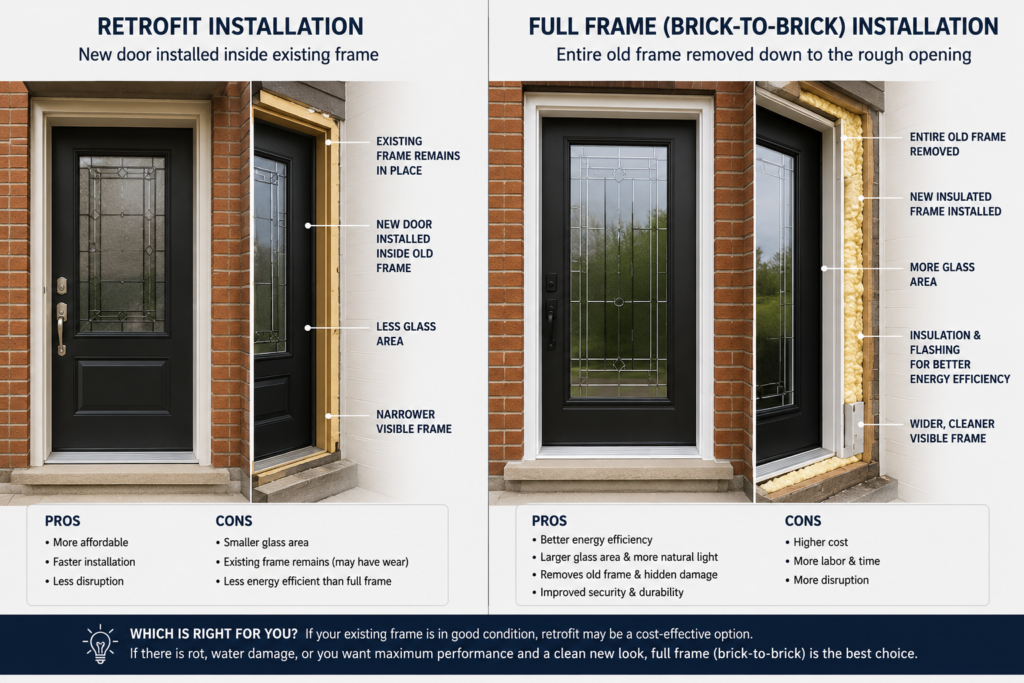
Not every entry door replacement is installed the same way.
A retrofit installation replaces the door while keeping the existing frame in place.
This option may be suitable when the existing frame is in excellent condition and properly aligned.
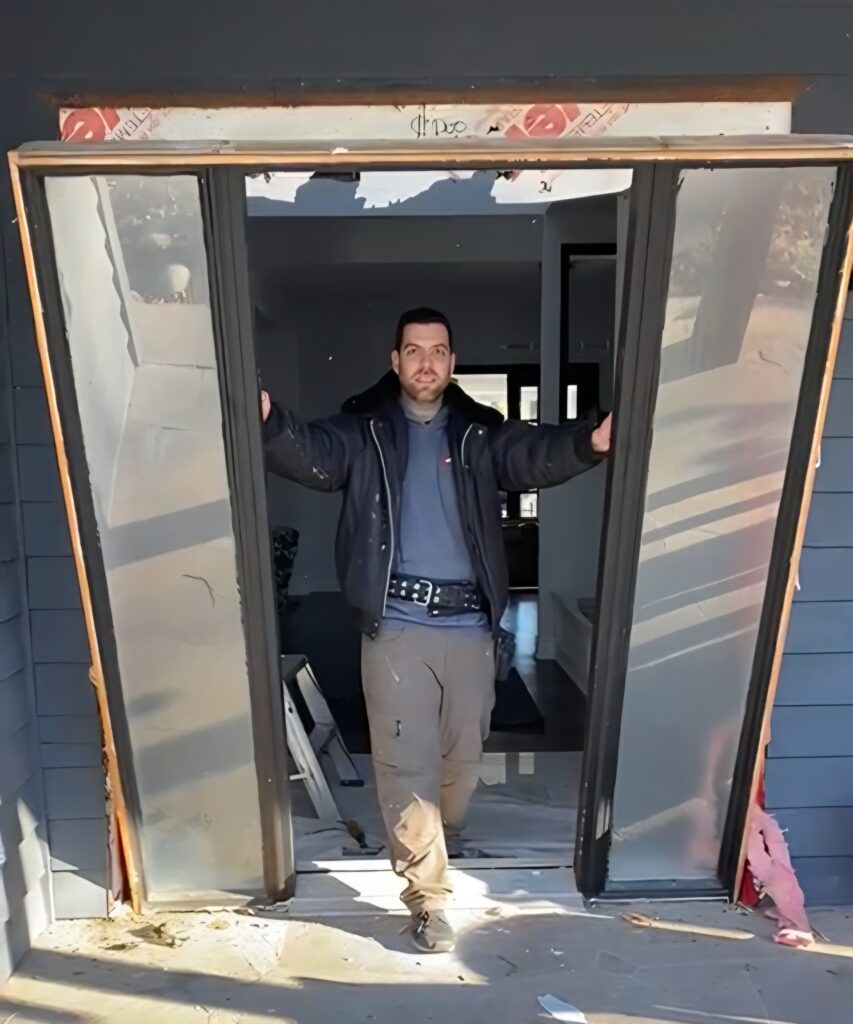
A full-frame replacement removes the entire existing door system, including the frame.
This approach allows installers to:
For many older homes in Toronto, a full-frame replacement provides the best long-term performance.
✅ Pro Recommendation
If your existing frame shows signs of age, water damage, or poor alignment, replacing the entire door system is often the better investment. It provides a fresh start and helps ensure your new door performs as intended for years to come.
While professional installation may seem like an added expense, it often helps homeowners avoid much larger repair costs in the future.
A properly installed entry door can:
When installed correctly the first time, your new entry door is far more likely to deliver the comfort, performance, and reliability you expect.
💰 Money-Saving Tip
The cheapest installation isn't always the best value. Paying for quality workmanship upfront can help prevent expensive repairs, service calls, and premature replacement later.
Before hiring a contractor, ask a few important questions:
✔️ Do they install the doors themselves or use subcontractors?
✔️ Is the installation covered by a workmanship warranty?
✔️ Will they inspect the frame for hidden damage?
✔️ Do they replace the entire frame when necessary?
✔️ Are all finishing and sealing materials included in the quote?
✔️ Can they provide examples of completed projects?
Taking the time to ask these questions can help you choose an installer who prioritizes quality, transparency, and long-term performance.
An entry door is designed to last for decades—but only when it's installed correctly.
Professional installation ensures your new door delivers the security, energy efficiency, comfort, and curb appeal you invested in. It also helps protect your home from drafts, moisture, and unnecessary repairs, allowing you to enjoy the benefits of your new entry door with confidence for years to come.
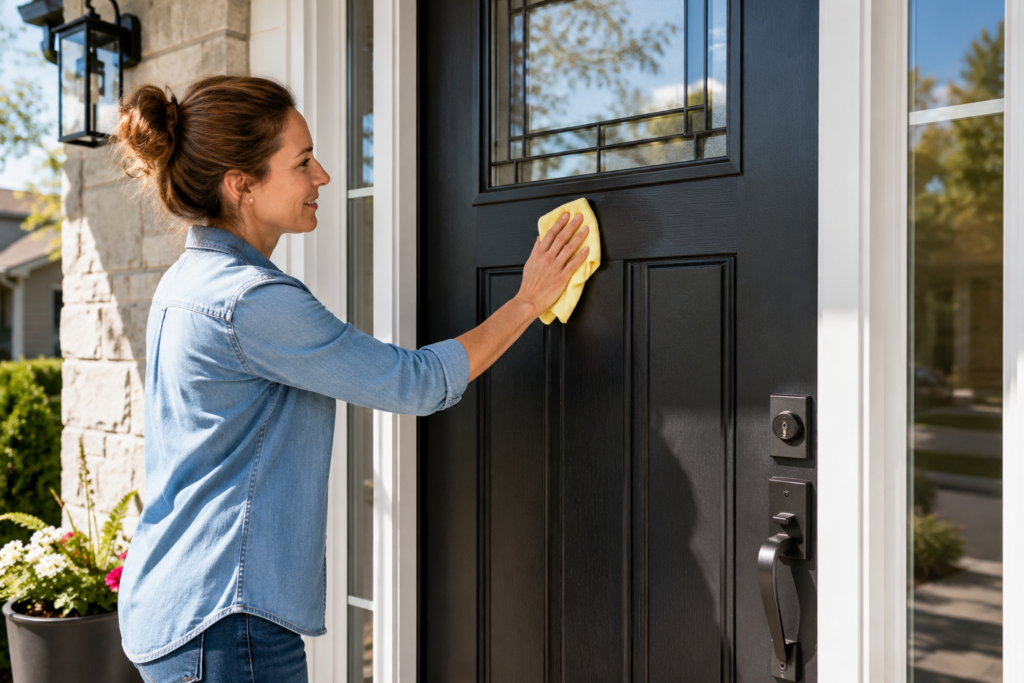
A quality entry door is built to withstand years of daily use, changing weather, and seasonal temperature swings. While modern fiberglass and steel doors require very little maintenance compared to traditional wood doors, a few simple maintenance habits can help keep your door looking great and operating smoothly for many years.
The good news is that most maintenance tasks only take a few minutes and can help prevent unnecessary wear while protecting your investment.
Dirt, dust, pollen, road salt, and other outdoor debris can gradually build up on your entry door throughout the year. Cleaning the surface regularly helps preserve the finish and keeps your home looking its best.
For most fiberglass and steel doors, warm water, mild dish soap, and a soft microfiber cloth are all that's needed. Avoid abrasive cleaners, steel wool, or harsh chemicals that could damage the painted or stained finish.
Pay extra attention to decorative glass, sidelights, and door hardware, as these areas often collect fingerprints and dirt more quickly.
🛠️ Maintenance Tip: Washing your entry door two or three times a year is usually enough for most homes. If you live near busy roads or areas with heavy dust or road salt, more frequent cleaning may help preserve the finish.
Weatherstripping creates the seal that helps keep cold air, rain, and drafts outside where they belong. Over time, it may compress, crack, or wear from repeated use.
At least once each season, inspect the weatherstripping around the door and look for:
Replacing worn weatherstripping is inexpensive and can improve comfort while helping reduce heating and cooling costs.
Like any moving parts, door hardware benefits from occasional maintenance.
If your hinges begin squeaking or the lock feels stiff, apply a silicone-based lubricant to:
Avoid oil-based lubricants that attract dirt and dust over time.
💡 Expert Tip: A quick application of lubricant once or twice a year can keep your door operating quietly and smoothly.
Exterior caulking helps keep moisture and air from entering around the door frame. As homes settle and experience seasonal expansion and contraction, caulking may eventually crack or separate.
Walk around the exterior of your home each spring and fall and inspect the seal around your entry door.
If you notice gaps, peeling, or cracking, replacing the damaged caulking promptly can help prevent water from reaching the framing behind the trim.
Decorative glass can be cleaned using standard glass cleaner and a soft cloth. Avoid abrasive pads that may scratch specialty glass finishes.
While cleaning, look for signs such as:
These may indicate a failed insulated glass unit that should be inspected by a professional.
Although modern fiberglass and steel entry doors are designed for long-term durability, protecting the finish helps maintain their appearance.
Avoid hanging heavy decorations directly from the handle or glass inserts, and use wreath hangers designed for entry doors rather than nails or screws.
If your door receives direct afternoon sunlight for many hours each day, occasional cleaning and manufacturer-approved touch-ups can help keep the finish looking its best for years.
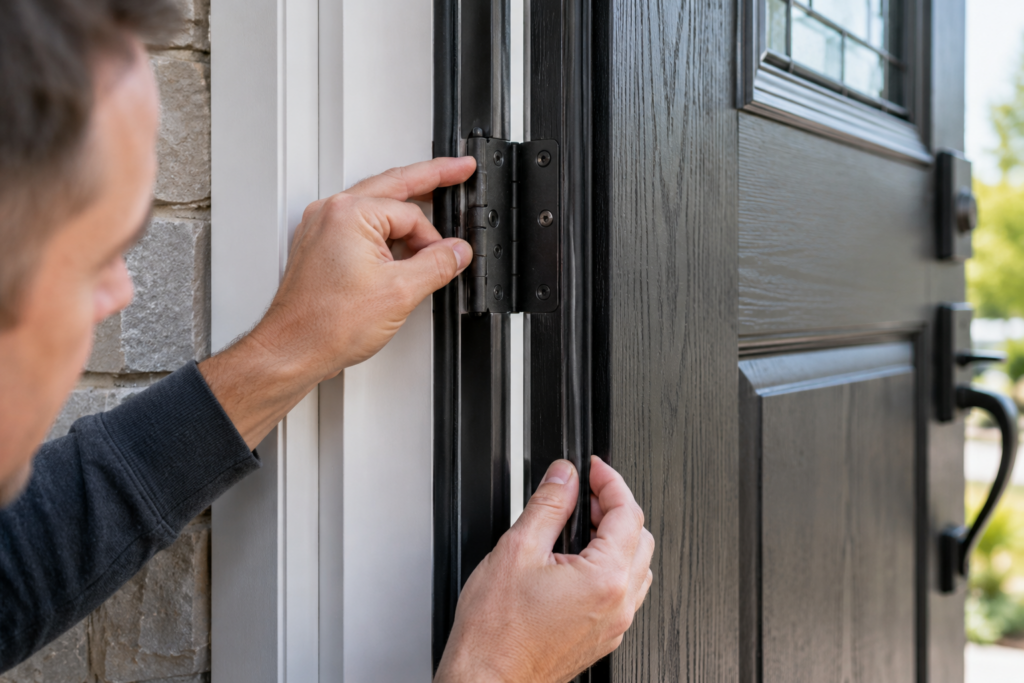
Once a year, take a few minutes to inspect your entry door from top to bottom.
Use this simple checklist:
✅ Door opens and closes smoothly
✅ Lock and deadbolt operate properly
✅ Weatherstripping is intact
✅ Caulking is in good condition
✅ Hinges are secure
✅ Decorative glass is clean and undamaged
✅ Paint or stain shows no unusual wear
Catching small issues early often prevents larger repairs later.
📋 Quick Checklist: Make your annual inspection part of your spring or fall home maintenance routine. A few minutes each year can help keep your entry door performing like new.
While routine maintenance is easy for most homeowners, some issues should be inspected by an experienced professional.
Consider scheduling an inspection if you notice:
Addressing these issues early can help prevent more extensive repairs and protect your home's comfort and security.
With proper maintenance, a high-quality entry door can provide decades of reliable performance while enhancing your home's curb appeal, security, and energy efficiency. Before making your final decision, here are answers to some of the most common questions homeowners ask about entry door replacement.
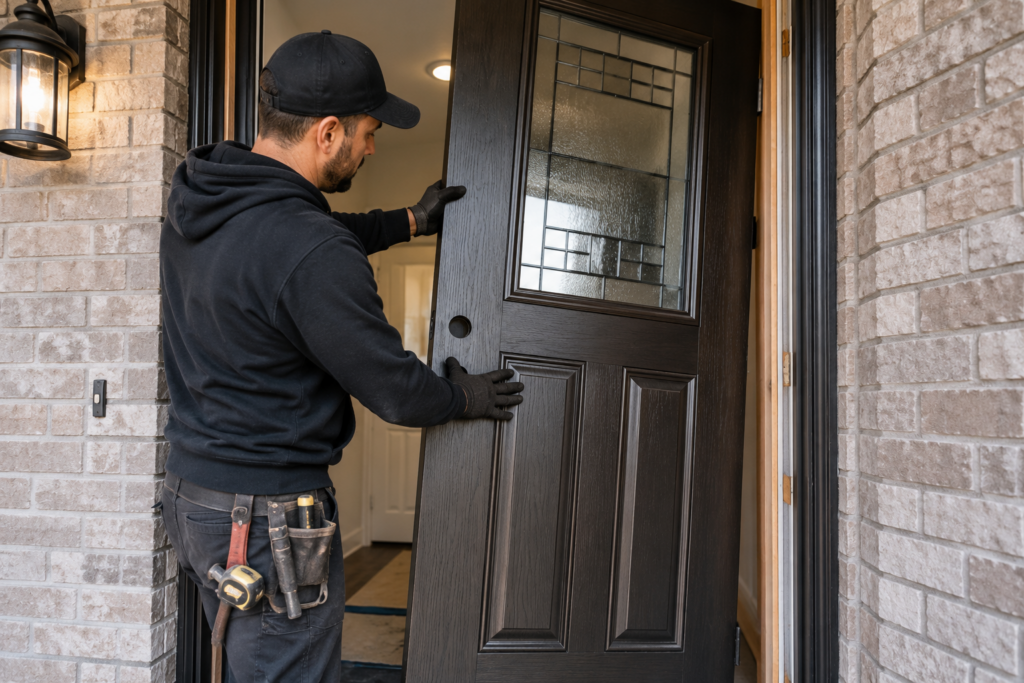
Many homeowners put off replacing their front door because they're unsure what the installation process involves. The good news is that a professional entry door replacement is usually straightforward, with most projects completed in just a few hours.
Knowing what to expect helps you prepare your home, reduces stress, and ensures the project goes as smoothly as possible.
Before your new door is manufactured, your installer should visit your home to take precise measurements. Even a small measurement error can cause installation problems later, so this step is one of the most important parts of the project.
During this visit, you'll typically confirm:
Custom entry doors are built specifically for your home, so final measurements are usually verified before manufacturing begins.
💡 Expert Tip: Don't schedule painters or exterior renovations until your installation date is confirmed. Custom doors can require several weeks for manufacturing depending on the style and finish.
On installation day, there isn't much you need to do, but a little preparation makes the process easier.
We recommend:
Your installer will usually protect nearby flooring and clean the work area before leaving.
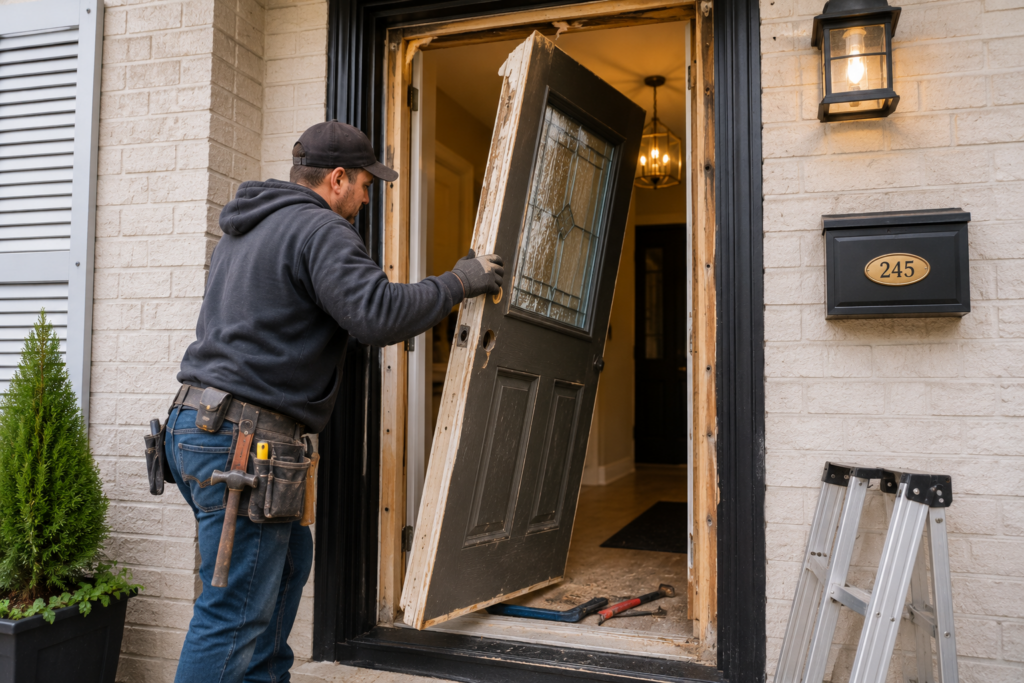
The first step is carefully removing the existing door and frame.
Experienced installers inspect the opening for hidden issues such as:
Finding these issues during installation allows them to be corrected before the new door is installed.
⚠️ Common Mistake: Installing a new door over damaged framing can lead to drafts, water leaks, and premature failure.
Once the opening has been prepared, the new door system is carefully positioned and secured.
Professional installers will:
Every adjustment is made to ensure the door opens smoothly, locks properly, and seals tightly against Ontario's changing weather.
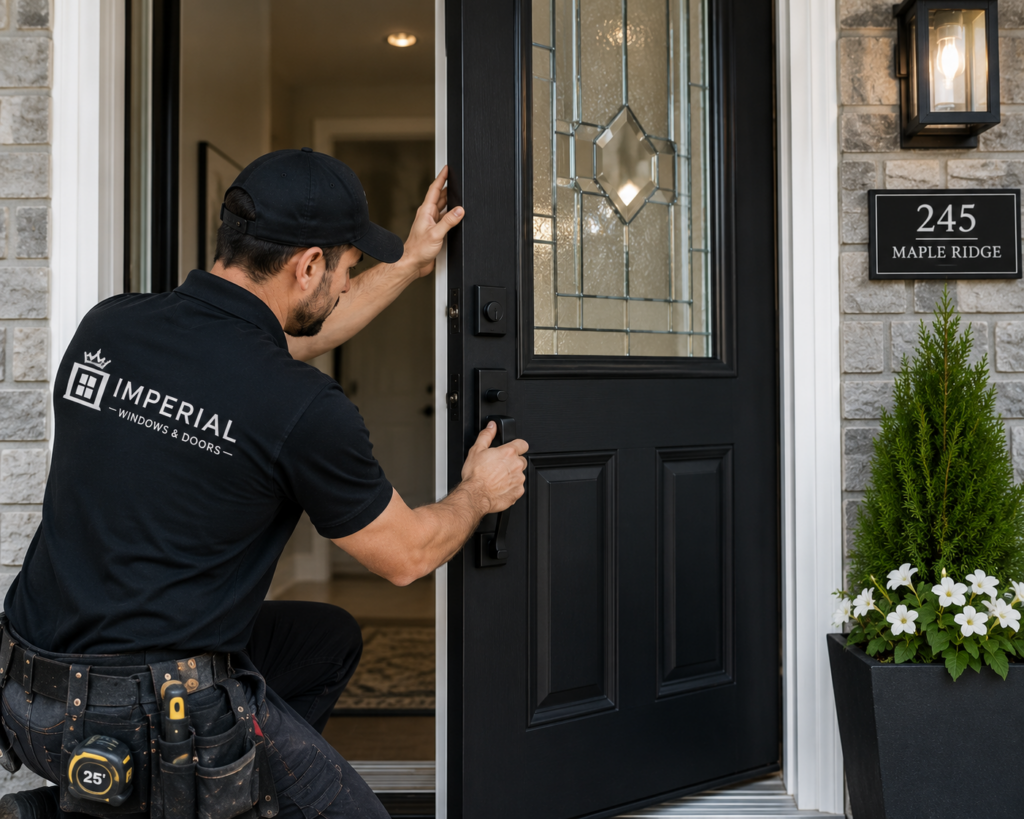
Before the project is complete, your installer should perform a full inspection.
This includes checking:
The goal is to leave your new entry door looking great and performing exactly as it should from day one.
✅ Pro Recommendation: Open and close your new door several times before the installer leaves. If anything doesn't feel right, it's much easier to make adjustments immediately.
Once your new entry door is installed, you'll notice improvements almost immediately.
Many homeowners experience:
Modern entry doors require very little maintenance, and with proper care they can provide decades of reliable performance.
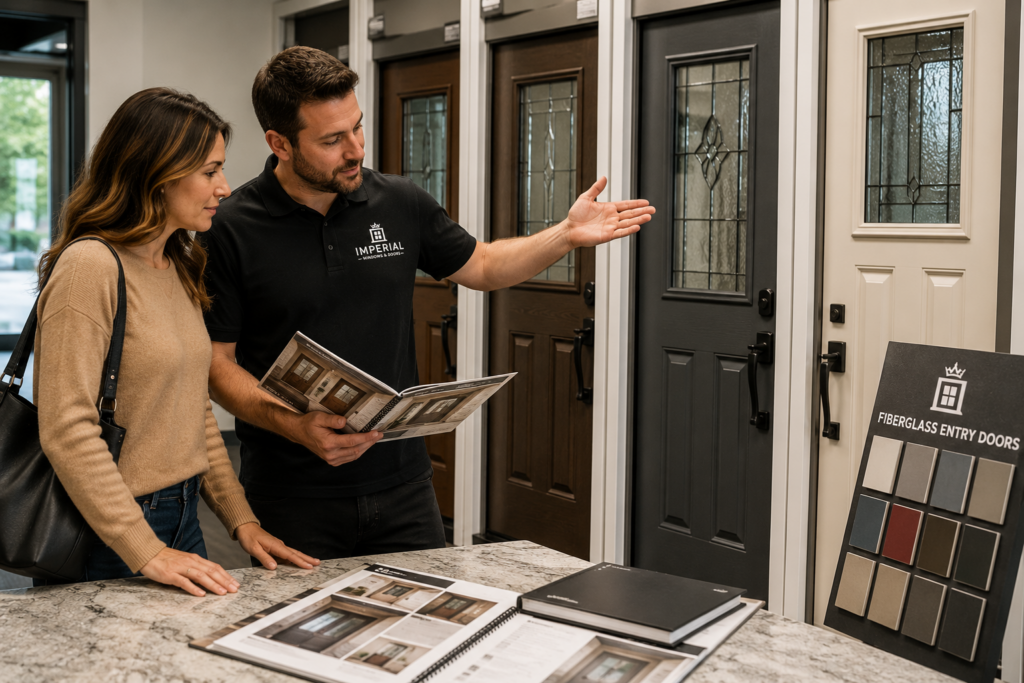
Replacing your front door isn't just about finding a style you like. The right door should complement your home's architecture, provide the level of security you need, improve energy efficiency, and fit your long-term maintenance expectations.
Taking a little extra time to compare your options can help you choose a door you'll be happy with for decades.
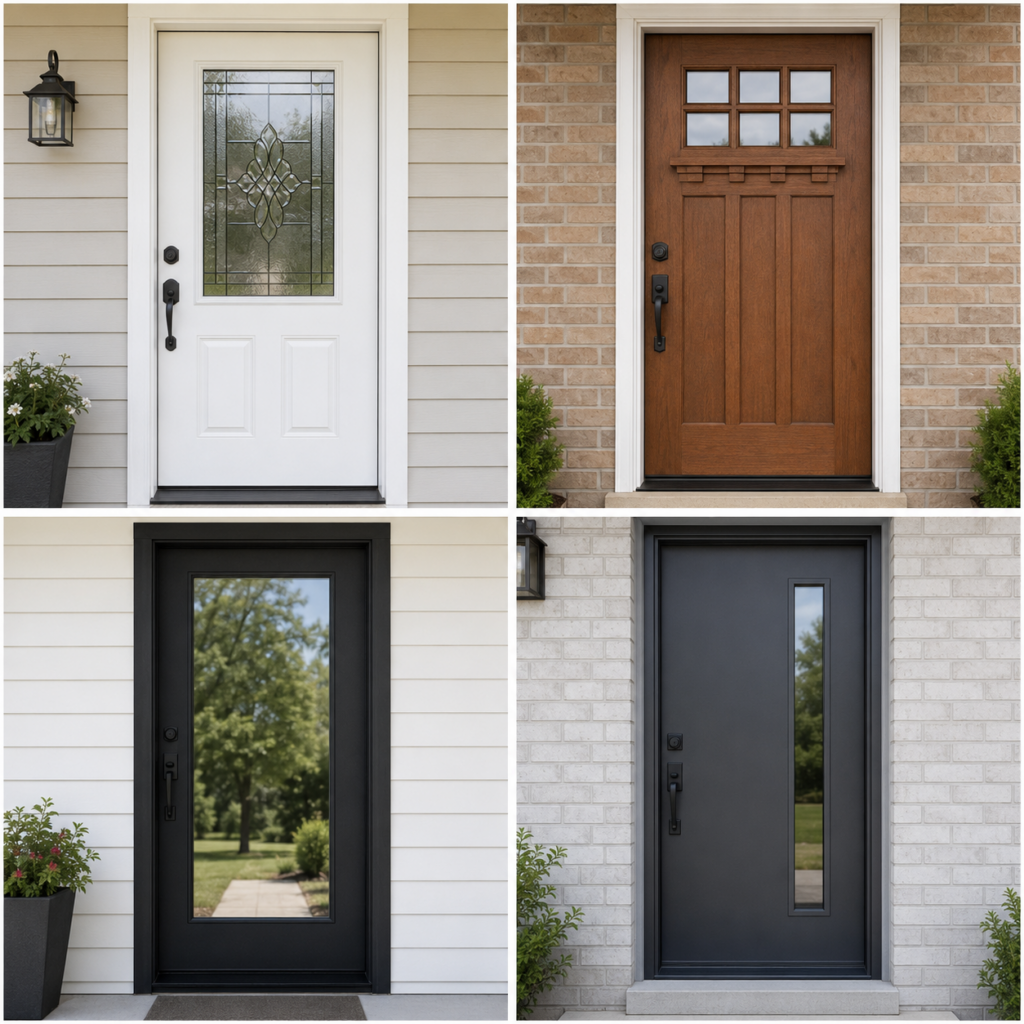
A new entry door should enhance the character of your home rather than compete with it.
For example:
Choosing a door that matches your home's style creates a more balanced appearance and can significantly improve curb appeal.
🏡 Toronto Climate Tip: Dark exterior colours are increasingly popular across the GTA, but quality factory finishes are especially important because they better withstand years of sun, rain, snow, and temperature swings.
Every family uses their front entrance differently.
Ask yourself:
The answers can influence everything from the type of finish you choose to the size of the glass inserts and the style of hardware.
For busy households, durability is often just as important as appearance.
Glass inserts can dramatically change both the look of your home and the amount of daylight entering your foyer.
Some homeowners prefer maximum privacy with solid panels, while others enjoy bright entryways with larger decorative glass designs.
Popular options include:
Modern energy-efficient glass provides excellent insulation, so adding decorative glass doesn't necessarily mean sacrificing comfort.
💡 Expert Tip: If privacy is important, consider decorative, frosted, rain, or satin glass instead of clear glass. These options allow natural light inside while limiting visibility from outside.
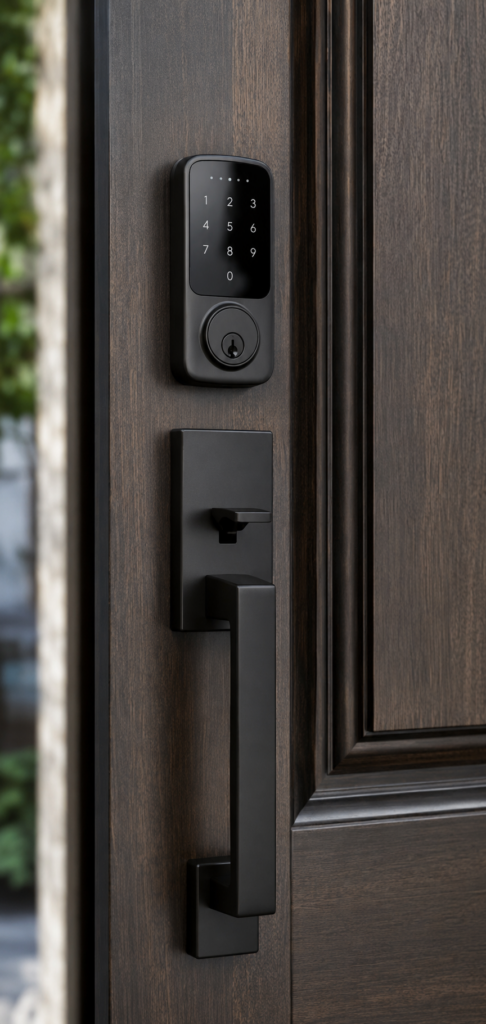
The right hardware is the finishing touch that brings your entry door together.
Popular finishes include:
Many homeowners are also choosing smart locks that offer:
Select hardware that complements both your home's style and your daily routine.
🔒 Security Insight: Multi-point locking systems provide additional protection by securing the door at multiple points instead of relying on a single deadbolt.
Different door materials require different levels of care.
If you're looking for the easiest option to maintain, fiberglass and steel doors generally require very little upkeep beyond occasional cleaning and simple hardware maintenance.
Wood doors offer timeless beauty but typically require more frequent refinishing to protect them from moisture and changing weather conditions.
Thinking about maintenance before purchasing your door can help you avoid unexpected work and costs later.
🛠️ Maintenance Tip: Factory-finished fiberglass doors typically retain their appearance much longer than painted wood doors exposed to Ontario's weather.
The least expensive door isn't always the best investment.
Instead of focusing only on the purchase price, consider the overall value the door provides through:
A quality entry door can continue adding value to your home long after installation.
✅ Pro Recommendation: Choose the best quality door that fits your budget rather than selecting the lowest-priced option. A well-built, properly installed entry door usually delivers better long-term performance and fewer future repairs.
A strong-looking front door does not automatically mean a secure one. In many homes, the weakest point is not the door slab itself—it is the lock, strike plate, frame, glass, or the way everything was installed.
When choosing a new entry door, it is worth looking at the entire system rather than focusing only on appearance. A well-built fiberglass or steel door can provide excellent protection, but only when it is paired with reliable hardware and a properly reinforced frame.
The deadbolt is one of the most important parts of any entry door. A good deadbolt should extend deeply into the frame and operate smoothly without requiring you to pull or push the door into position.
When the lock feels tight, sticks, or only turns when pressure is applied to the door, it can be a sign that the slab, frame, or strike plate is not properly aligned.
A high-quality deadbolt should include:
Decorative hardware matters, but the internal construction of the lock is far more important than the shape or finish.
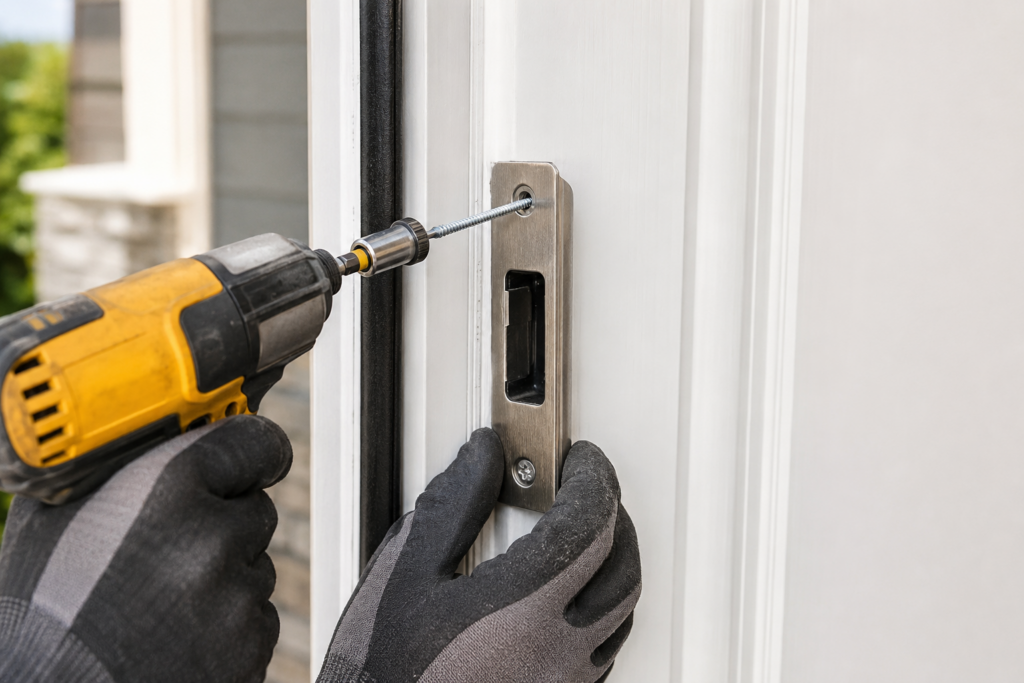
The strike plate is the metal component attached to the frame where the deadbolt enters. Standard strike plates are sometimes installed with short screws that only grip the thin door jamb.
A reinforced strike plate uses longer screws that extend into the wall framing behind the jamb. This creates a much stronger connection and makes it more difficult for the frame to split under force.
🔒 Security Insight: A premium door with a weak strike plate can still be vulnerable. The lock, strike plate, frame, and installation should all work together as one system.
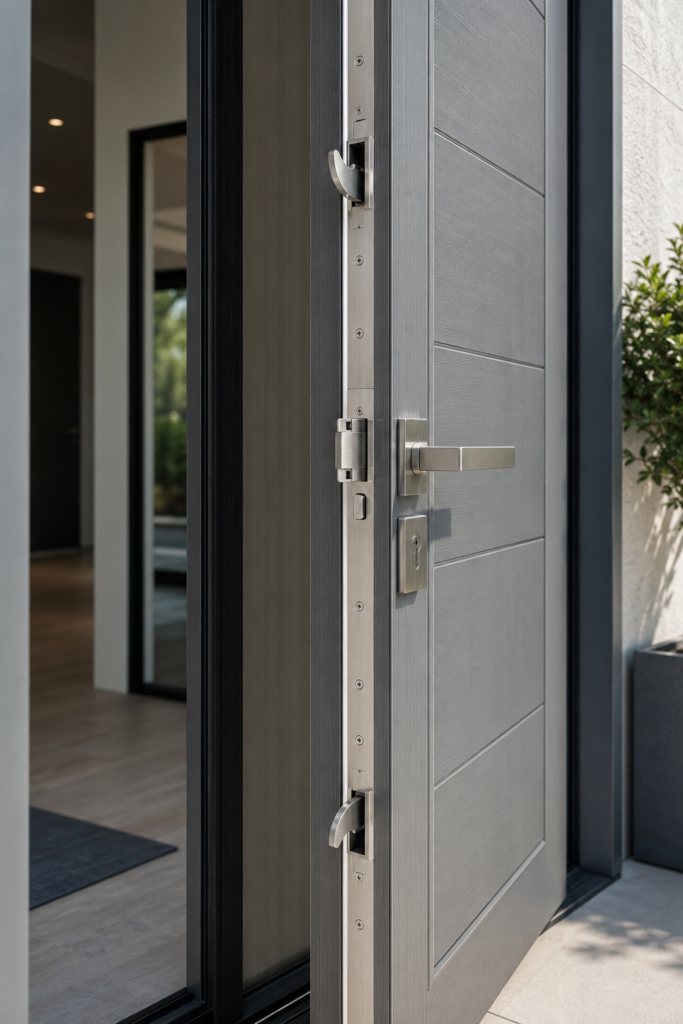
A multipoint lock secures the door at more than one location, usually near the top, centre, and bottom of the slab. Instead of relying on a single deadbolt, the locking mechanism engages several points along the frame.
Multipoint systems can offer several advantages:
They are especially useful for taller doors, wider slabs, double-door systems, and entry doors with large glass inserts.
One detail homeowners should understand is that some multipoint systems require the handle to be lifted before the key or thumb turn can engage the locks. This is normal for that type of hardware, but the installer should explain how it operates before leaving.
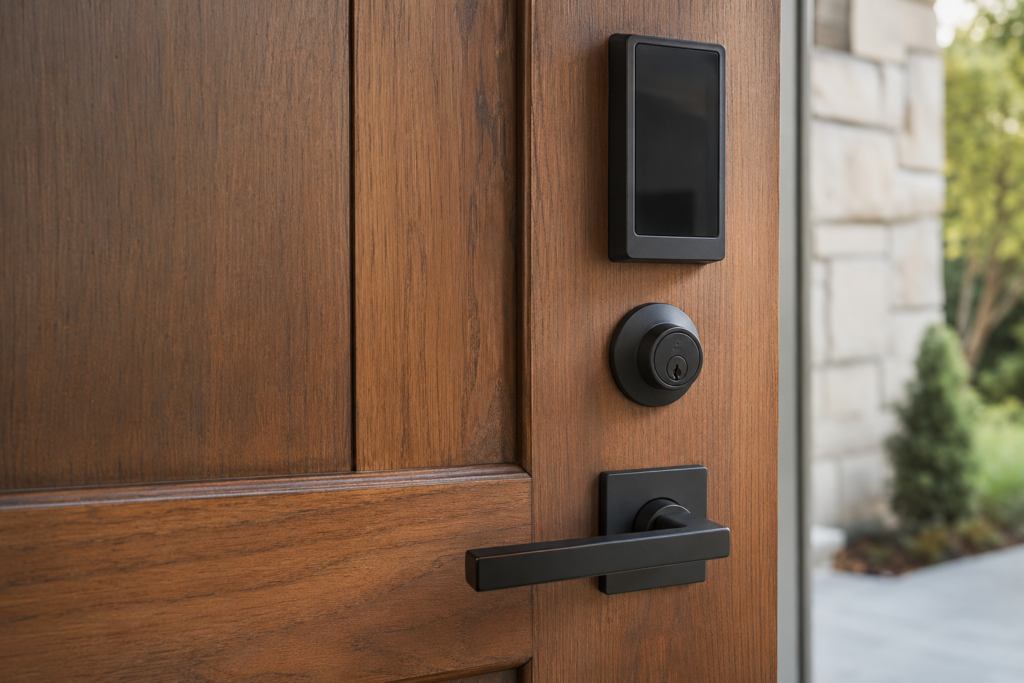
Smart locks have become increasingly popular because they allow homeowners to unlock the door using a keypad, smartphone, fingerprint, or temporary access code.
They can be especially useful for:
The best smart lock is not necessarily the model with the most features. It should be reliable, easy to use, compatible with the door hardware, and capable of operating properly during cold Canadian winters.
Battery performance is also important. Toronto temperatures can affect battery life, so homeowners should choose a lock designed for exterior use and replace the batteries before they become fully depleted.
💡 Expert Tip: A smart lock should improve convenience, not create unnecessary complexity. Choose a system that still allows reliable manual access in case the batteries or electronics fail.
The frame supports the hinges, lock, strike plate, and weatherstripping. If the frame is damaged, poorly secured, or out of square, even a strong door may not perform properly.
During installation, the frame should be:
A secure installation also prevents the slab from shifting over time, which can cause the lock to become difficult to operate.
This is one reason full-frame replacement may be the better choice when the existing jamb is damaged, rotted, twisted, or poorly installed.
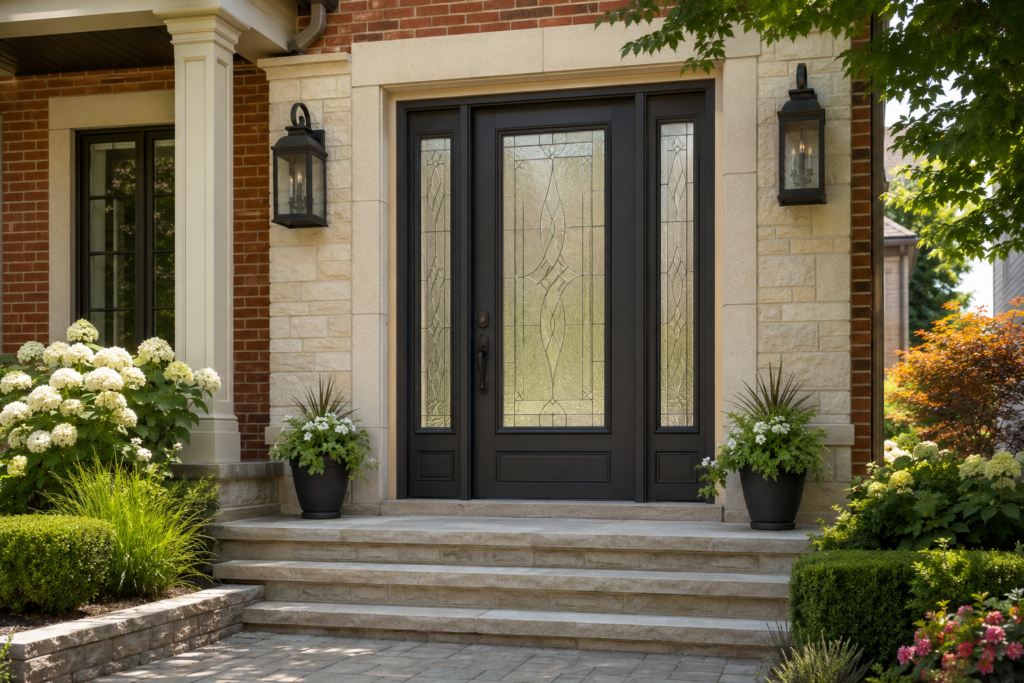
Many homeowners want natural light without making the entrance feel exposed. Decorative glass, sidelights, and door inserts can still be used safely when the glass package is designed properly.
Security-conscious options may include:
Laminated glass contains an inner layer that helps hold the glass together if it is broken. It does not make the opening completely indestructible, but it can make entry more difficult and time-consuming.
For homeowners who want privacy, textured or obscure glass can allow daylight into the foyer while limiting visibility from outside.
The hinge side of the door should not be overlooked. Quality exterior hinges and properly installed hinge screws help support the slab and keep it aligned.
For doors that swing outward, security hinges or non-removable hinge pins may be recommended so the pins cannot easily be removed from the exterior.
Heavy fiberglass and steel doors also require the correct number of hinges. If the hinges are undersized or poorly positioned, the door may sag and place stress on the locking system.
Double-door systems require additional planning because one slab is often secured with flush bolts while the active slab uses the main lock.
The inactive door should lock securely at both the top and bottom. The meeting point between the two slabs must also be properly aligned and sealed.
Sidelights can create a beautiful entrance, but the frame surrounding them should be securely anchored. When the door and sidelights are installed as one complete system, the entire unit can be reinforced and aligned more effectively than a collection of separate components.
Matte black, satin nickel, brass, and bronze hardware can all look excellent, but the finish should not be the only consideration.
Before choosing a handle set, homeowners should ask:
Premium hardware should feel solid when operated. Loose handles, excessive movement, and thin internal components can reduce the lifespan of the system.
Even the best lock and strongest door can underperform when installed incorrectly. A secure entry door should close evenly, latch without force, and remain aligned through changing temperatures.
The installer should test:
✅ Pro Recommendation: Treat the entry door as a complete security system. The slab, lock, frame, glass, hinges, and installation are all equally important.
A secure door should not feel difficult to use. It should close smoothly, lock easily, and provide confidence every time you leave the house or go to sleep.
The design of an entry system involves more than choosing a door colour or glass pattern. The size and layout of the opening can completely change how the entrance looks, how much light enters the home, and how comfortably people move through it.
Some homes are best suited to a simple single door. Others have enough space for sidelights, a double-door system, or a transom above the door. The right choice depends on the existing opening, the architecture of the home, and how the entrance is used every day.
Before changing the configuration, it is important to understand what each option offers and what may be involved in the installation.
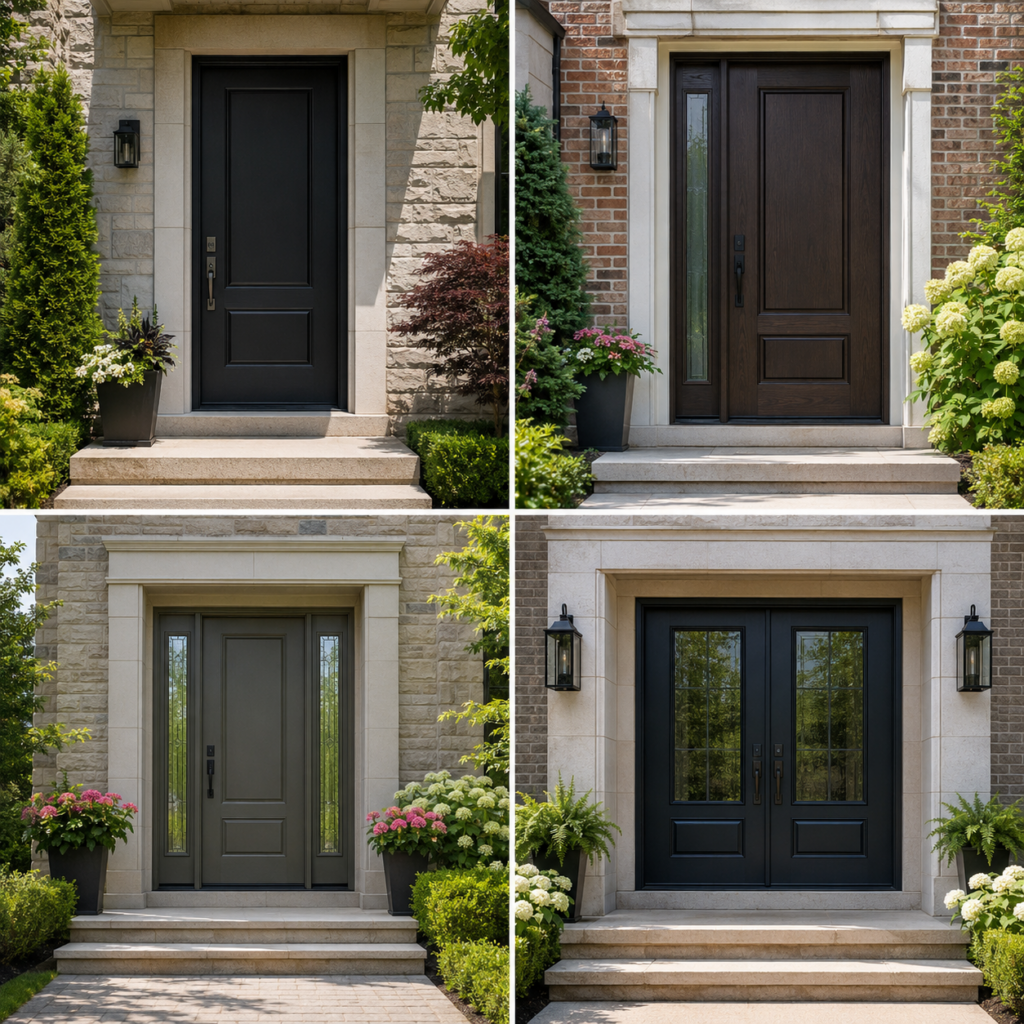
A single entry door is the most common configuration found in Toronto and GTA homes. It works well for townhouses, semi-detached homes, bungalows, and detached houses with a standard-sized entrance.
Single doors are available in many widths, heights, materials, colours, panel designs, and glass configurations. They can be simple and traditional or large and modern, depending on the surrounding architecture.
The main advantages include:
A standard single door can still create a dramatic entrance. Taller slabs, oversized pull handles, bold colours, decorative glass, or surrounding stonework can provide plenty of visual impact without requiring a double-door opening.
For many homeowners, keeping the existing single-door configuration is the most practical option because it avoids unnecessary structural changes.
A sidelight is a narrow glass section installed beside the door. A single sidelight can be placed on either the handle side or hinge side, depending on the existing opening and design of the home.
This configuration is useful when homeowners want more daylight without making the entrance feel overly large.
A single sidelight can also help balance an entrance that is positioned slightly off-center. For example, the glass can visually connect the front door to a nearby window, garage, or architectural feature.
When deciding which side should contain the sidelight, consider:
A carefully positioned sidelight can make a narrow foyer feel brighter and more open while preserving enough solid wall space inside the home.
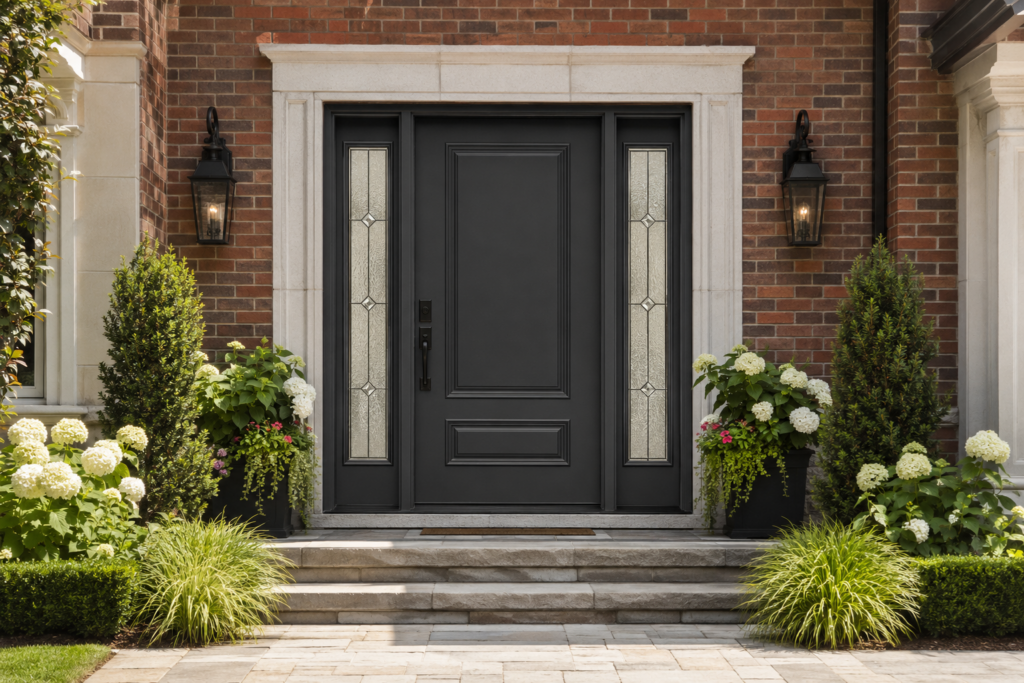
A door with sidelights on both sides creates a wider and more symmetrical entrance. This layout is common in larger detached homes and houses with a centered front façade.
Two sidelights can make a standard door appear more substantial without introducing the additional hardware and operation required by double doors.
This configuration works especially well when:
The width of the sidelights should be proportional to the door. Narrow sidelights can add subtle detail, while wider glass sections create a brighter and more open entrance.
Privacy should still be considered. Clear glass may look beautiful in a showroom, but decorative, textured, tinted, or internal-blind options may be more comfortable in a home facing a busy street.
🏡 Toronto Home Tip: Many GTA homes are built close to sidewalks, neighboring properties, or shared driveways. Look at the entrance from the street before selecting clear sidelight glass. What feels private from inside the showroom may feel very exposed once installed.
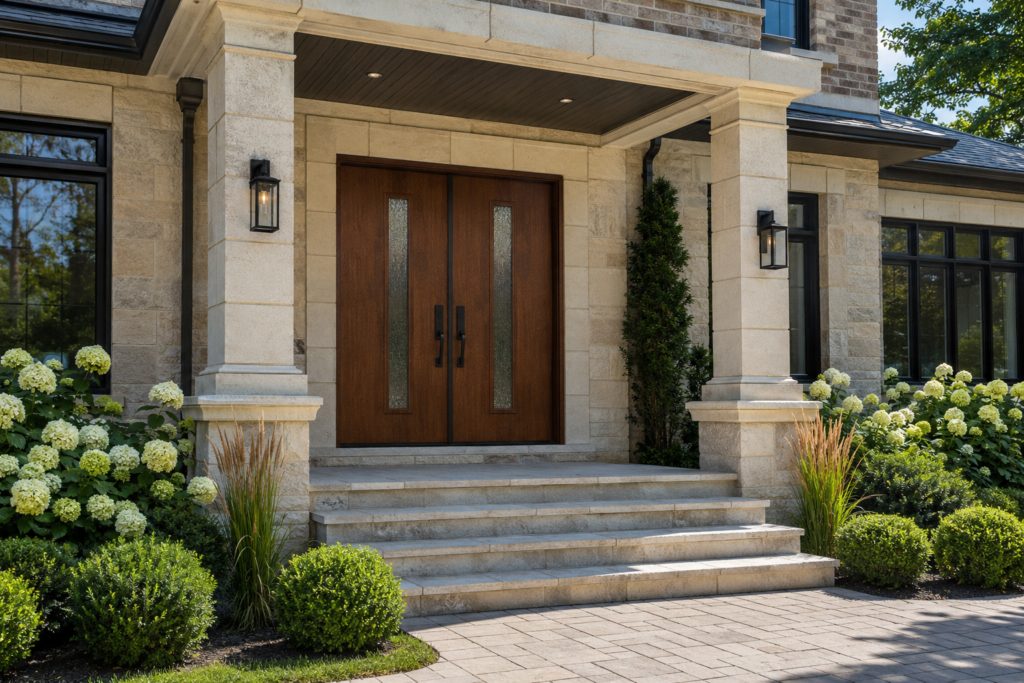
Double entry doors create a wide, impressive opening and can make it easier to move large furniture, appliances, and renovation materials into the home.
In most double-door systems, one slab acts as the primary door for daily use. The second slab remains secured until the full opening is needed.
Double doors are often suitable for:
The proportions matter. Double doors can look out of place when squeezed into a narrow façade, but they can look exceptionally balanced when the entrance was designed for them.
Homeowners should also consider how much space is available inside. Both slabs require adequate clearance to open without hitting furniture, walls, closets, or stair railings.
Unlike a single door with sidelights, both sides of a double-door system can open. This provides a wider usable opening, but it also introduces more hinges, alignment points, seals, and hardware that must be installed correctly.
These configurations can appear similar from the street, but they function very differently.
A double-door system provides two operable slabs. A door with sidelights has one operable slab surrounded by fixed glass panels.
A single door with sidelights may be the better choice when the homeowner wants:
Double doors may be preferable when the homeowner needs:
There is no universal winner. The best option depends on the size of the opening and whether the extra operable width will actually be used.
💡 Expert Tip: Do not choose double doors only because they look luxurious in photographs. Measure the interior foyer and think about normal traffic flow. A well-proportioned single door with sidelites can look just as impressive and may perform better for the way the home is used.
A transom is a window installed above the door. It can be rectangular, arched, or shaped to follow the design of the entrance.
Transoms are especially valuable in tall entrance openings because they allow the door system to fill the space without requiring an unusually tall and heavy slab.
They can provide:
A transom can be installed above a single door, a door with sidelites, or a complete double-door system.
The glass design should coordinate with the rest of the entrance. A highly decorative transom combined with unrelated door glass can make the system feel too busy. In many cases, repeating one pattern, texture, or finish creates a cleaner result.
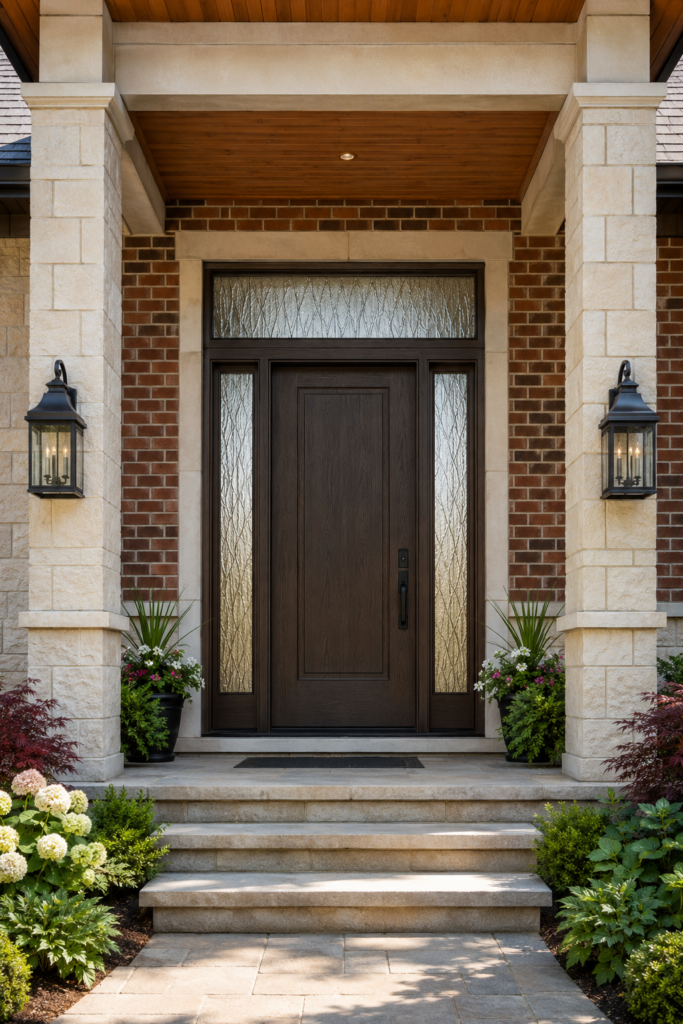
Tall entry doors have become popular in modern and custom homes. An eight-foot door can create a dramatic appearance, especially when paired with high ceilings and a large exterior overhang.
However, taller doors require careful planning.
The slab is heavier, the hinges carry more load, and the frame must remain properly aligned. Hardware placement should also feel comfortable for everyday use rather than being positioned only for appearance.
Before selecting an oversized door, consider:
A taller door does not automatically improve the entrance. It works best when the surrounding architecture supports the additional height.
Some homeowners want to replace a single door with double doors, remove sidelites, add glass panels, or make the entrance wider.
These changes may be possible, but they are more involved than replacing one door system with another of the same size.
Changing the configuration may affect:
Before ordering the door, the installer should determine whether the existing opening can accommodate the proposed configuration without major structural work.
It is also important to distinguish between changing the appearance within the same overall frame size and physically enlarging the opening. Replacing two narrow sidelites with wider ones may be possible within the existing dimensions. Expanding the entire entrance into the wall is a different type of project.
⚠️ Common Mistake: Never order a new door configuration based only on the visible size of the current slab. The complete frame, sidelites, transom, brick opening, interior trim, and structural conditions must all be measured.
Door swing is an important part of choosing the configuration.
Most residential entry doors swing inward, but the hinge side can sometimes be changed depending on the layout. The correct swing should provide a clear path into the home without interfering with walls, closets, furniture, or stairs.
Think about where people naturally stand when entering and whether the door blocks part of the foyer when open.
The handle side should also be convenient from the exterior. A poorly planned swing can make visitors step around railings, landscaping, columns, or narrow porch areas to reach the handle.
For double doors, determine which slab will be active. The active door should align with the main walkway and provide the most natural route into the home.
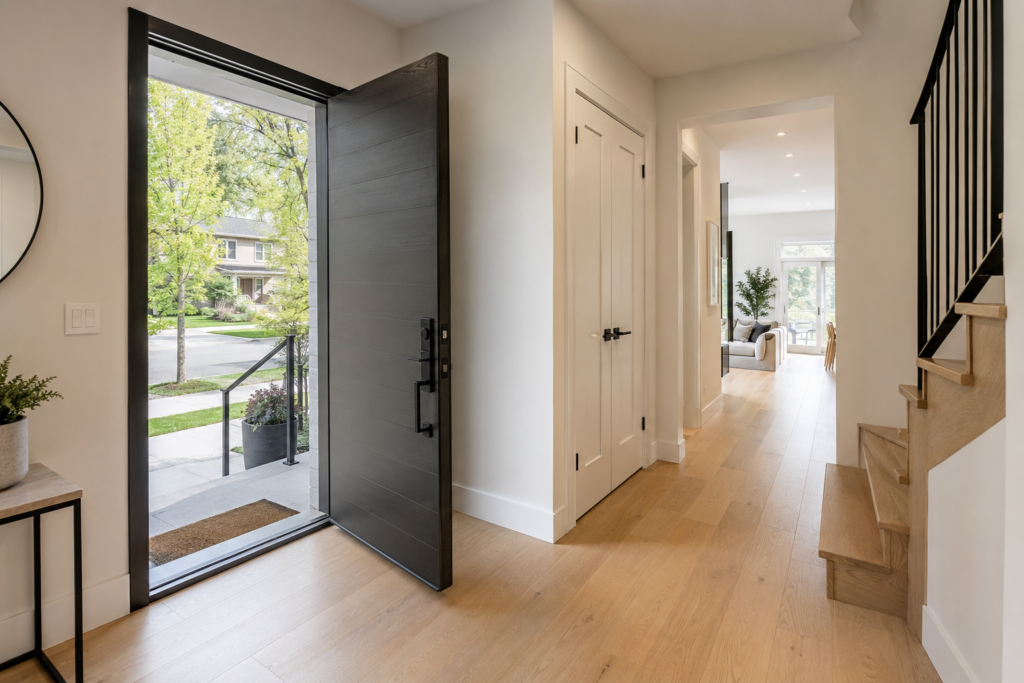
An attractive entry should also be comfortable to use.
Homeowners may want to consider a wider primary slab, a low-profile threshold, easy-to-operate hardware, and adequate clearance around the door. These details can make the entrance more convenient for children, older adults, people carrying groceries, strollers, or anyone with limited mobility.
A wider door is not only useful for major furniture deliveries. It can make everyday movement noticeably easier.
Where accessibility is a priority, the complete entrance should be assessed—including the steps, landing, threshold, handle height, door weight, and available turning space.
A successful entrance should look like it belongs to the house.
Large double doors may overpower a modest façade. A narrow basic door may appear undersized on a wide custom home. Sidelites and transoms can help bridge the difference by adding width and height without making the door itself unnecessarily large.
The best configuration usually reflects the proportions already present in the home:
✅ Pro Recommendation: Choose the entry configuration before finalizing the colour, glass, and hardware. The shape and proportions of the complete system will have a greater effect on the home’s appearance than any single decorative feature.
A properly planned entrance should feel balanced from the street, comfortable from inside the foyer, and practical every time the door is used.
Two entry door quotes can look similar at first glance while covering very different products and levels of installation. One contractor may provide a basic door replacement, while another includes custom sizing, upgraded glass, new exterior trim, interior finishing, disposal, and structural corrections.
That is why the total price should never be the only thing you compare.
A useful quote should clearly explain what door is being supplied, what work will be completed, which materials are included, and what may cost extra. The more complete the quote is before the order is placed, the less likely you are to face surprises during installation.

The quote should identify the actual door being ordered rather than using a vague description such as “fiberglass entry door” or “new front door.”
Important specifications may include:
These details allow you to confirm that each company is quoting a comparable product.
For example, a white door with no glass may cost considerably less than a painted woodgrain door with decorative glass and matching sidelites. If one quote does not list these details, it may appear less expensive simply because it includes a more basic configuration.
⚠️ Common Mistake: Do not assume that a colour, glass insert, handle set, or exterior trim shown in a salesperson’s sample is automatically included in the quoted price. Every selected upgrade should appear in writing.
Many Toronto-area homes do not have perfectly standard door openings. Older houses may have shifted frames, unusual brick openings, oversized sidelites, narrow slabs, or custom transoms.
A quote should explain whether the replacement door is:
Custom sizing can provide a cleaner fit and preserve more of the usable opening, but it may also affect the price and manufacturing time.
Be cautious when a contractor provides a final price without taking accurate measurements. Preliminary pricing can be helpful, but the door should not be ordered until the complete opening has been properly assessed.
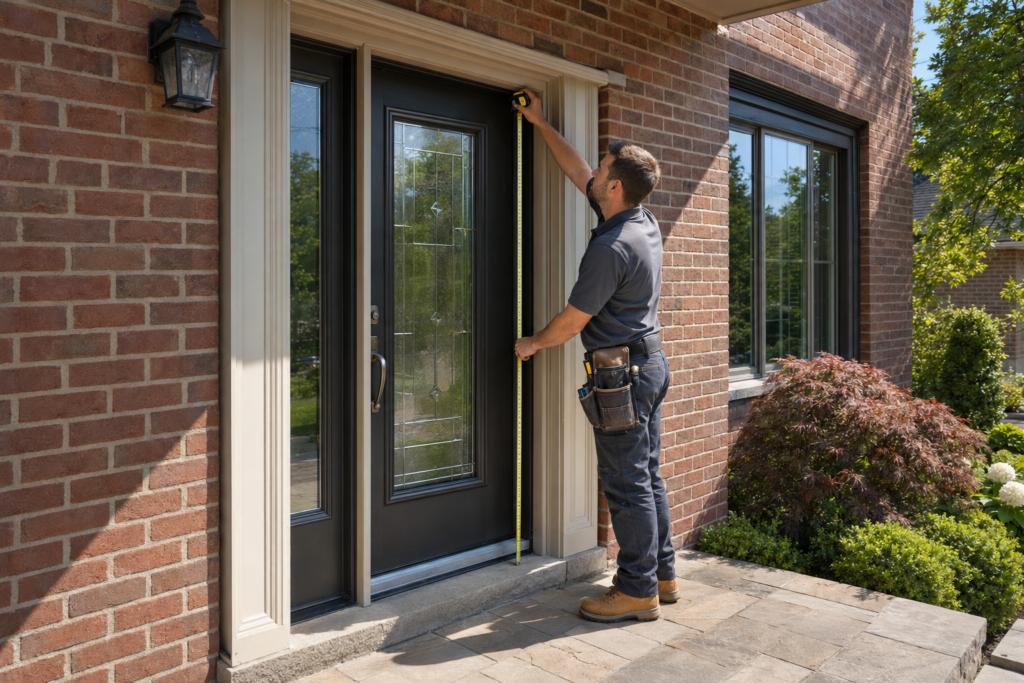
The phrase “installation included” can describe very different scopes of work.
A complete installation quote should clarify whether it includes:
Some contractors may install the new unit but leave interior trim, painting, drywall repair, alarm connections, or masonry work for the homeowner to arrange separately.
There is nothing wrong with exclusions when they are clearly explained. Problems arise when homeowners assume certain work is included and discover otherwise on installation day.
The finishing work around the door has a major effect on the final appearance.
On the exterior, ask whether the quote includes new brickmould, aluminum capping, caulking, or other finishing materials. If the new frame is narrower or wider than the old one, additional trim may be required to cover the surrounding opening properly.
Inside the home, determine whether the existing casing will be reused or replaced. Reusing trim can sometimes reduce costs, but old casing may crack during removal or may not fit the dimensions of the new frame.
The quote should also explain whether painting, staining, drywall repair, or touch-up work is included.
A professionally installed door should not look unfinished once the main installation is complete. Any work that remains should be discussed before the project begins.
Door hardware is another area where quotes can differ significantly.
One quote may include a standard handle set, while another may price the door with hardware preparation only. Smart locks, decorative grip sets, multipoint systems, electronic keypads, and premium finishes may be additional.
Ask whether the quoted price includes:
Customer-supplied hardware should be checked for compatibility before installation. The door thickness, bore spacing, backset, lock preparation, and handle design must all match the new system.
💡 Expert Tip: Choose the hardware before the door is ordered whenever possible. Some locks and handle sets require specific factory preparation that may be difficult to modify after manufacturing.
Decorative glass can account for a significant portion of the price, particularly when the entrance includes large inserts, sidelites, or a transom.
The quote should identify:
Small differences in glass size can noticeably change the door’s appearance. A narrow top insert and a large full-length insert should not be treated as equivalent products when comparing prices.
The glass shown in a brochure should also be confirmed using the manufacturer’s exact name or model number. Similar-looking designs can differ in construction, privacy, and price.
A contractor cannot always see every condition until the existing door is removed. Rot, hidden water damage, deteriorated wood, damaged masonry, or an uneven subfloor may be concealed behind the frame.
However, the quote should explain how unexpected work will be handled.
Ask:
A reputable installer should not perform significant additional work and present an unexpected charge afterward without discussing it first.
📋 Quick Checklist: Any potential extra cost should be explained in advance whenever reasonably possible. Hidden conditions cannot always be predicted, but the process for approving additional work should be clear.
A door project may include more than one warranty.
The manufacturer may cover the door slab, frame, glass seal, finish, or hardware. The installation company may provide a separate warranty for workmanship.
Ask each contractor to clarify:
A long product warranty is useful, but it does not automatically mean all labour, shipping, refinishing, or replacement costs are included.
The warranty should be treated as part of the overall value—not just a number used in advertising.
The quote should show the deposit requirement, remaining balance, and when each payment is due.
Custom entry doors are manufactured specifically for the home, so a deposit is commonly required before the order is placed. However, the payment terms should still be clear.
Review:
Avoid relying on verbal payment arrangements. The written agreement should match what was discussed with the salesperson.
The lowest price may not be the best choice if the company cannot provide a realistic manufacturing and installation timeline.
Custom doors may require time for production, painting, glass assembly, quality control, and delivery. The contractor should provide an estimated range rather than promising an exact installation date before the product is ready.
Ask whether the timeline begins:
Weather, factory schedules, material availability, and custom finishes can affect timing. A realistic estimate is more valuable than an unrealistic promise made only to secure the sale.
A one-line quote may be easy to read, but it offers very little protection if questions arise later.
Be cautious when a quote does not clearly identify:
A professional quote does not need to be filled with complicated legal language. It should simply provide enough information for both parties to understand exactly what is being supplied and installed.
A lower quote may still be an excellent choice when it includes a suitable product and complete installation. A higher quote is not automatically better either.
The goal is to understand what you are receiving for the price.
Consider the complete package:
✅ Pro Recommendation: Place the quotes side by side and compare each category separately. When one price is significantly lower, identify exactly what is different before making a decision.
The best quote is usually the one that provides the right door for the home, clearly defines the work, and leaves the fewest unanswered questions.
An entry door may represent only a small portion of a home’s exterior, but it can have a noticeable effect on comfort near the foyer. When the door is poorly insulated, incorrectly adjusted, or allowing air to pass around the frame, the entrance may feel cold in winter, hot in summer, or uncomfortable during windy weather.
Energy performance depends on more than the material of the door slab. The glass, frame, weatherstripping, threshold, hardware alignment, and installation all influence how well the complete system performs.
For Toronto and GTA homeowners, the best entry door is one that remains tightly sealed through freezing winters, humid summers, heavy rain, and repeated seasonal temperature changes.
Homeowners frequently compare fiberglass and steel doors based on insulation value alone. However, even a well-insulated slab will not perform properly when outdoor air can enter around the perimeter.
Common signs of air leakage include:
Air leakage often develops when weatherstripping becomes compressed, the threshold is not properly adjusted, or the door shifts slightly out of alignment.
A good entry system should compress evenly against the seals on all sides without requiring excessive force to close.
🏡 Toronto Climate Tip: Wind can expose weaknesses that are not noticeable on calm days. A door may appear properly sealed during an inspection but still leak when strong winter winds press against a particular side of the house.
Modern fiberglass and steel entry doors are commonly built with an insulated core. This helps reduce heat transfer through the slab while keeping the door relatively lightweight and stable.
Fiberglass doors are often selected for their resistance to dents, moisture, and temperature-related movement. They are also available with convincing woodgrain finishes without requiring the maintenance associated with natural wood.
Steel doors can also provide strong thermal performance when the slab, edges, and frame are properly constructed. They offer a clean surface and are often a practical choice for homeowners who want a painted finish.
The difference between two door systems may come from more than whether one is fiberglass and the other is steel. Performance can also vary based on:
That is why it is better to evaluate the complete entry system instead of choosing solely by material.
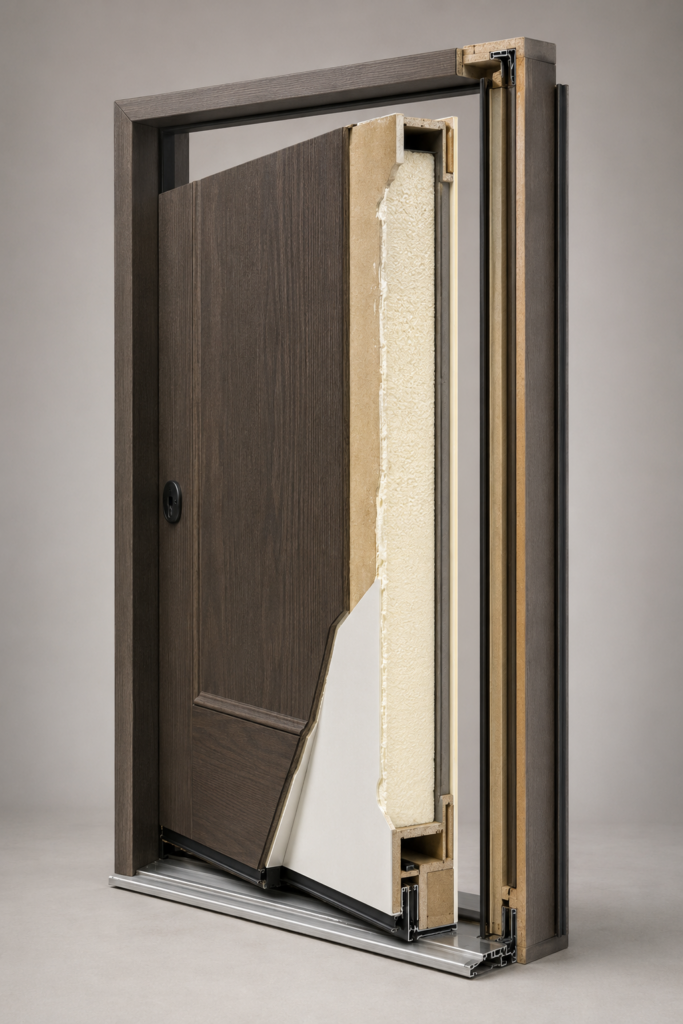
Glass can make an entrance brighter and more attractive, but larger glass inserts generally allow more heat transfer than a mostly solid insulated slab.
This does not mean homeowners should avoid door glass. It means the glass should be selected carefully based on the entrance location and the amount of natural light desired.
Important considerations include:
A small upper insert will usually have less effect on thermal performance than a full-lite door with large sidelights. However, high-quality glass packages can still provide good comfort while allowing plenty of daylight.
The goal is to find the right balance for the home rather than automatically choosing the smallest or largest glass option.
Low-emissivity glass contains a thin coating designed to reduce heat transfer while still allowing visible light through.
During winter, it can help reduce heat loss through the glass. During warmer months, the correct glass package can help control some of the heat entering through the entrance.
The effect will depend on the complete glass construction and the direction the door faces.
A west-facing entrance may receive strong afternoon sun, while a north-facing entrance may remain shaded and feel colder in winter. These two homes may benefit from different glass sizes or performance priorities.
💡 Expert Tip: Choose door glass based on the actual exposure of the entrance. Sunlight, shade, porch depth, nearby trees, and the direction the home faces can all affect comfort.
Sidelights and transoms can transform a dark foyer, but they also increase the amount of glazing in the entry system.
When a home has a large door, two sidelights, and a transom, the glass should be treated as one complete package. Selecting high-quality glass only for the door insert while using a basic option in the sidelights may create uneven performance.
The glass design should also align properly across the complete entrance. Matching privacy levels, coatings, decorative patterns, and frame colours creates a cleaner appearance and more consistent comfort.
For homeowners concerned about heat loss, it may be possible to use narrower sidelites, reduce the total glass area, or select a more efficient glazing package without giving up natural light entirely.
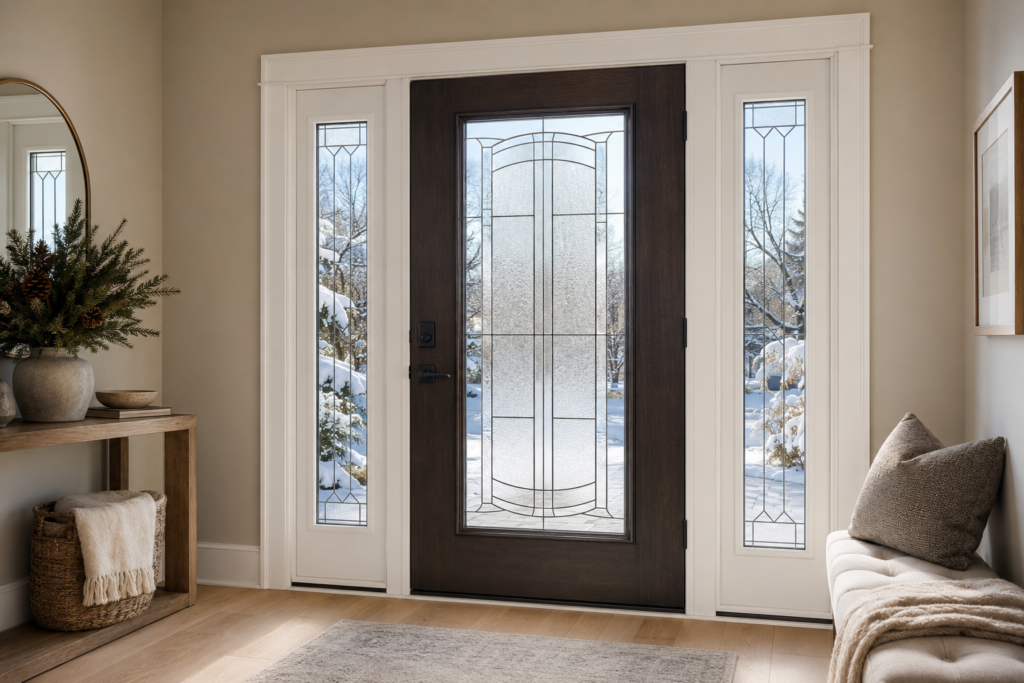
Weatherstripping creates the flexible seal between the door slab and the frame. When the door closes, the slab should press gently and evenly against this material.
If the seal is too loose, air and water may enter. If it is too tight, the door may become difficult to latch or lock.
Good weatherstripping should:
The corners are especially important. Even a small gap where the vertical seal meets the threshold can create a noticeable draft.
🛠️ Maintenance Tip: Inspect the weatherstripping at least once a year. Look for cracking, flattening, tears, loose sections, or areas where daylight is visible.
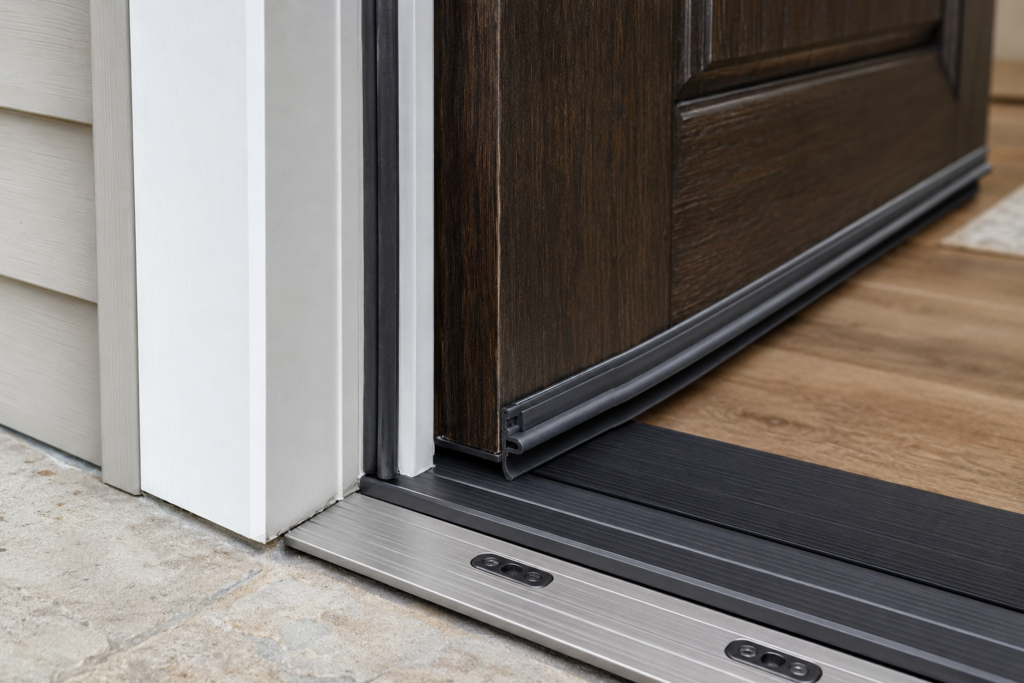
The bottom of an entry door is one of the most common places for air and water leakage.
The threshold forms the base of the opening, while the door sweep or bottom seal closes the space beneath the slab. These components must work together.
A properly adjusted threshold should provide enough contact to block drafts without dragging heavily against the door.
Problems can develop when:
Exterior grading and porch drainage also matter. A door system is not designed to compensate for water continuously collecting against the threshold.
⚠️ Common Mistake: Do not automatically raise the threshold every time a draft appears. The real issue may be slab alignment, damaged weatherstripping, a worn sweep, or movement in the frame.
Dark entry doors can create a bold, modern appearance, but they absorb more solar heat than lighter colours.
This is especially important for doors exposed to strong afternoon sun or installed behind a storm door. Heat can become trapped between the two doors, creating very high surface temperatures.
Before selecting a dark finish, consider:
A black or charcoal door may perform perfectly well in the right location. The concern is not the colour alone—it is the combination of colour, sun exposure, ventilation, and door construction.
Moisture on the interior glass or hardware can occur when warm, humid indoor air contacts a colder surface.
This is more common during very cold weather, especially when indoor humidity is high. Cooking, showers, humidifiers, drying laundry indoors, and large numbers of houseplants can all raise moisture levels.
Condensation may appear on:
A small amount of temporary condensation during extreme weather may be related to indoor humidity rather than product failure.
However, persistent water between sealed glass panes, moisture entering from outside, or repeated water damage around the frame should be inspected.
📋 Quick Checklist: When condensation appears, check where the moisture is located. Water on the room-side surface, between the panes, and around the exterior frame can indicate three different issues.
A door can be performing properly while the foyer still feels cooler than the rest of the house.
This may happen when:
Entry doors are opened repeatedly, allowing outdoor air into the home. No door can prevent this temporary heat loss while it is open.
The goal is to reduce unnecessary leakage when the door is closed and help the entrance return to a comfortable temperature quickly.
Homes and building materials respond to changes in temperature and humidity. A door that operates perfectly in spring may feel slightly tighter or looser during another season.
Minor adjustment may occasionally be required, particularly during the first year after installation.
Possible changes include:
These issues do not necessarily indicate a major defect. However, they should be corrected before they place unnecessary stress on the lock or allow air to pass around the frame.
A door should never need to be slammed, lifted, or pulled forcefully to lock.
Homeowners can perform a simple visual and physical inspection without removing any components.
With the door closed and locked:
Avoid using an open flame to check for drafts. A tissue or lightweight piece of paper can provide a safer indication of moving air.
If the paper moves noticeably near one specific area, the door may need adjustment or resealing.
An energy-efficient entrance does not have to look basic.
Homeowners can still choose:
The key is to select the complete system carefully.
A large glass entrance may be worth it for a dark foyer. A mostly solid door may make more sense for a shaded north-facing entrance. A deep covered porch may allow more flexibility than a door exposed directly to wind and rain.
✅ Pro Recommendation: Focus on air sealing, glass quality, weatherstripping, threshold design, and installation—not just the insulation value of the slab. The complete door system determines how comfortable the entrance will feel.
A properly selected and installed entry door should help keep the foyer comfortable, reduce drafts, and perform consistently through Toronto’s changing seasons.
Many Toronto homeowners assume they must wait until spring to replace an entry door. In reality, entry doors can often be replaced during the winter, provided the weather conditions are suitable and the installer uses materials designed for cold-weather applications.
Winter installation requires more planning than installation on a mild summer day, but it does not automatically mean your home will be left open to the cold for hours or that the new door will not seal properly.
The condition of the existing entrance should guide the decision. If the door is allowing major drafts, leaking water, failing to lock securely, or becoming increasingly difficult to operate, waiting several months may create more problems than arranging a properly planned winter replacement.
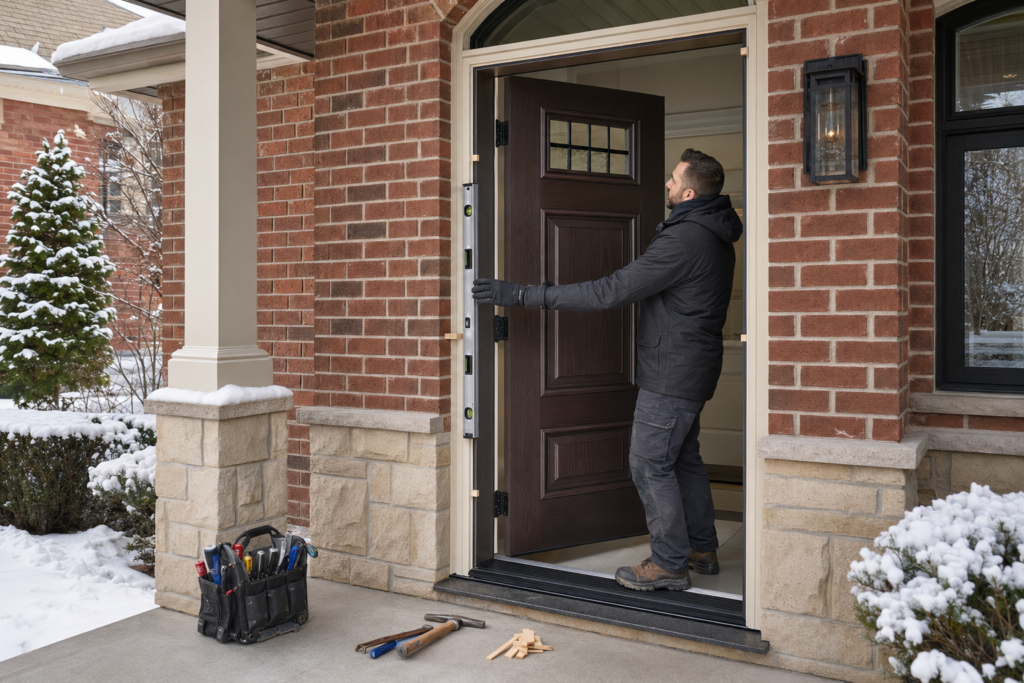
The calendar alone does not determine whether a door can be installed safely. The actual conditions at the home are far more important.
A winter installation may proceed normally when:
Installation may need to be delayed during extreme cold, strong winds, blowing snow, freezing rain, or any situation where the opening cannot be kept dry and frost-free.
The decision should be based on both safety and product requirements—not simply whether the temperature is below freezing.
🏡 Toronto Climate Tip: Winter conditions can vary significantly across the GTA. A calm, dry day below freezing may be more suitable for installation than a warmer day with heavy rain, wet snow, or strong wind.
There will be a temporary period when the old door and frame have been removed, allowing some outdoor air into the entrance. However, an experienced crew can reduce this exposure by organizing the project before opening the wall.
The new door, tools, insulation, fasteners, and finishing materials should be prepared before the existing system is completely removed. This allows the installers to position and secure the replacement unit without unnecessary delays.
Heat loss can also be reduced by:
The foyer may feel colder during the installation, but the temperature should begin recovering once the new door is positioned, insulated, and sealed.
💡 Expert Tip: Ask how the installer plans to stage the work during cold weather. A professional crew should have the new unit and required materials ready before fully exposing the opening.
The door itself is only one part of the installation. The materials used around the frame are equally important.
These may include:
Not every product can be applied at the same temperature. Some all-season window and door foams are manufactured for use below freezing, while other products require warmer conditions. Certain exterior sealants may also be applied in cold weather, but the surfaces must remain clean, dry, and free of frost.
For example, some cold-weather window and door foams are rated for applications well below freezing, while flashing and sealant manufacturers specify their own minimum temperatures, storage requirements, and surface-preparation instructions.
The installer should choose products based on the actual temperature and the materials surrounding the opening rather than using the same product for every season.
⚠️ Common Mistake: A product being labelled “exterior” does not automatically mean it can be applied in freezing temperatures. The manufacturer’s application instructions still need to be followed.
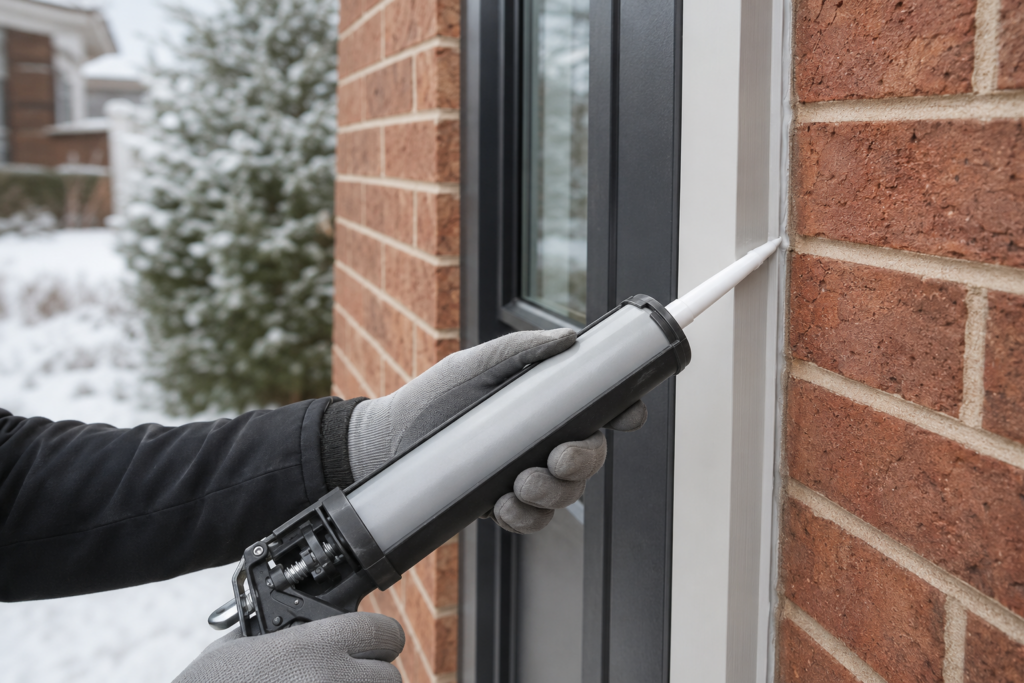
Cold weather itself is not always the biggest concern. Moisture and frost can create more serious installation problems.
Sealants, flashing tapes, and other materials may not bond properly when applied over:
The area around the door should be cleaned and inspected before sealing begins. Snow should not be trapped behind the brickmould, and exterior joints should not be caulked over visible frost.
Several building-envelope manufacturers specifically require installation surfaces to be clean, dry, and frost-free, even when the product itself is approved for cold-weather use.
This is one reason a dry winter day may be perfectly suitable while a wet day near the freezing point may not be.
A reputable installer should be willing to reschedule when conditions could affect safety or installation quality.
The project may need to be postponed when:
A short weather delay is better than forcing an installation under unsuitable conditions.
✅ Pro Recommendation: The installer should review both the weather forecast and the manufacturer requirements for the products being used. The lowest outdoor temperature is only one part of the decision.
Different components may have different storage and temperature requirements.
Some sealants, adhesives, foams, hardware, and finishing products may need to be stored or conditioned within a particular temperature range before application. The installer should follow the instructions for each product rather than assuming everything can be taken directly from a cold vehicle and used immediately.
The door system should also be protected from:
There is no single acclimation rule that applies to every door and installation material. Proper handling depends on the manufacturer, product type, finish, and weather conditions.
One benefit of a winter installation is that air-sealing problems may become noticeable immediately.
On a cold or windy day, the installer can check for:
The new door should close firmly without needing to be slammed. The weatherstripping should make consistent contact around the perimeter, and the lock should operate without requiring the homeowner to push, pull, or lift the slab.
Natural Resources Canada identifies caulking, gaskets, and weatherstripping as important parts of controlling air leakage around building components and exterior doors.
Homeowners do not need to make major changes, but a few preparations can make the installation safer and more efficient.
Before the installers arrive:
The installer should protect the nearby flooring and keep wet boots, snow, debris, and installation materials contained as much as reasonably possible.
📋 Quick Checklist: If the front entrance is the home’s only practical access point, discuss this beforehand so the crew can maintain a safe route when necessary.
Before the crew leaves, operate the door several times and inspect the entrance from both sides.
Check that:
The door may feel slightly firmer than an older, worn system because the new weatherstripping has not yet experienced years of compression. However, it should never require excessive force to close or lock.
Toronto homes experience substantial changes in temperature and humidity throughout the year. Minor movement can occur as the home and door materials respond to seasonal conditions.
When warmer weather arrives, check:
A small adjustment does not necessarily indicate a defective product or poor installation. However, it should be addressed before it causes the lock to bind, damages the weatherstripping, or creates an air gap.
Waiting may make sense when the replacement is purely cosmetic and the existing door remains secure, dry, and functional. Spring or fall may also offer a wider selection of suitable installation days.
However, waiting is not always the better choice when the current entrance has:
In these situations, a properly planned winter installation may be safer and more practical than continuing to use a failing entrance for several more months.
✅ Pro Recommendation: Do not postpone an urgent replacement simply because it is winter. Instead, choose an experienced installer who understands cold-weather materials, surface preparation, air sealing, and Toronto’s changing conditions.
An entry door installed during winter can perform just as reliably as one installed during a warmer season when the weather is suitable, the correct materials are used, and every part of the opening is properly prepared and sealed.
A storm door can add ventilation, protect the main door from everyday wear, and create an extra barrier between the home and the outdoors. However, it is not necessary for every entrance—and in some situations, installing one can create more problems than benefits.
Modern fiberglass and steel entry doors are already designed to handle exterior conditions when they are properly installed and maintained. A storm door should therefore be treated as an optional accessory rather than a requirement for making the entrance weather-resistant.
The right decision depends on how exposed the doorway is, how much ventilation the homeowner wants, the colour and material of the main door, and the amount of direct sunlight the entrance receives.
A storm door is installed outside the main entry door and usually includes glass, screen panels, or a combination of both.
Depending on the model, it may provide:
A storm door does not replace the need for a properly sealed main entry door. If the primary door is drafty, misaligned, or allowing water into the frame, installing a storm door over it will not correct the underlying problem.
The main entry system should still provide the insulation, security, and weather resistance.
A storm door may be a worthwhile addition when the entrance is exposed to frequent contact, wind-driven rain, or blowing snow.
It can also be useful for families who like to leave the main door open for ventilation while keeping children, pets, and insects inside or outside.
Homeowners may benefit from a storm door when:
A storm door can also protect decorative paint and hardware from direct contact, although the amount of protection will depend on its construction and how well it seals.
Many modern entry doors perform very well without an additional exterior door.
A storm door may offer limited practical value when:
In these cases, the storm door may add cost and maintenance without significantly improving the entrance.
Modern and contemporary homes also tend to look better with a clean, unobstructed entry door. A storm door frame can visually cover panel details, glass designs, hardware, and the finish of the main door.
💡 Expert Tip: Decide whether you want a storm door before finalizing the entry door design. Hardware, swing direction, brickmould dimensions, glass placement, and exterior trim can all affect compatibility.
A full-view storm door contains one large glass or screen panel with minimal framing.
This style works well when homeowners want to keep the main entry door visible. It is often paired with decorative fiberglass doors, woodgrain finishes, or large glass inserts.
Full-view models may use:
The advantage is that the storm door does not visually divide the entrance into several smaller sections.
The disadvantage is that seasonal glass and screen panels may need to be removed, stored, and reinstalled. Large glass panels can be heavy, so homeowners should consider whether they have a safe place to keep them when not in use.
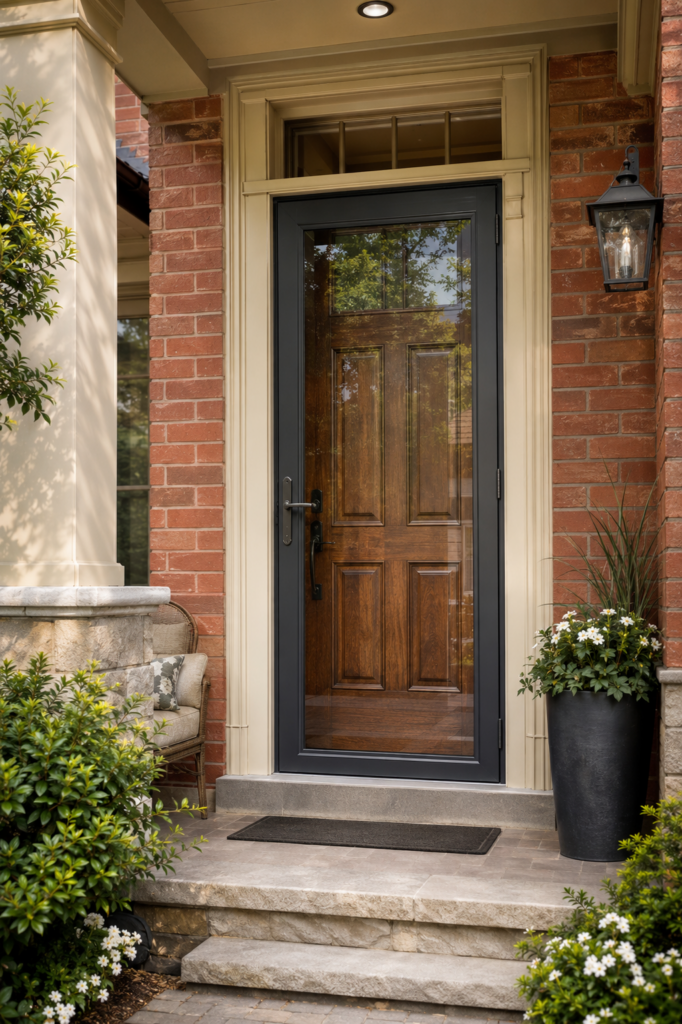
Ventilating storm doors normally have separate upper and lower sections. One section may slide or open to expose a screen.
These doors allow homeowners to adjust ventilation without removing a full glass panel.
They can be practical for busy family entrances because they are easy to operate and do not require seasonal panel storage. However, the additional rails and framing create a more traditional appearance and partially cover the main door.
This design may work well on:
The screen and sliding components should operate smoothly and be easy to repair or replace if damaged.
Some storm doors contain a screen that rolls into the frame when it is not in use. This provides ventilation without requiring the homeowner to remove and store a separate panel.
A retractable screen can create a cleaner appearance, but it introduces additional moving parts. The screen, track, springs, and rolling mechanism may eventually require adjustment or repair.
Before choosing this type, consider:
Convenience is the main advantage, but a simpler removable screen may be easier and less expensive to maintain over the long term.
One of the most important considerations is solar heat.
When direct sunlight passes through a glass storm door, heat can build up in the enclosed space between the storm door and the main entry door. This can create extremely high surface temperatures, especially when the main door has a dark finish.
The risk may be greater when:
Excessive heat may affect the door finish, weatherstripping, adhesives, glass components, or warranty coverage.
🏡 Toronto Climate Tip: A storm door may be helpful during cold or wet weather but still create high temperatures during a sunny Ontario summer. Evaluate the entrance during the hottest and sunniest part of the day—not only during winter.
Before installing a storm door over a dark entry door, check the entry-door manufacturer’s recommendations and warranty conditions.
Storm-door hardware is positioned close to the handle set on the main door. If the two handles are not planned together, they may contact each other or prevent one of the doors from closing properly.
Potential conflicts include:
The hardware should be checked from both sides of the opening before the storm door is ordered.
In some cases, the storm-door handle can be installed on the opposite side from the primary handle. This may improve clearance, but it must still suit the hinge position and natural traffic flow.
⚠️ Common Mistake: Do not assume that every storm door will fit over every handle set. Decorative and smart-lock hardware can project farther from the door than standard locks.
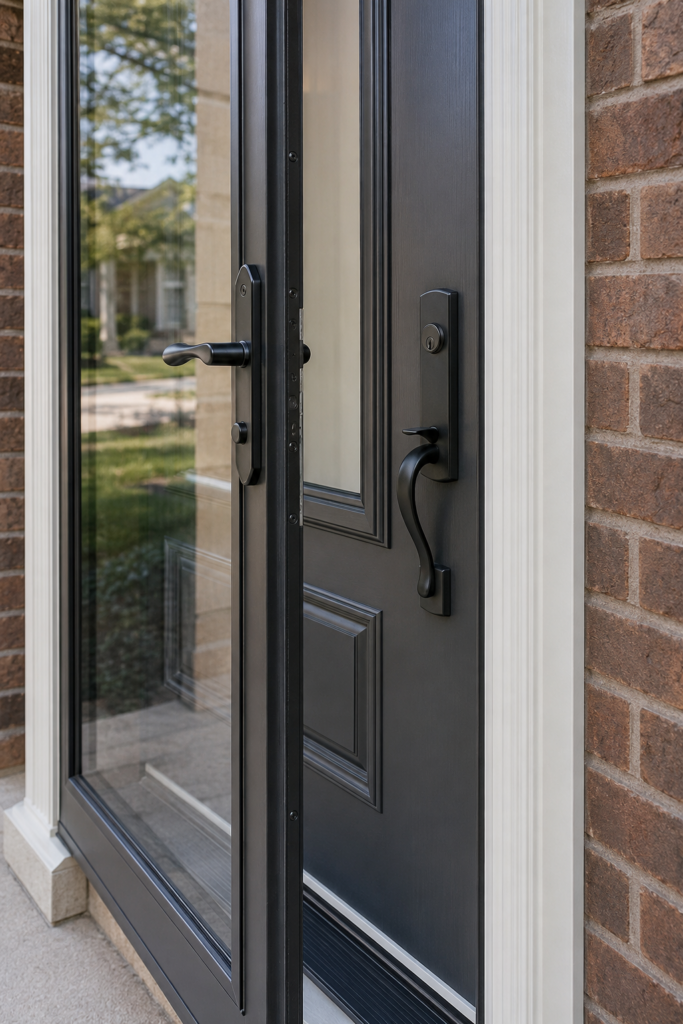
The main entry door usually swings inward, while the storm door swings outward.
The outward swing requires enough clear space on the porch or landing. It should not hit:
The storm door should also open in the most practical direction for someone approaching the home.
If the handle is placed on the wrong side, visitors may need to step around the open door or stand too close to a railing. This becomes especially awkward on narrow porches.
For attached homes and side entrances, the installer should confirm that the open storm door will not block a shared walkway or interfere with another entrance.
Storm doors are normally attached to the exterior brickmould or surrounding trim—not directly to the entry-door slab.
The mounting surface must provide:
Some replacement entry doors have narrow, decorative, or custom brickmould that may not accommodate a standard storm door.
If the homeowner plans to add one later, the installer should know before the new entry system is manufactured. The brickmould can then be selected or prepared with the storm-door installation in mind.
Storm-door sizing is based on the finished opening where the new frame will be mounted.
Important measurements include:
An older storm door may have been modified, trimmed, or installed into an irregular frame. Ordering a replacement based only on its stated size can result in poor fit.
📋 Quick Checklist: Measure after the main entry door and exterior trim are finalized. Even a small change in brickmould thickness can affect the finished storm-door opening.
Storm doors are lighter than main entry doors and can be caught by strong wind when opened.
A quality system should use properly adjusted closers that control the opening and closing movement. Some doors use two closers—one near the top and another near the bottom—for better control.
The closer should prevent the door from slamming, but it should not make the door unnecessarily difficult to open.
Wind chains or limiting devices may provide additional protection, but they should not be treated as a substitute for proper closer adjustment.
When a storm door is repeatedly pulled open by wind, the stress can damage:
Homes with exposed entrances may need heavier hardware than entrances protected by a deep porch.
A storm door is exposed to rain, snow, dust, sunlight, and frequent operation. It will require occasional maintenance even when it is installed correctly.
Homeowners should periodically inspect:
The bottom area should be kept clear of ice, leaves, dirt, and debris.
Screens should be repaired when damaged, and removable glass panels should be handled carefully to prevent breakage or frame damage.
🛠️ Maintenance Tip: Do not allow the storm door to close against snow or ice. Repeated obstruction can place unnecessary strain on the closer, hinges, and frame.
The answer depends on how the entrance is used.
A storm door may provide good value when the homeowner regularly uses the screen, wants additional protection from everyday wear, or has an exposed entrance that suits the product.
It may provide less value when the entrance is already sheltered, the new door has a dark finish in direct sunlight, or the storm door would hide an expensive decorative design.
Consider the complete cost, including:
The best choice is not automatically the most expensive model. It is the storm door that fits the opening, operates smoothly, suits the exposure, and provides a function the homeowner will actually use.
✅ Pro Recommendation: Add a storm door because it improves the way you use the entrance—not simply because the previous door had one. Modern entry doors do not automatically require an additional exterior door.
A properly selected storm door can be a useful addition. The key is confirming that it is compatible with the entry door, hardware, sunlight exposure, porch layout, and surrounding trim before anything is ordered.
Older Toronto homes often have beautiful entrances, solid masonry, detailed interior trim, and architectural features that are difficult to reproduce. They can also present challenges that are not always visible until the existing door system is carefully measured and inspected.
In many older houses, the opening is no longer perfectly square. The brick may be uneven, the threshold may have been repaired several times, and previous owners may have added layers of trim, capping, insulation, or flooring around the entrance.
This does not mean the door cannot be replaced properly. It means the project should be planned around the actual condition of the home rather than assuming that a standard replacement will fit without modification.
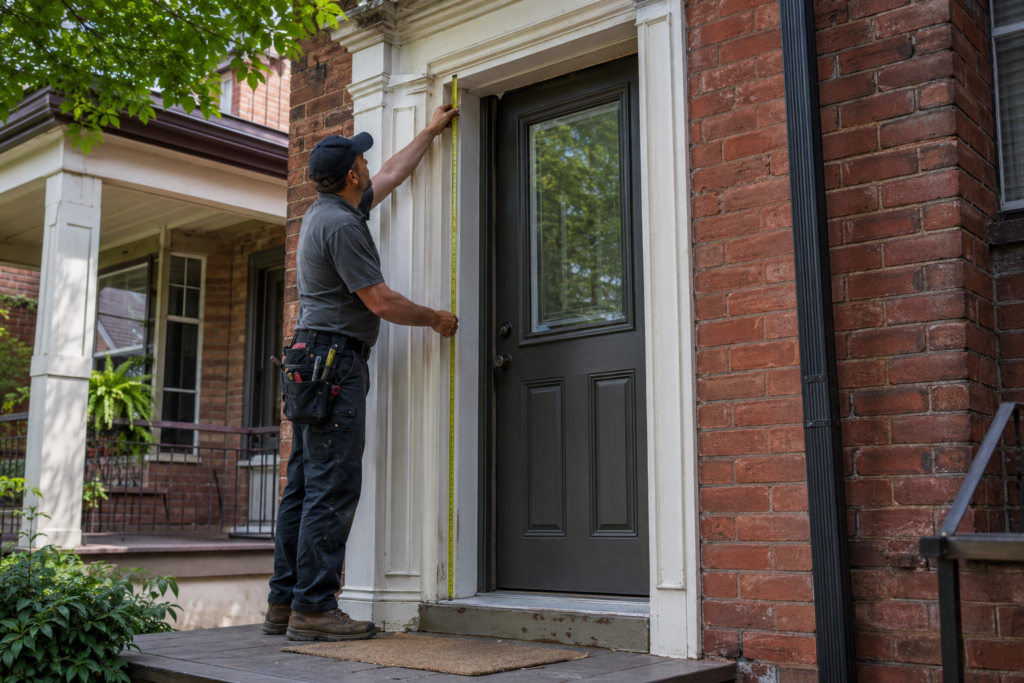
Homes naturally settle and move over time. An entrance that was square when the house was built may now be slightly wider at the top, narrower at the bottom, or leaning to one side.
The existing door may still appear to fit because previous installers adjusted the frame, added fillers, altered the trim, or modified the slab.
Before ordering a replacement door, measurements should be taken at several points:
The smallest measurement cannot always be used automatically. The installer must determine what is causing the difference and how the new frame will be positioned within the opening.
🏡 Toronto Home Tip: Brick homes built many decades ago may have slightly irregular masonry around the entrance. The replacement door should be measured to the actual opening—not ordered using the age or style of the house as a guide.
A common mistake is measuring only the existing slab and assuming the replacement should be the same size.
The complete entrance also includes:
An older door may have a narrow slab installed inside a much larger structural opening. In other homes, thick layers of trim may make the entrance appear larger than it really is.
The installer should determine the dimensions of the complete system before deciding whether the new entrance should match the existing layout or be redesigned.
⚠️ Common Mistake: Do not order a door from the slab measurement alone. The visible width does not always reveal the true frame or masonry opening.
Older Toronto homes sometimes have narrower entrances than newer houses. This makes the usable opening especially important.
A poorly planned replacement can unintentionally reduce the clear width by adding:
Even a small reduction can make it more difficult to move furniture, appliances, strollers, or renovation materials through the entrance.
Before finalizing the order, ask what the finished slab width and clear opening will be after the frame, hinges, and hardware are installed.
A custom-sized door may cost more than a standard unit, but it can help preserve valuable opening width and create a cleaner finished appearance.
💡 Expert Tip: Compare the finished usable opening—not only the overall frame dimensions. Two door systems with similar exterior sizes may provide different amounts of clear passage space.
The masonry surrounding an older entrance can reveal part of the home’s renovation history.
You may find:
Some of these conditions can be handled with new brickmould, trim, insulation, and sealant. Others may require masonry repairs before the entrance can be finished properly.
The goal should be to create a secure, weather-resistant connection without covering serious damage behind decorative trim.
A small amount of irregularity is common. Loose masonry, large cracks, severe deterioration, or movement around the opening should be addressed before the new door is permanently sealed.
Moisture damage is not always visible while the old door remains in place.
Water may enter behind exterior capping, cracked caulking, loose brickmould, or a damaged threshold. Over time, the wood surrounding the opening can soften or rot.
Possible warning signs include:
Minor damaged material may be removable during installation. More extensive deterioration may require additional framing or repairs before the new system can be secured.
The homeowner should be informed when hidden damage is discovered and given a clear explanation before significant additional work begins.
The bottom of an older entrance can be one of the most complicated parts of the project.
The threshold may meet:
Previous renovations may have raised the interior floor without changing the entrance. In other homes, the exterior landing may have been resurfaced, leaving very little clearance below the door.
The new threshold must provide a stable base while maintaining proper clearance for the slab, sweep, flooring, and exterior drainage.
Important questions include:
A new door should not be installed over an unstable or deteriorated base. Movement underneath the threshold can affect the frame, air seal, lock alignment, and water resistance.
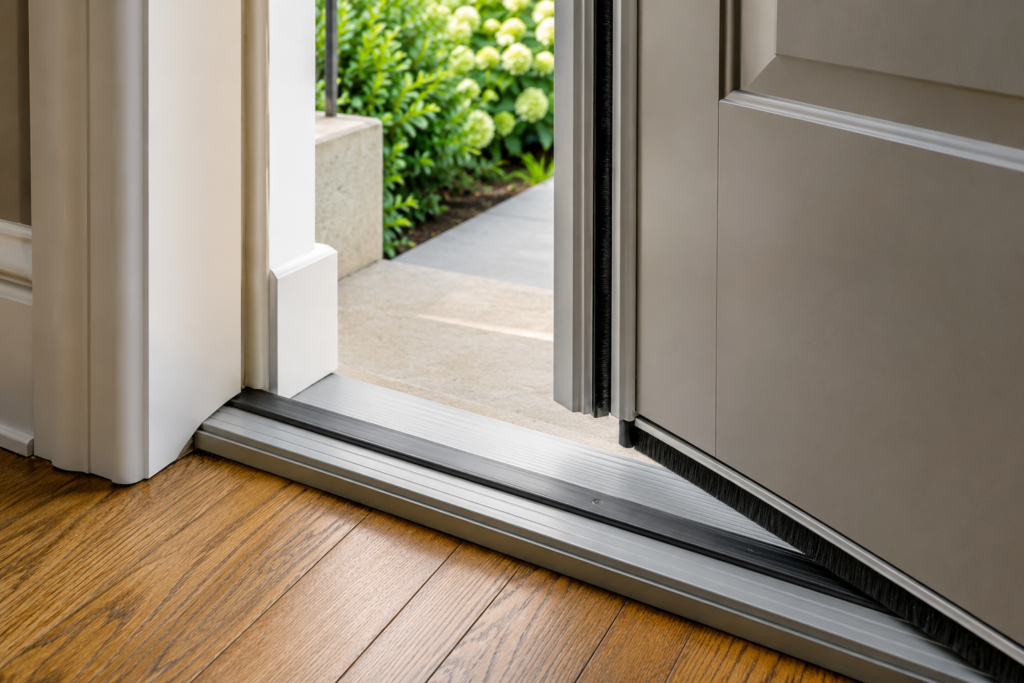
Older homes may have interior finishes that are more fragile than modern drywall and casing.
Removing the existing frame can disturb:
Some original trim can be carefully removed and reused, but this is not always possible. Dry wood may split, layers of paint may hold pieces together, and the dimensions may not match the new frame.
Before installation, homeowners should decide whether they want to:
The finished door should look intentional from inside the home. A high-quality exterior installation can still feel incomplete when the interior trim does not match the surrounding space.
Many older homes contain decorative sidelights or transoms that were built specifically for the original entrance.
Their dimensions may not match commonly available modern systems.
Replacing them requires accurate measurements of:
Homeowners may choose to preserve the original configuration, simplify it, or redesign the entrance within the available opening.
For example, two narrow sidelights may be replaced with wider modern glass sections, or an old transom may be recreated using a cleaner rectangular design.
The new configuration should still suit the proportions of the façade. Removing too much glass can make a large opening look heavy, while adding oversized sidelights can make the main door appear too narrow.
Older entry doors often have details worth preserving:
Preserving the architectural character does not mean the new door must duplicate every flaw or outdated component.
A modern fiberglass or steel system can reproduce a traditional appearance while providing improved weatherstripping, insulated glass, modern locks, and more dependable operation.
The best result often combines:
A door that is too modern can look disconnected from the home. At the same time, a replacement selected only because it looks old-fashioned may miss opportunities to improve light, convenience, and durability.
✅ Pro Recommendation: Identify the architectural features that give the entrance its character, then preserve those features while updating the parts that affect comfort, security, and maintenance.
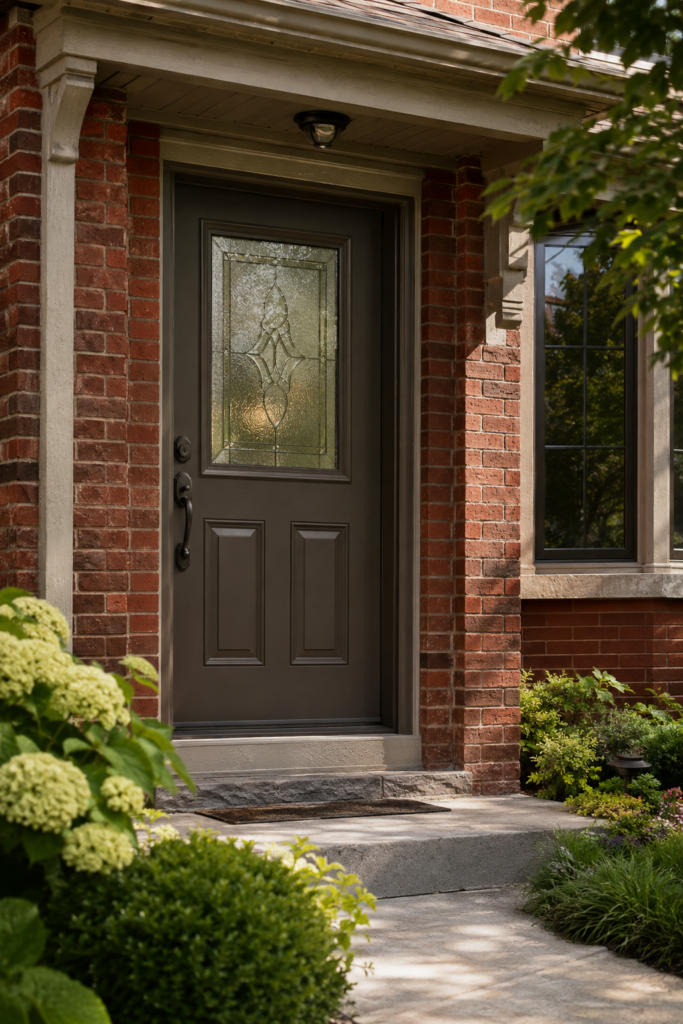
Older Toronto brick can contain several shades within the same wall. Red, brown, orange, charcoal, and cream tones may all be visible depending on the age and style of the home.
The door colour does not need to match the brick exactly. It should coordinate with the complete exterior, including:
Dark charcoal, black, deep green, navy, brown, and warm woodgrain finishes can all work well with traditional brick when the undertones are coordinated.
Very bright colours can also be successful, but they become a major focal point. Homeowners should view colour samples outside because indoor showroom lighting can change how a finish appears.
Some older door systems are surrounded by aluminum capping that covers the original wood trim.
Capping can provide a low-maintenance exterior finish, but it may conceal:
The old capping may not fit the dimensions of the new frame. Attempting to reuse it can leave visible gaps or create a patched appearance.
New brickmould, fresh aluminum work, or another compatible finishing method may be required to complete the entrance properly.
The exterior finish should direct water away from the opening and create a continuous sealed connection around the frame.
Older entrances may contain wiring added during several different renovations.
Components near the frame can include:
These items should be identified before the existing frame is removed.
Some devices can be disconnected and reinstalled. Others may require an electrician, alarm technician, or additional wiring work.
The contractor should know about these components in advance so the door configuration, trim, and hardware do not interfere with them.
Many Toronto semis, townhouses, and older detached homes have limited space around the entrance.
Installation planning may need to account for:
The new door must be carried safely to the opening without damaging the slab, glass, hardware, or surrounding property.
Homeowners can help by clearing the walkway, removing planters and decorations, and keeping vehicles away from the working area.
A narrow porch can also affect the choice of door swing, exterior handle, and storm door. The finished entrance should be practical after the installers leave—not only during installation.
Wide trim and capping can create a clean appearance, but they should not be used to conceal significant movement or damage.
Before finishing the entrance, the installer should confirm that:
Decorative finishing should be the final step—not the solution to an unstable opening.
When serious structural or masonry concerns are found, the homeowner may need to involve the appropriate trade before the door installation is completed.
Older homes require more than a quick slab measurement.
A thorough assessment should examine:
📋 Quick Checklist: Before ordering, confirm the final frame size, slab size, usable opening, interior finish, exterior finish, glass layout, colour, hardware, threshold height, and any repairs that may be required.
Older Toronto homes can accommodate beautiful, secure, and energy-efficient entry systems. The key is respecting the original architecture while designing the replacement around the home’s actual measurements and present condition.
Most straightforward entry door replacements do not involve a complicated approval process. When the new door is installed in the same location and the existing opening is not being enlarged or structurally altered, the project can usually move forward without a Toronto building permit.
However, replacing the door is not always the same as changing the entrance.
Converting a single door into double doors, widening the opening, removing masonry, changing a structural header, or altering a heritage façade can introduce additional requirements. Condo owners, landlords, and homeowners in heritage areas may also need permission from someone other than the City.
Understanding these requirements before ordering the door can prevent delays, redesign costs, and problems on installation day.
The City of Toronto lists replacement windows and doors among the projects that generally do not require a building permit when there is no change to the location or size of the opening.
This commonly applies when:
The new door does not need to look identical to the old one.
A homeowner may still be able to change:
The important distinction is whether the building opening itself is being structurally changed.
Replacing an old steel door with a custom fiberglass door in the same opening is very different from removing brick and framing to create a larger entrance.
A permit may be required when the proposed entrance changes the size, location, structure, or surrounding wall.
The City identifies a new door opening or the enlargement of an existing opening as work that requires a building permit.
Projects that should be reviewed before work begins include:
Some configuration changes may fit inside the existing overall opening without affecting the structure. For example, a door with two sidelights may sometimes be redesigned as a wider single door with one sidelight while keeping the same outer frame dimensions.
That does not automatically mean the change is permit-free. The proposed system and surrounding construction should still be assessed before the order is finalized.
⚠️ Common Mistake: Do not assume that a project is a basic replacement simply because a door already exists. Changing the surrounding brick, framing, header, or overall opening can turn it into a structural alteration.
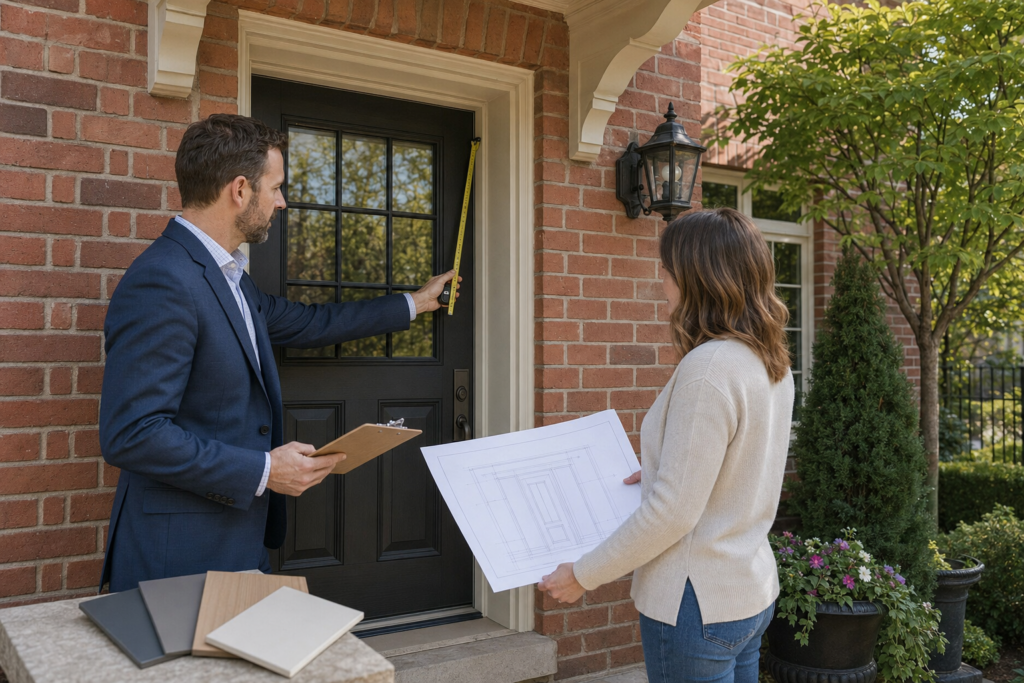
Homeowners often focus on whether there is enough room between the bricks. However, the visible masonry is only one part of the entrance.
A larger opening may affect:
The new configuration also needs enough support around the sides and above the frame.
Removing a few inches of brick does not necessarily mean that the structure can safely accommodate a wider door. The framing behind the masonry must be understood before the opening is altered.
For larger conversions, drawings or input from a qualified designer, engineer, or other appropriate professional may be required as part of the permit process.
A project may not require a conventional building permit but may still require heritage review.
Toronto properties can be:
The City states that permission is required for alterations to individually designated properties. Its Heritage Permit Guide advises property owners to contact Heritage Planning to determine whether a proposal requires heritage approval.
Entry doors can be important heritage features because they contribute to the appearance, proportions, materials, and character of the façade.
Heritage review may consider:
Some repairs or like-for-like replacements may qualify for a simplified process, while other changes require a formal application. The requirements can also differ between individual properties and Heritage Conservation Districts.
🏡 Toronto Home Tip: Heritage approval should be checked before choosing the final design—not after the new door has been manufactured. A custom door that does not meet the property’s heritage requirements may be difficult or impossible to change.
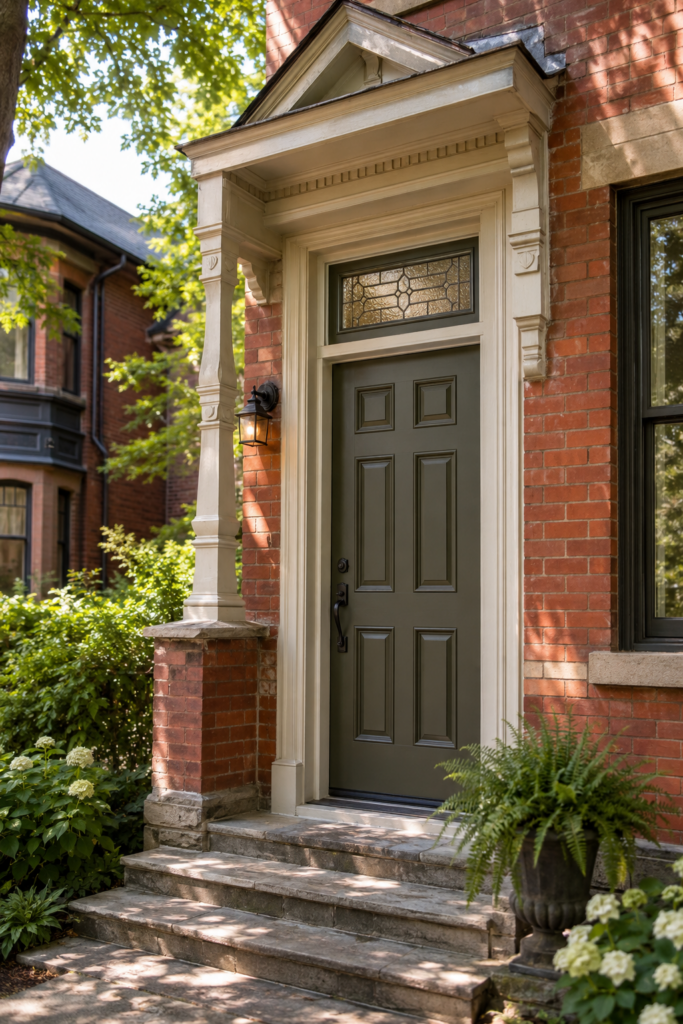
Do not rely only on the age or appearance of the house.
An old Victorian-style home is not automatically designated, while a less decorative property may still be located within a Heritage Conservation District.
Before ordering:
Photographs of the existing entrance can be useful, particularly when they clearly show the door, transom, sidelites, trim, porch, and surrounding façade.
Product drawings should accurately represent the proposed replacement. A generic brochure image may not provide enough information when the selected dimensions, glass, or panel design differ from the sample.
A front door may appear to belong entirely to the unit owner, but condominium ownership can divide responsibility differently.
Depending on the corporation, the entrance door, exterior finish, frame, hallway-facing surface, hardware, or surrounding wall may be considered:
The Condominium Authority of Ontario explains that repair and maintenance responsibilities depend on the Condominium Act and the corporation’s declaration, bylaws, rules, and standard-unit definition. Condo corporations are generally responsible for common elements and standard-unit elements, but the governing documents may alter those responsibilities.
Before replacing a condo or condominium-townhouse door, obtain written clarification regarding:
Some corporations require all hallway-facing doors to remain visually consistent. Even when an owner is responsible for the cost, the corporation may restrict the colour, panel style, peephole, lock, knocker, or exterior finish.
🔒 Security Insight: Do not replace condo hardware without confirming the building’s requirements. Master-key systems, access-control equipment, alarm contacts, and approved lock functions may need to remain compatible.
A freehold townhouse owner generally has more control over the front entrance than an owner in a condominium townhouse complex.
However, visual restrictions may still exist through:
This is especially important in developments where every door has the same colour, glass pattern, or exterior trim.
A contractor can help determine whether a product physically fits, but the homeowner is responsible for confirming that the proposed appearance is permitted.
Written approval is preferable to a verbal conversation with a neighbour, superintendent, concierge, or individual board member.
A tenant should not arrange a permanent entry door alteration without the property owner’s authorization.
The door affects the building envelope, security, insurance, appearance, and potentially the landlord’s legal and maintenance responsibilities.
Before an estimate or installation is finalized, clarify:
For multi-unit rental properties, the entrance may also be connected to a master-key, intercom, access-control, or fire-safety system.
The contractor should not assume that the person occupying the home has authority to change these components.
A door connecting an attached garage to the house should not be treated as an ordinary front or side entry door.
These openings are part of the separation between the garage and the living area. The Ontario Building Code contains specific provisions for doors between garages and houses or dwelling units.
Before replacing this type of door, confirm:
A decorative exterior door selected for the front entrance may not automatically be suitable for the garage connection.
✅ Pro Recommendation: Tell the supplier and installer exactly where the door will be used. Product requirements can differ between a front entrance, garage entrance, exterior basement door, shared corridor, and multi-unit building.
Replacing an existing basement or side door in the same opening may be straightforward.
Creating a new entrance is different.
A new basement entry may affect:
A door opening should never be cut into a foundation or exterior wall based only on the size of the desired door.
These projects often involve several trades and should be reviewed before excavation, concrete cutting, masonry removal, or door manufacturing begins.
Changing the hinge side or swing direction may not enlarge the opening, but it can still affect how the entrance functions.
The new swing should not create conflicts with:
Most residential front doors open inward, while storm doors normally open outward. Side and secondary entrances can have different conditions.
The opening direction should be documented on the order and confirmed from both the interior and exterior perspectives.
A left-hand door viewed from outside may be described differently depending on the manufacturer’s ordering system. Rather than relying only on terminology, the contract should clearly identify the hinge location and opening direction.
Entry doors are commonly manufactured to order. Once production begins, changing the dimensions, swing, colour, glass, or panel design may be expensive or impossible.
Before paying the deposit, confirm:
📋 Quick Checklist: Keep copies of approvals, product drawings, measurements, colour selections, glass selections, and written changes together with the contract.
The approval process does not need to make a standard replacement complicated. For most homeowners replacing a door in the same opening, it may involve little more than confirming the specifications and scheduling the installation.
The important thing is identifying the less common situations before the door is ordered.
A professional entry door company should identify visible conditions that may affect installation and alert the homeowner when a project appears to involve structural changes or special approvals.
However, the contractor cannot automatically know every restriction attached to the property.
The homeowner or property representative should disclose:
When uncertainty remains, confirmation should come from the appropriate authority rather than from assumptions.
That may include:
✅ Pro Recommendation: Confirm approvals first, complete the final measurements second, and order the door third. Following that sequence protects the homeowner from paying for a custom product that cannot be installed as planned.
A properly approved project is easier to schedule, easier to inspect, and far less likely to encounter expensive surprises after manufacturing has begun.
A replacement entry door is made from several separate components, and those components may not all carry the same warranty.
The door slab may be covered by the manufacturer, while the decorative glass, painted finish, hardware, smart lock, and installation work may each have different terms. A homeowner who is told that the door has a “lifetime warranty” may reasonably assume the entire entrance is covered for life, but that is rarely how entry door warranties are structured.
Before purchasing a new door, it is important to understand who is responsible for each part of the system, how long the coverage lasts, and what the homeowner must do if a problem develops.
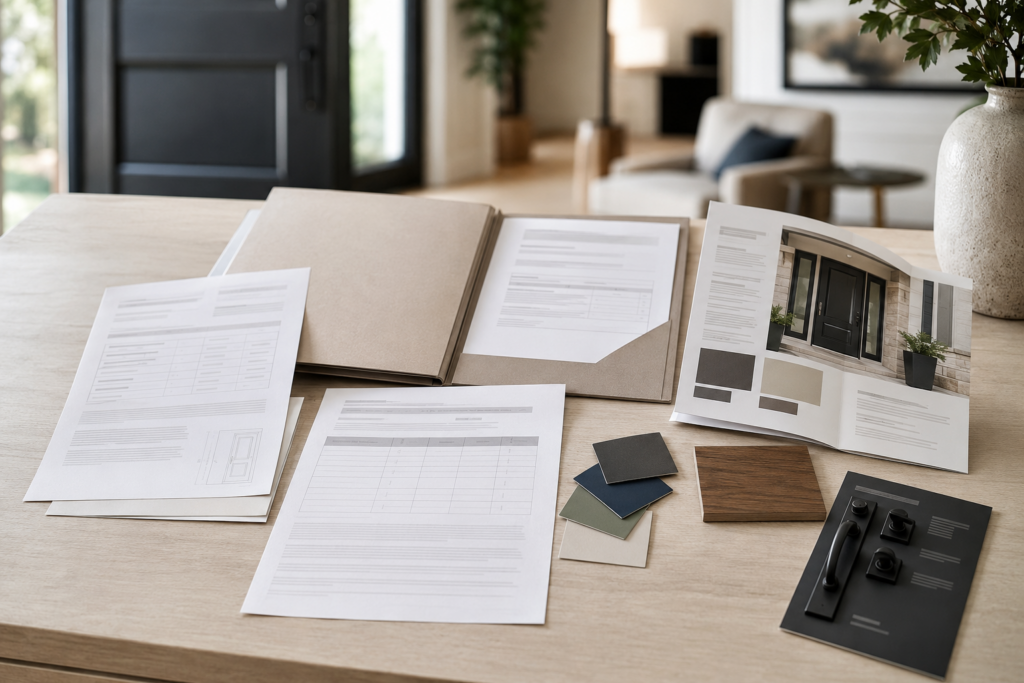
Most entry door projects involve at least two types of coverage:
The manufacturer’s warranty generally applies to defects in the supplied door components. The installation warranty applies to problems caused by how the system was fitted, fastened, insulated, sealed, or adjusted.
For example, a warped door slab may be a product issue, while a frame that was installed out of square may be an installation issue.
Some problems require both parties to be involved. A manufacturer may provide a replacement component, while the installation company completes the labour required to remove and reinstall it.
Homeowners should know whom to contact first instead of trying to determine the cause on their own.
💡 Expert Tip: Keep the door company’s contact information with the original contract. Starting with the company that supplied and installed the complete system is usually easier than contacting several manufacturers separately.
The door slab is the main operable panel of the entrance. Fiberglass and steel slabs are designed to remain stable under normal residential use, but the exact coverage depends on the manufacturer and product line.
A slab warranty may address issues such as:
The manufacturer will normally define how much movement or distortion qualifies as a warrantable defect.
A door that has moved slightly but still closes, seals, and locks properly may remain within the manufacturer’s acceptable tolerance. Visible movement does not always mean the slab has failed.
The entire frame should also be checked before assuming the slab is warped. Loose hinges, seasonal movement, frame settlement, and strike-plate alignment can create similar symptoms.
The frame surrounding the slab may be manufactured from wood, composite materials, vinyl-covered components, metal, or a combination of materials.
Coverage may differ for:
Damage caused by manufacturing defects may be covered, while deterioration caused by long-term moisture exposure, failed exterior caulking, improper drainage, or physical damage may not be.
The lower corners of the frame are especially important because they are close to the threshold and exposed to water, snow, salt, and debris.
A durable frame still depends on the surrounding entrance directing water away from the opening.
Decorative door glass is often supplied as a sealed glass unit installed inside a frame or insert.
The warranty may apply to a failed seal when moisture or fogging develops between the sealed panes. It may not cover condensation that forms on the room-side or exterior surface of the glass.
These are different conditions:
Decorative textures, handmade glass, caming, and privacy patterns can also contain natural variations. Small differences in texture or appearance may be considered part of the design rather than a defect.
Before choosing glass, ask whether accidental breakage is included or whether the warranty only applies to seal failure and manufacturing defects.
A sealed-glass warranty should not automatically be interpreted as glass-breakage protection.
Glass can break because of:
Some manufacturers or contractors may offer additional glass-breakage coverage. Others may treat all physical breakage as the homeowner’s responsibility.
This distinction is especially important for large door inserts, full-lite doors, sidelites, and transoms because replacement glass can be more expensive than a small decorative insert.
The door’s painted or stained finish may carry different coverage from the slab itself.
A fiberglass slab may remain structurally covered while the painted surface has a shorter warranty period.
Finish warranties may address excessive:
They may not cover ordinary fading, minor colour variation, surface dirt, impact damage, scratches, or deterioration caused by harsh cleaning products.
Exposure also matters. A deeply covered entrance and a south-facing door exposed to direct sun do not experience the same conditions.
Dark finishes can reach higher surface temperatures, especially when installed behind a full-view storm door. This may affect the finish and could conflict with the manufacturer’s warranty requirements.
🏡 Toronto Climate Tip: Keep your door’s colour name, finish code, and manufacturer information. Matching the finish years later can be difficult when the original selection is not documented.
All exterior finishes are exposed to sunlight, temperature changes, rain, snow, and airborne dirt. Some gradual change in appearance may occur over time.
A warranty may distinguish between normal weathering and premature failure.
Normal changes can include:
Potential finish problems may include widespread peeling, bubbling, or loss of adhesion under normal conditions.
The homeowner should avoid repainting or applying another coating before the issue is assessed. Modifying the original finish may make it more difficult to determine what caused the problem.
Handles, deadbolts, hinges, smart locks, multipoint locks, door knockers, and other hardware may not be manufactured by the door company.
Each product can have its own warranty, registration process, exclusions, and replacement procedure.
Hardware coverage may apply to:
It may not cover:
A smart lock may have one warranty for mechanical components and another for electronic parts.
The homeowner should keep the hardware model number and any programming instructions provided at installation.
Matte black, satin nickel, polished brass, bronze, and other decorative finishes may change over time.
Exterior hardware is repeatedly touched and exposed to:
Some finishes are designed to age naturally. Others are protected by a coating but may still show wear in high-contact areas.
A warranty that covers the lock’s mechanical operation may not provide the same coverage for appearance.
Avoid cleaning hardware with abrasive pads, strong solvents, bleach, or unapproved chemicals. Mild soap, water, and a soft cloth are generally safer unless the manufacturer provides different instructions.
🛠️ Maintenance Tip: Never spray cleaner directly into a key cylinder, smart lock, multipoint mechanism, or electronic keypad. Apply the approved cleaner to a cloth instead.
When a door becomes difficult to close or lock, homeowners sometimes assume the slab or lock is defective.
The actual cause may be:
The installer should assess the complete system before replacement parts are ordered.
For example, replacing a deadbolt will not solve a problem caused by a door that has dropped slightly on its hinges. Replacing weatherstripping may not help when the frame itself is out of alignment.
A proper diagnosis can prevent unnecessary parts, delays, and repeat service visits.
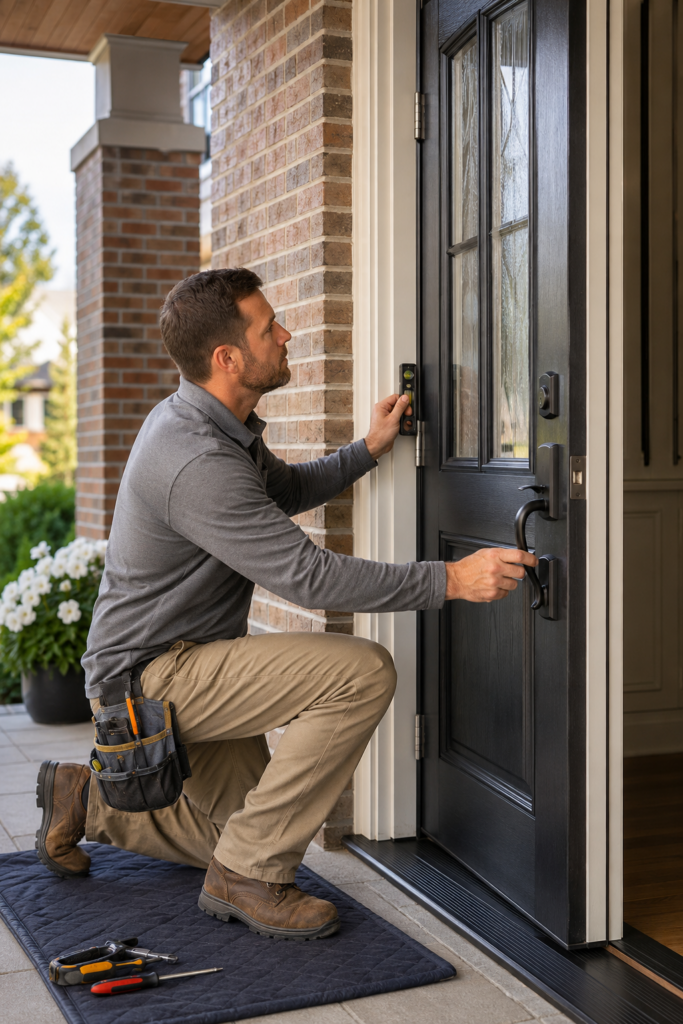
Warranty exclusions vary, but many warranties do not cover damage caused by conditions outside the manufacturer’s or installer’s control.
Possible exclusions may include:
A warranty is designed to address covered defects. It is not a maintenance plan or protection against every possible type of damage.
⚠️ Common Mistake: Do not drill into the slab, frame, glass insert, or multipoint-lock area without confirming that the modification is permitted. Installing an accessory incorrectly can damage hidden components and affect warranty coverage.
Exterior caulking seals the joint between the door system and the surrounding brick, stone, siding, or trim.
Even high-quality sealant does not remain unchanged forever. Sunlight, movement, moisture, and seasonal temperature changes can eventually cause cracking or separation.
Homeowners should periodically inspect for:
A workmanship warranty may cover an installation-related sealing issue for a specified period. It may not cover joints that fail years later because routine maintenance was not completed.
Water entering through neglected exterior joints can damage components that would otherwise have remained in good condition.
The threshold and bottom sweep experience constant contact.
Shoes, dirt, ice, salt, pets, moving furniture, and repeated opening can gradually wear these parts.
A worn sweep does not necessarily indicate that the entire door has failed. It may simply need adjustment or replacement.
Homeowners should keep the threshold clean and avoid allowing ice or debris to build up under the door.
Dragging, tearing, or excessive resistance should be corrected before the sweep is damaged further.
Some thresholds are adjustable, but adjustment should be made carefully. Raising one section too much can make the door difficult to close or create uneven pressure across the bottom seal.
Certain manufacturers require the homeowner to maintain the product in accordance with their instructions.
This may include:
Failure to correct a small issue can sometimes lead to more extensive damage.
For example, a minor opening in the exterior sealant may be easy to repair. If it is ignored for several years and water damages the frame, the resulting deterioration may not be treated as a manufacturing defect.
✅ Pro Recommendation: Review the care instructions shortly after installation instead of waiting until a problem appears.
A warranty claim is easier when the homeowner has complete records.
Keep copies of:
Store digital copies as well as paper copies where possible.
The label or manufacturing information may be located on the hinge side, top edge, glass spacer, frame, or original order paperwork. Avoid removing labels unless instructed.
Some manufacturers ask the original purchaser to register the product.
Registration may require:
The deadline and process vary.
Do not assume the contractor automatically completed registration unless this is stated in writing. Ask whether registration is required and who is responsible for submitting it.
Failure to register does not affect every warranty in the same way, but completing the process early can make future service easier.
Homeowners planning to sell may want to know whether the warranty can be transferred to the next property owner.
A transferable warranty can be a useful selling feature, but transfer conditions may include:
The new homeowner should receive the contract, product details, maintenance information, and service contact.
Do not advertise a warranty as transferable without confirming the actual terms.
When a problem develops, document it before making major adjustments or repairs.
A useful service request should include:
Photographs should show both the close-up problem and the complete door. A very tight picture of a gap may not reveal whether the frame, hinge, slab, or threshold is causing it.
Avoid hiring another contractor to modify the system before the original company has had an opportunity to inspect it. Unauthorized work may make the cause harder to determine.
📋 Quick Checklist: Report the problem, provide photographs, follow the company’s instructions, and keep a record of all service communication.
Some concerns are caused by wear, maintenance, accidental damage, or changes to the home rather than a covered defect.
Examples may include:
The service may still be available, but a charge could apply.
A reliable door company should explain the difference between covered warranty service and chargeable maintenance or repair before completing the work whenever possible.
A routine cosmetic concern can usually wait for a standard service appointment. A security or water-related problem may require faster action.
Contact the installer promptly when:
In the meantime, avoid forcing the lock or repeatedly slamming the door. Additional force can damage hardware and make the original problem worse.
For emergencies involving forced entry or major damage, temporary security work may be necessary before the warranty cause can be assessed.
The written warranty matters, but homeowners should also consider how warranty service is handled.
Before purchasing, ask:
A long warranty has limited value when the homeowner cannot reach the company or does not know who is responsible.
✅ Pro Recommendation: Evaluate the product, installation company, and after-sales service together. The best warranty is one that is clearly written, properly documented, and supported by a company that responds when help is needed.
A quality entry door should provide many years of reliable operation. Understanding the warranty from the beginning helps homeowners maintain the system correctly, recognize genuine problems, and know exactly what to do when service is required.
Replacing a front door is a major home improvement, and it is normal to have questions before choosing a product or scheduling installation. Below are straightforward answers to some of the questions Toronto and GTA homeowners ask most often.
For most Toronto homes, fiberglass is our top recommendation because it provides a strong balance of durability, insulation, design flexibility, and low maintenance.
Fiberglass resists rust, rot, cracking, and moisture damage while handling Toronto’s changing temperatures well. It is also available in smooth painted finishes and realistic woodgrain styles.
Insulated steel doors can also be an excellent choice, particularly for homeowners looking for a strong, practical door with a clean painted finish. The best option ultimately depends on the entrance exposure, preferred appearance, glass design, maintenance expectations, and available budget.
The cost depends on the size and configuration of the entrance, the selected material, glass, colour, hardware, frame, and installation requirements.
A standard white single door without decorative glass will normally cost less than a custom-painted fiberglass door with sidelights, a transom, premium hardware, or a multipoint lock.
When comparing quotes, confirm that they include the same product specifications, installation work, interior and exterior finishing, removal of the existing door, disposal, and applicable taxes. A lower price may represent a more basic door or a smaller installation scope.
Most standard entry door replacements can be completed within one working day once the custom door has been manufactured and delivered.
The installation normally includes removing the existing door and frame, inspecting the opening, positioning and securing the new system, insulating around the frame, installing the hardware, completing the finishing work, and testing the door.
Double doors, sidelights, transoms, structural changes, masonry work, or hidden damage may require additional time.
Manufacturing time varies depending on the supplier, season, product availability, and level of customization.
Factory-painted colours, decorative glass, sidelights, transoms, multipoint locking systems, unusual dimensions, and double-door configurations may require more production time than a basic standard-size door.
The most reliable timeline begins after the final measurements and all product selections have been confirmed. Installation should normally be scheduled after the completed door arrives and has been inspected for accuracy and damage.
Yes. Entry doors can often be replaced during winter when the weather conditions are suitable and the correct cold-weather installation materials are used.
The project may need to be postponed during freezing rain, heavy snow, extreme cold, or strong wind. The opening and surrounding surfaces must remain clean, dry, and free of ice or frost so insulation and exterior sealants can be applied properly.
An experienced crew will prepare the replacement door, tools, and materials before removing the existing system to reduce the amount of time the entrance remains exposed.
A properly selected and installed entry door can reduce drafts and improve comfort near the entrance.
Energy performance depends on the complete system, including:
Even a highly insulated slab can perform poorly when the frame is misaligned or air is passing around the perimeter. Professional installation and a consistent seal are just as important as the door material.
A mostly solid door generally provides greater privacy and reduces the total amount of glass in the entrance. A door with decorative or privacy glass can brighten the foyer and make the entrance feel more welcoming.
The right choice depends on how much natural light you want, the direction the entrance faces, and how visible the interior is from the street.
Textured, frosted, tinted, or decorative privacy glass can bring in daylight while limiting the view into the home. Matching sidelights and transoms can provide even more light when the entrance is wide enough.
It may be possible in certain situations, but it is not always the best long-term solution.
The existing frame must be solid, square, properly secured, and free from rot, water damage, or significant movement. The new slab must also match the existing frame, hinges, threshold, weatherstripping, and lock preparation accurately.
A complete prehung door system is often preferable when the existing frame is damaged, poorly insulated, misaligned, or no longer sealing properly. Replacing the complete system allows the slab, frame, threshold, weatherstripping, and hardware to be fitted together.
A straightforward replacement in the same opening will generally be different from a project that enlarges or relocates the entrance.
Additional review may be needed when the project involves:
Condo owners may also require written approval from their condominium corporation, even when a municipal building permit is not needed.
Always confirm any necessary approvals before ordering a custom-made door.
A storm door may be useful when you want additional ventilation, a screen, or some protection from everyday contact and weather exposure.
It may not be necessary when the main entrance is already protected by a deep porch or when the homeowner does not plan to use the screen.
Special care is required when installing full-view glass storm doors over dark entry doors exposed to strong sunlight. Heat can build up between the two doors. Handle clearance, brickmould dimensions, outward swing space, and compatibility with the main door should also be checked before ordering.
The useful life of an entry door depends on the product, installation, exposure, maintenance, and frequency of use.
A quality fiberglass or insulated steel door can provide dependable service for many years when the frame remains properly sealed, the hardware is maintained, and water is directed away from the threshold.
Weatherstripping, sweeps, exterior caulking, and some hardware components are wear items and may require adjustment or replacement before the complete door system reaches the end of its useful life.
A complete door project may involve separate warranty coverage for:
Ask whether labour is included when a manufacturer supplies a replacement part. Also confirm the warranty-registration requirements, exclusions, transfer conditions, and whom to contact when service is required.
Keep your contract, invoice, colour information, glass selection, hardware model, installation date, and warranty documents together.
Start by considering the home’s architecture, entrance size, weather exposure, natural-light needs, security priorities, and daily use.
A professional assessment should confirm:
✅ Pro Recommendation: Select the complete entry system—not only the door slab. The frame, glass, hardware, weatherstripping, threshold, finishing, and installation all affect how the entrance looks and performs.
A properly planned entry door replacement should complement the home, operate smoothly, seal tightly, and provide reliable security through every Toronto season.
Although this guide focuses on entry door replacement in Toronto, the same planning, product, installation, security, and energy-efficiency considerations apply to homeowners throughout the Greater Toronto Area.
For information tailored to your community, explore our local entry door replacement pages:
Imperial Windows & Doors serves homeowners throughout Toronto and the GTA with professionally installed fiberglass and steel entry doors. Every entrance is carefully measured and customized to suit the home’s architecture, opening size, security requirements, glass preferences, and exposure to Ontario’s changing weather.
Whether you are replacing a standard single door, upgrading to decorative glass, adding sidelites, or planning a complete entrance transformation, our team can help you compare suitable options and choose a door system designed for lasting performance.
Your front entrance should look right for your home, operate smoothly, keep out drafts, and provide reliable security through every Toronto season. Choosing the right door starts with accurate measurements and a clear understanding of the options available for your opening.
Imperial Windows & Doors provides professional entry door replacement throughout Toronto and the Greater Toronto Area. We offer custom fiberglass and steel entry doors in a wide range of colours, panel styles, decorative glass designs, sidelites, transoms, and hardware configurations.
During your consultation, we can help you:
Every replacement door is carefully measured for the home and professionally installed with attention to alignment, insulation, weather sealing, hardware operation, and interior and exterior finishing.
Contact Imperial Windows & Doors to arrange a free in-home estimate for entry door replacement in Toronto or the GTA.
We will inspect your existing entrance, discuss your design and performance priorities, and help you choose a door system that fits your home, budget, and everyday needs.
Serving Toronto, Vaughan, Richmond Hill, Markham, Mississauga, Brampton, Caledon, Bolton, Aurora, Newmarket, Burlington, Ajax, and surrounding GTA communities.

Imperial Windows and Doors have long been serving our valued clients for over 10 years to be exact. We strive to deliver our clients only the finest solutions guaranteed to suit their needs, style, preferences and budget.

Imperial Windows & Doors provides professionally installed replacement windows, entry doors and patio doors for homeowners across Toronto and the GTA.