Get inspired for your next home improvement projects by browsing through our blog posts, which are full of great tips, valuable advice, and industry insights.

Blog
Last reviewed: August 27, 2026
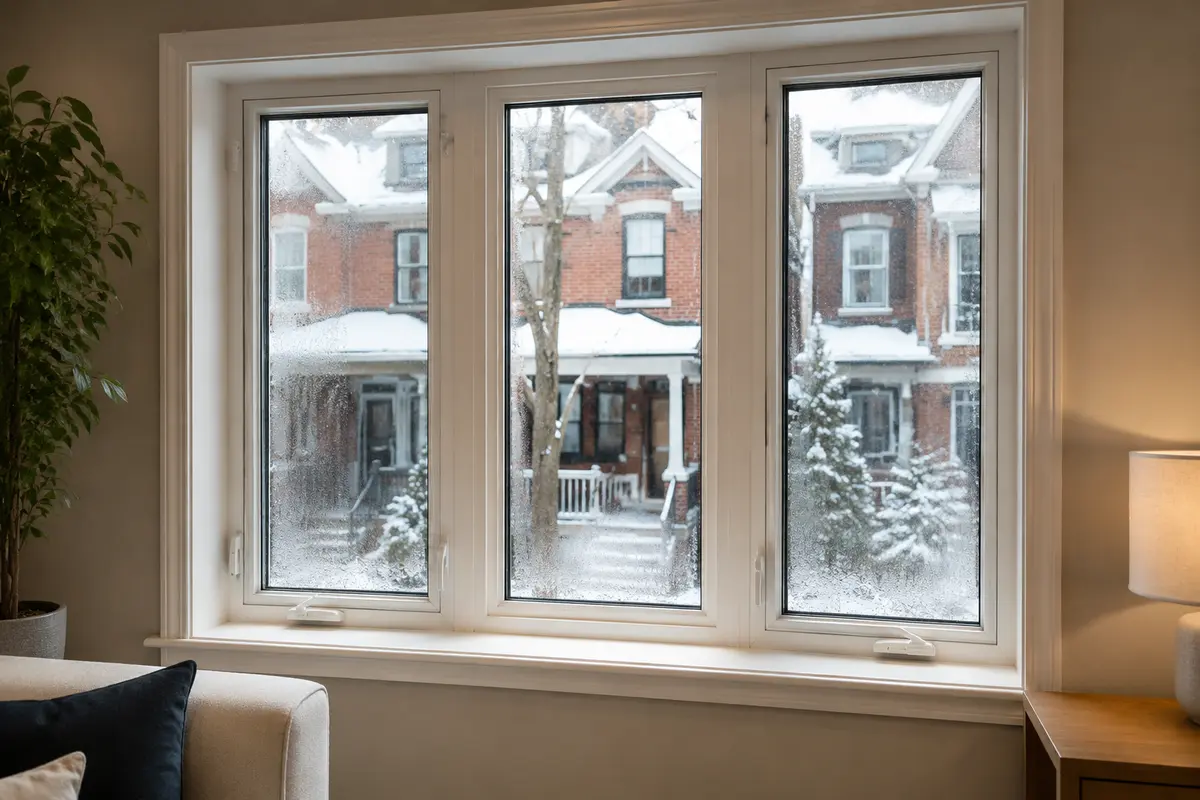
Window condensation in Toronto does not always mean the glass or installation has failed. Water droplets, fog and frost can have very different causes. In some homes, condensation is mainly an indoor-humidity problem. In others, cloudy glass indicates that the seal around an insulated glass unit has failed. Moisture on the outdoor surface can be harmless morning dew.
The location of the moisture is the most important clue:
Interior condensation alone does not prove that a window is defective, and a failed sealed unit does not always mean that the complete frame must be removed. This guide explains how to identify the type of window condensation, reduce preventable moisture and decide when glass repair or complete window replacement in Toronto is the more sensible solution.
Before adjusting the furnace, ordering glass or replacing a window, determine exactly where the moisture is located.
If you can wipe the droplets from inside the room, the condensation is on the room-side glass. This commonly happens when indoor humidity is high relative to the outdoor temperature, the glass surface is cold or warm room air cannot circulate across the window.
A small amount during an unusually cold morning does not automatically mean that the window has failed. Persistent water, frost or wet trim deserves attention because repeated moisture can damage surrounding materials and support mould growth.
If the room-side glass is dry but droplets can be wiped from outdoors, the moisture is exterior condensation. It may appear on cool mornings when humid outdoor air contacts glass that is colder than the outdoor dew point.
Exterior condensation is usually temporary. It can occur on efficient windows because less indoor heat reaches the exterior pane, although exterior dew by itself is not proof of a window’s energy rating.
If the cloudy area cannot be wiped from either accessible surface, it may be trapped inside the insulated glass unit. A persistent haze, streaking, mineral-like marks or droplets between factory-sealed panes normally indicates that the edge seal is no longer performing as designed.
This is different from moisture in the space between a removable storm window and the primary window. That space is not the sealed cavity of an insulated glass unit and should be diagnosed separately.

Condensation forms when moist air contacts a surface at or below its dew-point temperature. The air beside the surface cools and can no longer hold the same amount of water vapour, so some of that vapour becomes liquid water.
Windows are often the first place homeowners notice this process because glass and frame edges can be among the coldest visible surfaces in a room during winter.
Natural Resources Canada explains that the risk of condensation increases as outdoor conditions become colder and indoor humidity rises. The result depends on several conditions working together:
This is why two windows in the same house may behave differently. A bedroom window hidden behind a closed blind may collect moisture while a similar window in an open living room remains clear.
Toronto homes experience large differences between heated indoor air and cold outdoor conditions. As the outdoor temperature falls, the interior surface of a window also becomes colder. If the home contains enough moisture, the glass can fall below the indoor air’s dew point and condensation appears.
Normal household activities continually add water vapor to the air. Common sources include:
New construction, fresh concrete, drywall compound, paint and other renovation materials can also release moisture for a period of time. A newly renovated or recently built home may therefore experience more condensation during its first cold season.
Not necessarily.
Room-side condensation shows that the glass surface is cold enough, relative to the indoor temperature and humidity, for moisture to form. It does not identify the cause by itself.
The window may be functioning normally while the house contains too much moisture for the current weather. Closed blinds may be preventing warm air from reaching the glass. An older window may also have a colder interior surface than a better-insulated replacement window, making condensation more likely under the same indoor conditions.
An inspection becomes more important when:
These signs can point to a combination of excessive humidity, poor thermal performance, air leakage, deteriorated materials, drainage problems or an installation concern.
Use this simple inspection before deciding what to repair.
Use a clean, dry cloth. If the moisture disappears, it was on the interior surface. Watch whether it returns and note the indoor humidity, outdoor temperature and room conditions.
Inspect from outdoors only when access is safe. Do not lean out of an opening or use an unsecured ladder. Exterior dew often clears as the sun warms the glass or outdoor conditions change.
Fog trapped between panes often appears as a soft cloudy patch, streak or residue that remains after both accessible surfaces are cleaned. Changing the viewing angle can make the haze easier to see.
Compare windows with similar size, orientation, coverings and room use. A single opening that behaves very differently may need closer inspection, but the comparison is only useful when the conditions are reasonably similar.
Photograph the problem and note:
This information can help distinguish a humidity pattern from a failed glass seal or water-infiltration problem.
If the moisture is on the room-side glass, begin with the moisture sources and airflow before assuming that every window must be replaced.
Use a reliable hygrometer instead of judging humidity by comfort alone. Check more than one room if the problem is localized.
Health Canada’s moisture and mold guidance recommends maintaining indoor relative humidity between 30% and 50% as a general range. However, a particular window may require a lower indoor humidity level during very cold weather to remain free of condensation. The right setting depends on the outdoor temperature, window performance and household comfort.
Do not reduce humidity blindly to an uncomfortable level. Make gradual adjustments, monitor the glass and consult an HVAC professional if you are unsure how to operate a whole-home humidifier, dehumidifier, heat-recovery ventilator or energy-recovery ventilator.
Run the bathroom exhaust fan during bathing and after the shower is finished. Health Canada recommends keeping it running for at least 30 minutes after a shower or bath. Confirm that the fan actually exhausts outdoors rather than into an attic or ceiling cavity.
Use a range hood that vents outdoors while cooking, especially when boiling water. A recirculating hood may filter grease and odors but does not remove moisture from the house in the same way as an outdoor-vented fan.
A humidifier setting that feels comfortable during mild winter weather may be too high during a severe cold spell. If condensation appears across several windows, reduce or temporarily turn off the humidifier and monitor the result.
Make sure the equipment is operating correctly. A stuck control, leaking water panel or inaccurate humidistat can add more moisture than expected.
Warm room air needs to reach the window.
Closed cellular shades and tightly fitted blinds can improve comfort, but they may also isolate the glass from warm room air. If condensation develops behind them, adjust how long they remain fully closed during cold weather.
Vent the clothes dryer outdoors and check that its duct is connected and clear. Avoid drying large amounts of laundry indoors. Cover cooking pots when practical, repair plumbing leaks promptly and use a dehumidifier in a damp basement when needed.
If several rooms remain humid despite reasonable changes, the home may need a ventilation or HVAC assessment.
Wipe water from the glass, frame and sill. Do not allow it to collect on wood trim, painted surfaces or drywall.
Drying the surface does not solve the source, but it helps protect surrounding materials while you correct the humidity or window problem. Recurring mold or widespread dampness should be addressed promptly rather than hidden with paint or caulking.

Frost is interior moisture that has frozen on a sufficiently cold surface. It can appear on glass, frame edges or around air-leakage paths during very cold weather.
An isolated light frost line during an extreme cold event does not diagnose the entire window. Repeated or heavy ice, however, should not be ignored. When it melts, water can soak into wood trim, drywall and nearby finishes.
If frost returns:
Do not use a sharp tool to chip ice from the glass or frame. It can scratch coatings, damage weatherstripping or break the glass.
Usually not.
Exterior condensation forms when humid outdoor air reaches a cold exterior glass surface. It is similar to dew on grass or a parked car. Shading, clear night skies, calm air and the orientation of the window can all affect where it appears.
It often clears naturally after sunlight, wind or a change in temperature. Because high-performance glazing reduces the movement of indoor heat to the outside pane, the exterior surface can sometimes remain cool enough for dew to form.
Exterior condensation does not normally justify replacing a window. Investigate further only if the moisture is actually entering the frame, collecting in an unexpected cavity or appearing with blocked drainage, damaged seals or water staining.
Modern double-pane and triple-pane windows use insulated glass units. The panes are separated by a spacer and sealed around the perimeter to create one or more insulating cavities. The cavities may contain dry air or an inert gas, and the spacer system includes moisture-control components.
When the edge seal fails, outside air and moisture can enter the sealed space. The result may be:
Fog between the panes usually means the sealed glass unit is no longer performing as designed. The appearance may come and go, but the seal does not normally restore itself permanently.
Drilling holes or applying a cosmetic “defogging” treatment may change the appearance in some situations, but it does not recreate the original factory-sealed insulating cavity. A proper recommendation should explain whether the insulated glass unit can be replaced or whether the condition of the complete window makes full replacement more practical.

Sometimes.
Replacing only the insulated glass unit may be reasonable when:
A glass-only replacement can restore the view and the sealed cavity without removing a serviceable complete frame. The new glass should match the required dimensions, thickness, coatings, safety-glazing requirements, spacer and appearance as closely as practical.
Before paying for the repair, check whether the glass is still covered. Review the manufacturer’s sealed-unit terms, labour coverage, transfer conditions and exclusions. Imperial customers can review our general window and door warranty information and contact us with the original project details when available.
A failed glass seal alone does not automatically require complete window replacement. Full replacement becomes more compelling when the foggy glass is only one part of a larger performance or condition problem.
Consider complete replacement when several of the following apply:
The opening should be assessed as a complete system. Replacing the glass will not repair rotten framing, poor perimeter insulation, a leaking wall or a window that no longer closes securely.
If full replacement is recommended, compare the complete scope—not only the new glass package. Our guide to retrofit versus full-frame window replacement explains what remains, what is removed and when brick-to-brick installation may be more appropriate.
You can also review the factors affecting window replacement cost in Toronto before comparing repair and replacement quotations.
Condensation and water infiltration can both leave a wet sill, but their patterns are often different.
These are clues, not a complete diagnosis. Water can travel inside a wall and appear far from its entry point, and condensation can coexist with an exterior leak.
Do not automatically cover every gap with caulking. Window and wall systems require intentional drainage paths. Blocking a drain or sealing the wrong joint can trap water instead of solving the source.
New energy-efficient windows can reduce the risk of room-side condensation because better-insulated glass and frames generally keep interior surfaces warmer. They cannot guarantee condensation-free glass under every condition.
Even a high-performance window can condense when:
When comparing products, consider the certified performance of the complete window, not just the number of panes. Triple-pane glazing generally maintains a warmer room-side surface than an otherwise similar double-pane option, but indoor humidity and installation quality still matter.
Read our double-pane versus triple-pane window guide to compare thermal performance, condensation resistance, cost and room-by-room priorities.
It can, but condensation alone is not proof of poor installation.
A professional assessment is worthwhile when one opening develops a strong, repeatable cold pattern that comparable windows do not. Possible concerns include insufficient perimeter insulation, air leakage, a sash that does not compress evenly, damaged weatherstripping, an unsuitable installation method or a cold bridge around the opening.
Look for:
The inspection should also consider the wall, lintel, sill, flashing and exterior drainage. A window contractor should not claim that every moisture problem originates with the window itself.
Proper installation is as important as the selected product. Learn what should be included in professional window and door installation and what happens during the complete window replacement process in Toronto.
People add moisture to the air while sleeping, and bedroom doors and blinds are often closed overnight. Condensation may therefore be visible in the morning even when the rest of the house appears dry.
Try opening the blinds after waking, improving air circulation and checking the humidity before bedtime and again in the morning.
Showers create a rapid moisture load. Use an outdoor-vented exhaust fan, keep the door positioned according to the ventilation design and continue running the fan after bathing.
If the bathroom has a window, wipe any wet frame or sill promptly. Privacy coverings can trap cool, moist air against the glass.
Boiling water, dishwashers and cooking can raise humidity quickly. Use the range hood and avoid directing steam toward a nearby window.
Basements may have cooler surfaces and independent moisture sources. A damp basement can contribute humidity to the entire house. Check for plumbing leaks, foundation moisture, unvented laundry equipment and the need for dehumidification.
Deep seats, tightly fitted blinds and furniture can reduce airflow around bay and bow windows. Their projection also exposes more surface area to outdoor conditions. Keep heating paths open and inspect all sections rather than assuming the centre unit is the only source.
If you can wipe the moisture from the room-side glass, it is not trapped between the sealed panes. Diagnose humidity, surface temperature and airflow first.
Temporary outdoor condensation is usually a weather condition, not a defect.
A new insulated glass unit will not correct rotten wood, a warped sash, failed hardware or water entering through the surrounding wall.
If the frame and sash are sound, a glass-only repair may be the better value. Ask for both options when appropriate.
The home may feel dry while the windows are already showing that the current moisture level is too high for their surface temperature. Measure the humidity and adjust carefully.
Tightly closed coverings can create a colder pocket of air beside the glass. Open them periodically and allow warm room air to circulate.
Repeated wetting can damage finishes and surrounding materials even when the original cause is ordinary surface condensation.
Do not caulk over weep holes or other intentional drainage paths. If you do not know what a joint or opening does, have it assessed before sealing it.
Start with these questions:
If the issue is not urgent, begin planning before the preferred installation period. Our seasonal guide explains the best time of year to replace windows in Toronto and why custom manufacturing and weather can affect scheduling.
Window condensation is a symptom, not a complete diagnosis. Moisture on the room-side surface, exterior dew and fog between sealed panes require different responses.
Start by locating the moisture and recording the conditions. Reduce excessive indoor humidity, improve airflow and dry wet surfaces promptly. If the haze is trapped between panes, determine whether a replacement insulated glass unit is practical. If the frame, hardware, installation or surrounding opening is also failing, complete replacement may provide better long-term value.
Imperial Windows & Doors helps homeowners in Toronto and the GTA assess foggy glass, deteriorated windows and complete replacement options. We can review the opening, explain whether the concern appears to involve the glass, complete window or installation, and provide a clear quotation for the work we recommend.
Contact Imperial Windows & Doors to request a free window replacement estimate in Toronto or the GTA.
Indoor humidity can rise overnight while bedroom doors and blinds are closed. At the same time, the outdoor temperature and room-side glass temperature may fall. When the glass reaches the indoor air’s dew point, droplets form. Open the blinds, improve circulation and check the humidity with a hygrometer.
No. Room-side condensation often results from the combination of indoor humidity, cold outdoor weather, glass temperature and limited airflow. Replacement may help when an old window has poor thermal performance or other failures, but humidity and ventilation should also be assessed.
Often, the insulated glass unit can be replaced if the sash and frame are in good condition and compatible components are available. If the frame, hardware or installation is also failing, replacing the complete window may be more practical.
No. Inter-pane fog may disappear temporarily as temperature and humidity change, but a failed factory seal does not normally restore itself permanently. The glass unit should be assessed for replacement.
Yes, temporary exterior dew can be normal. It forms when humid outdoor air contacts exterior glass that is below the outdoor dew point. It usually clears as sunlight, wind or temperature changes warm and dry the surface.
Triple-pane windows generally keep the room-side glass warmer than comparable double-pane windows and can improve condensation resistance. They are not condensation-proof. High indoor humidity, restricted airflow and severe cold can still produce moisture.
There is no single setting that prevents condensation on every window in every condition. Health Canada gives 30% to 50% relative humidity as a general indoor range, but the maximum a particular window can tolerate may need to be lower during very cold weather. Monitor both the humidity and the glass.
Yes. Drying the glass, frame and sill helps protect nearby finishes while you correct the moisture source. Repeated water, damaged materials or returning mold should be investigated rather than managed only by wiping.
Condensation usually forms on cold glass during cold weather and may affect several windows. Water infiltration is more closely associated with rain, melting snow, exterior damage or localized staining around the opening. Because both can occur together, persistent or unexplained water should be professionally assessed.
Coverage depends on the manufacturer, product, installation date, ownership and warranty terms. Review the sealed-glass coverage as well as labor, service and transfer conditions. Keep the original contract and product information when available.

Imperial Windows and Doors have long been serving our valued clients for over 10 years to be exact. We strive to deliver our clients only the finest solutions guaranteed to suit their needs, style, preferences and budget.

Imperial Windows & Doors provides professionally installed replacement windows, entry doors and patio doors for homeowners across Toronto and the GTA.