Get inspired for your next home improvement projects by browsing through our blog posts, which are full of great tips, valuable advice, and industry insights.

Blog

Window quotes often list U-factor, SHGC and ER beside the glass package. These numbers answer different questions, so choosing the highest number on every line will not necessarily give you the right window for your home.
This guide explains window energy ratings in Canada and how to use them when comparing residential replacement windows in Toronto and the GTA. Start with the exact window model and configuration, then discuss how its ratings fit the room, your comfort priorities and the installation plan.
Natural Resources Canada's ratings and certification guide explains these measures. They are useful together; none tells you everything about a replacement project.
In Canada, Natural Resources Canada administers and promotes ENERGY STAR. Certified products have independently verified performance testing. Ask whether the particular window configuration in your proposal is certified, rather than relying on a general claim about the manufacturer or a product family.
A certification symbol is a starting point for checking the proposed product. Keep the model information and specification sheet with your quote so you can identify what you are ordering and what arrives for installation.
A centre-of-glass value describes the glass portion rather than the complete product. When comparing replacement windows, ask for whole-window ratings that account for the proposed frame and sash as well as the glazing.
Make the comparison specific: a fixed window and an operating casement are different products. Ask for the manufacturer, model, operating style and glass package for each opening. A brochure's best-performing example may not be the configuration included in your estimate.
Canadian information commonly gives U-factor in W/m²·K. You may also see an imperial value in Btu/h·ft²·°F. The same performance is expressed with different numerical values in these two systems.
Before deciding that one window has a dramatically lower U-factor, confirm that both proposals use the same units and rating basis. Ask the supplier to present the figures consistently. Do not compare a centre-of-glass value in one quote with a whole-window value in another.
If reducing winter heat loss is a priority, U-factor is a useful comparison to discuss. A lower whole-window U-factor indicates less heat transfer under the rating conditions.
It is not a temperature guarantee for your room or a forecast of your heating bill. Record why an opening concerns you: a cold seating area, a large expanse of glass or discomfort near a bedroom window. That gives the estimator practical context alongside the product numbers.
Solar heat gain can help during the heating season, but extra sun entering a room may also contribute to summer overheating. Natural Resources Canada's window technology primer highlights the need for care with high solar-gain glazing on south- and west-facing openings, especially large glazed areas.
Tell the estimator which rooms overheat, when the sun reaches them and whether trees, nearby buildings or a porch shade the glass. Ask how the proposed glazing fits that exposure. The same glass choice does not have to be the answer for every room.
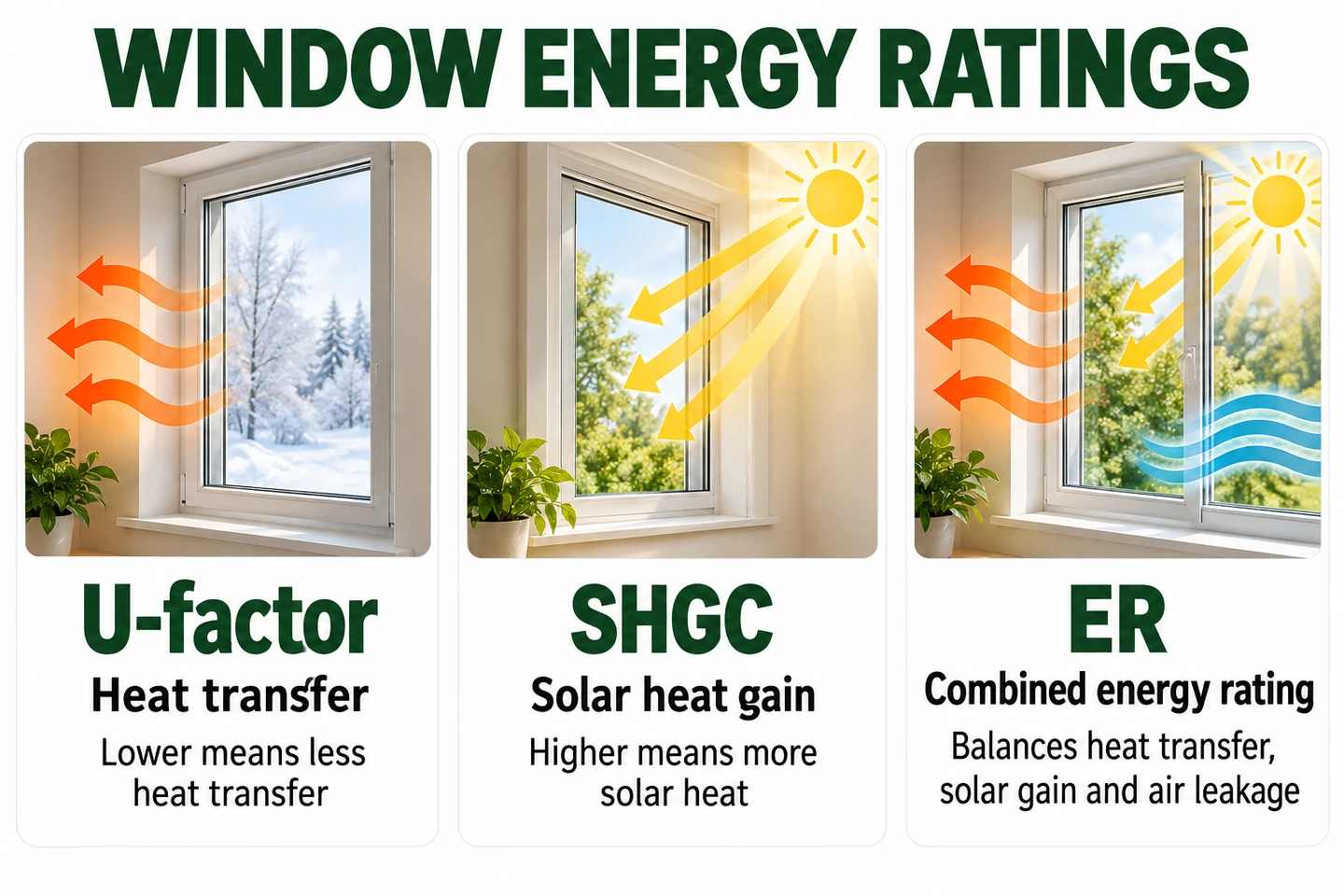
ER combines several aspects of performance. Because it includes solar gain as well as heat transfer and leakage, it is not interchangeable with U-factor.
If two proposals have different ER and U-factor results, ask the supplier to explain the trade-off using the same complete configurations. Keep your room's needs in the discussion instead of treating one headline rating as a universal answer.
Check visible transmittance if you are concerned about a darker room. Discuss daylight and solar heat separately: they describe different properties. Ask to review the proposed glass appearance and product information before ordering.
Also consider ventilation, opening clearance and cleaning access. Our window-style guide for Toronto homes covers those everyday choices. For the glazing construction decision, see our double-pane versus triple-pane guide.
If the information is incomplete, ask for clarification before comparing totals. A clearly specified proposal is easier to review than one that says only “energy-efficient windows.”
Product ratings are not a complete assessment of the existing opening or the proposed installation. Discuss the condition of the frame and surrounding area, the replacement method, sealing and finishing as part of the estimate.
Read our window replacement installation-day guide for the work sequence. If moisture is your main concern, our condensation guide explains why moisture needs its own assessment rather than a promise based on certification alone.
Imperial Windows & Doors supplies and installs residential replacement windows across Toronto and the GTA. Bring your questions about model specifications, room exposure and installation to your estimate.
Explore our replacement window options or request a free in-home window estimate. Use the ratings as part of a clear, complete specification for your home.
A lower U-factor means less heat transfer. Compare figures using the same units and whole-window rating basis.
Not automatically. Solar gain can be useful during heating season but can contribute to overheating. Discuss the room's exposure and shading.
No. ER combines heat transfer, solar gain and air leakage; U-factor describes heat transfer. Read the values together.
No. Certification verifies product performance against program requirements. Conditions in your home and the installation still matter; ask for an assessment rather than a guaranteed outcome.

Imperial Windows and Doors have long been serving our valued clients for over 10 years to be exact. We strive to deliver our clients only the finest solutions guaranteed to suit their needs, style, preferences and budget.

Imperial Windows & Doors provides professionally installed replacement windows, entry doors and patio doors for homeowners across Toronto and the GTA.